Wednesday, 22 February 2012

Videos from Germany & Italy

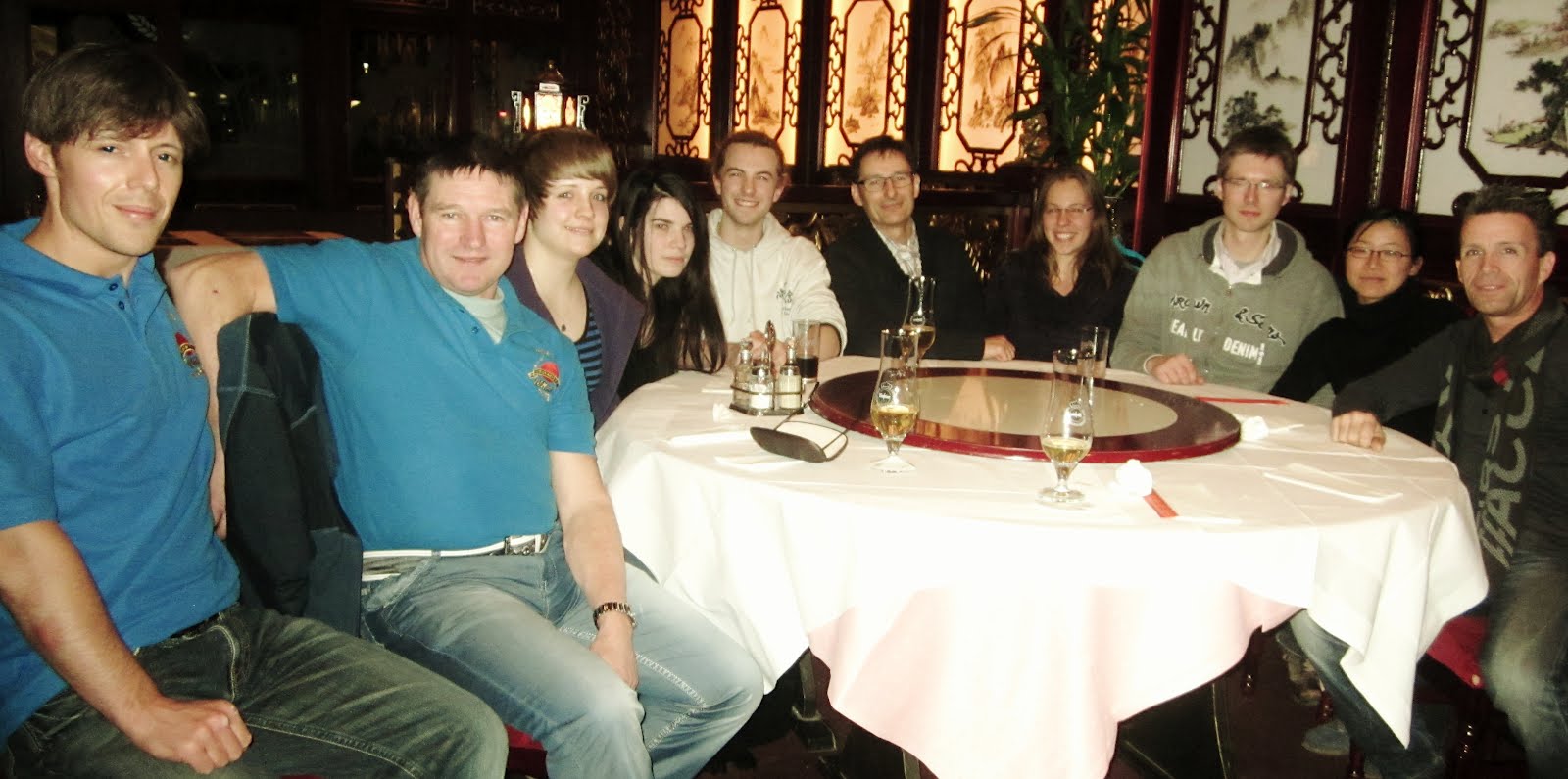
Here are all of the videos from my seminars in Germany and Italy (January/February 2012). When time allows I will post one more, which will feature some different points. Please note that these videos are not on my channel nor were made by me. I was just training and teaching karate-do as usual. The full credit goes to my friends and fellow karateka, Oliver Schomburg, and Silvio Cannizzo (who both also trained very hard). Enjoy and please feel free to make some comments. All the best, Andre

______________


GERMANY 2012 (PART 1)
GERMANY 2012 (PART 2)
GERMANY 2012 (PART 3)
GERMANY 2012 (PART 4)

MIRA, VENICE, ITALY (2012)

© André Bertel. Christchurch, New Zealand (2012).

Monday, 20 February 2012

Andre Bertel 2012 European Seminars (Part Four)

Below is an embedded video from my recent seminars in Mira (Venice Italy) at the new dojo of Mauro Mion Shihan - 7th Dan.


The video was created by my dear friend Silvio Cannizzo Sensei - 5th Dan, and kindly filmed by his son Erik. Domo arigato gozaimasu!


For more information please check Mion Shihan's Italian honbu-dojo website: http://www.jksitalia.it/.


To see the other films from my January/February 2012 seminars in Europe please scroll down the following article: http://andrebertel.blogspot.co.nz/2012/02/andre-bertel-2012-european-seminars.html


© André Bertel. Christchurch, New Zealand (2012).


Sunday, 19 February 2012

Andre Bertel 2012 European Seminars (Part Three)

It was once again a huge pleasure to teach seminars at Mauro Mion Shihan's Italian National Honbu Dojo in Mira (Venice).


This year the core focus was on tai no shinshuku (the contraction and expansion of the body) for effective martial arts karate - as defined by my late teacher Shuseki-Shihan Tetsuhiko Asai. The kata taught was Shotei (Dai). This koten-gata is focused on employing teisho (shotei) and other open hand techniques such as koken (kakuto), haishu, shuto and haito. The focus was on creating `extreme power' which if released, without careful control, is uttery destructive.

I will not outline the seminars, except to say that they were fantastic, and for the members of Mion Shihan's Organisation. IT WAS TRULY A SPECIAL TRADITIONAL KARATE EVENT IN ITALY. Next time, we will cover an even higher level of Asai-ha Shotokan-ryu to compliment the diversity of the previous two courses. Sadly, many could not make it due to the terrible weather conditions in Europe, which unluckily hit Italy during the seminar weekend.


I'd once again like to thank Mion Shihan (7th Dan), Silvio Cannizzo Sensei (5th Dan) both pictured with me above, and all of the karateka who participated in the seminars (also as pictured). Overall, there was strong spirit in the dojo throughout, so I felt like I was at home. Until next time. OSU!


(c) André Bertel. Christchurch, New Zealand (2012).

Saturday, 18 February 2012

Mauro Mion Shihan: Karate master & a gentleman

Mauro Mion Shihan (7th Dan) is not only an Italian master of Shotokan Karate but also an exceptional human being whom I have great respect for.


It was an honour for me to be once again invited to Italy to teach Asai-ha Shotokan-ryu Karate at his fantastic dojo in Mira, Veneto.


As I've said before, his class is a "must do" if you are visiting Venice and are interested in studying traditional Shotokan Karate-Do. Here is a link to his organisations homepage: http://www.jksitalia.it/


I would once again like to thank Mion Shihan very much. Domo arigato gozaimashita!


(c) André Bertel. Christchurch, New Zealand (2012).

Friday, 17 February 2012

Andre Bertel 2012 European Seminars (Part Two)


Along with some images here are a couple of reports on my recent Karate-Do Seminars in Ahrensburg Germany. As more reports are written, and photos/videos are availabl


Report in Italian by Roberto Ricomagno Sensei (Italy) who attended the Germany Seminars: http://takushoku.blogspot.co.nz/2012/02/trasferta-in-germania-per-allenarci-con.html

Report on the Tuam Karate Club homepage by Ben Kelly (Ireland): http://tuamkarateclub.blogspot.co.nz/2012/02/andre-bertel-course-report-germany.html


(c) André Bertel. Christchurch, New Zealand (2012).


Special classes at the Hamburg Karate Dojo.

I once again greatly enjoyed teaching classes at Sensei Stefan Scharnweber’s Hamburg Karate-dojo. I was introduced to Stefan by Oliver and Yan Schomburg two years ago when I taught IJKA Karate there.


Stefan is the kata coach for Northern Germany and besides having excellent Shotokan technique is a really neat guy. Like me, an Unsu man! For example when driving a red light is what he refers to as “cherry green”… He is a classic Sensei, so I can’t wait to host him at my home in Japan when we are back there.


Away from his humorous side he is a direct student of the late Taiji Kase Sensei and has graded to Godan (5th Degree Black Belt) under the legendary Hiroshi Shirai Sensei. And now, for the last two years, he has been studying Asai-ha Shotokan-ryu with me, so with combination of karate “Kase-Shirai-Asai” he has a lot of traditional karate knowledge.


Anyway, the classes I taught at his dojo in Hamburg were focused on the coordination of koshi no kaiten (hip rotation), tai no shinshuku (the contraction and stretch of the body), and junansei (which is basically ‘softness’). Added to this were Miyamoto Musashi’s strategies of Sen No Sen, Go No Sen and in particular, Tai No Sen.


Overall, the sessions were a fantastic set-up for higher level training, which Stefan and I discussed for the development of traditional karate-do in the Hamburg region. When I return there will be a Jokyu (high-level) course of IJKA Asai-ha Shotokan Karate, which will come straight from Asai Sensei’s socho-geiko. This time, I was proven sincerity and strong kokoro. Many thanks to Stefan Sensei, Marcel, Piotr, Thomas and all the other members at the Hamburg Dojo. OSU!


(c) André Bertel. Christchurch, New Zealand (2012).

Thursday, 16 February 2012

Brian Toomey Sensei

It was great to finally meet Brian Toomey Sensei - 6th Dan who attended my seminars in Germany.

He is my senpai (senior) in Karate-Do and is a hard training budoka; moreover, he is a super person with a great sense of humour! Domo arigato gozaimashita Brian Sensei.


(c) André Bertel. Christchurch, New Zealand (2012).

Wednesday, 15 February 2012

André Bertel 2012 European Seminars (Part One)

This is the first of several posts I will make on my 2012 karate seminars in Europe. It was great to teach Asai-ha Shotokan-ryu in both Germany & Italy again, and catch up with friends!

Considering the terrible weather in Europe (which has made international news) the amount of participants in my classes were surprisingly high; nevertheless, many were stopped from attending due to the treacherous conditions.


Anyway, rather than talk a lot, I'll begin by embedding links to four videos (kindly made and posted by Oliver Schoemburg) and let the karate talk for itself. Furthermore, these seminars mark the beginning of my sharing more advanced techniques, applications, and principles of my late teacher Shuseki-Shihan Tetsuhiko Asai. More photos and videos to come, so stay tuned!


© André Bertel. Christchurch, New Zealand (2012).

Sunday, 15 January 2012

Well prepared for Germany & Italy

Here are some photographs from my self-training at Sumner beach today.


I'm now well prepared and in top condition for my upcoming seminars in Germany, and Italy (in the coming weeks). These technical clinics will be fantastic for all of the attendees, and will cover many underlying aspects of Tetsuhiko Asai Sensei's unique form of Shotokan Karate-Do.


As this will probably the last post (before I depart for Europe) I want to express my looking forward to seeing everyone there. OSU, Andre.


© André Bertel. Christchurch, New Zealand (2012).

Thursday, 12 January 2012

Kizami-zuki, gyaku-zuki & oi-zuki

The base techniques of standard karate-do are essentially kizami-zuki (jab punch), gyaku-zuki (reverse punch) and oi-zuki (lunge punch). This is because they are the underlying kihon-waza (insofar as correctly utilising the hips is concerned) and establish `the shortest distance between you and your opponent’ from a natural position. This goes beyond straight-line attacks, as only via perfecting funnel-like lines with one's thrusts, can a karateka fully express and maximise the circular techniques which obviously deviate from these. In the above photo I am doing pre-arranged kumite with my kohai and JKF (Japan Karatedo Federation) Kumite Champion, Inada Yasuhisa (4th Dan), who is countering me with chudan gyaku-zuki.


To avoid charging off on a tangent (and addressing the diverse subject of trajectories), I’d like to say here that regardless of style: “fundamentally all karate techniques are generated by the harmonious connection of upper and lower body derived from the waist, one’s kokyu (breathing), and the kokoro (the spirit/mind)”. In Japanese culture physical energy & mental/spiritual energy is said to be found in the hara or pit of the abdomen; therefore, it shouldn’t be a surprise that one’s `koshi’ is most important in the execution of all Japanese budo (martial arts). Of course, this sounds all nice in words and written text, but it must translate into actual training, and more importantly, be constantly practiced.


Without being exhaustive here are some basic examples from the three aforementioned core foundational techniques: (1) From KIZAMI-ZUKI: age uke, soto-uke, uchi-uke, gedan-barai, uraken yokomawashi-uchi, mae-ashi mawashi-geri and so forth. (2) From GYAKU-ZUKI: essentially any offensive waza from the reverse side. And
(3) From OI-ZUKI: any oi-waza i.e. – mae geri. Also waza employing gyaku-hanmi (reverse half-facing position).


My training & teaching: When I train and also when teaching, I follow this `basic' underlying pattern of kihon, no matter how `advanced' the session is. This is because it is essential for me in my own karate, and regardless of who I'm teaching or practicing with, it immensely benefits them as well. Practice and refinement in such a manner ensures immediate and long-term technical advancement. Obviously, from there people can move on to other things, with a very solid foundational understanding. Nevertheless, the foundation constantly requires the house to be lifted, and more concrete to be poured, whilst the rennovations continue. It's like a garden, you can plant all the nice plants and continue to do so, but you still have to tend to the weeds, water the grass etc. It seems that many people are either dehyrdraing their gardens or drowning them...


Based on these fundamental aspects, it is easy to see why in Japan, irrespective of style, most traditional karate-geiko begins with many repetitions of kizami-zuki kara gyaku-zuki & oi-zuki (in ido-kihon) or their wonderful variations. Yes, these techniques are being constantly tempered into precisely trained weapons, but so are many others, directly through them.


© André Bertel. Christchurch, New Zealand (2012),