Tuesday, 27 March 2012

Christchurch Shotokan Karate Instructor Training

In addition to training in the general class at the Christchurch Shotokan Karate Club (CPIT dojo) here is the current instructors class training. Please note: the exception of the tokui-gata, which of course dependent on the individual.


I. Junbi-undo: Light jiyu-kumite progressively building in intensity and range of motion/lowering of the hips followed by dynamic stretches.

II. Stationary kihon: (1) Sanbon-zuki (hachinoji-dachi); (2) Hidari jodan kizami-zuki kara migi chudan gyaku-zuki; (3) Migi jodan kizami-zuki kara hidari chudan gyaku-zuki; (4) Hidari chudan maeashi mae-geri kara migi jodan mae-geri; & (5) Migi chudan maeashi mae-geri kara hidari jodan mae-geri. – 50 maximum speed repetitions of “1-3” for a total of 250 tsukiwaza and 30 repetitions of “4 & 5” for a total of 120 keriwaza.

III. Ido-kihon: (1) Sanbon-zuki; (2) Jodan age-uke kara mae-geri soshite chudan gyaku-zuki; (3) Chudan soto-uke kara yori-ashi (kiba-dachi) yoko empi-uchi, uraken yokomawashi uchi soshite chudan gyaku-zuki; (4) Chudan shuto-uke (kokutsu-dachi) kara mae-ashi mae-geri soshite nukite; (5) Chudan uchi-uke kara kizami-zuki soshite gyaku-zuki; (6) Tenshin gyaku-zuki (Kaiten-shinagara gedan-barai kara chudan gyaku-zuki); (7) Ren-geri: Chudan mae-ashi mae-geri kara mae-geri; (8) Chudan mae-ashi mawashi-geri kara mawashi-geri; (9) Ushiro-geri; & (10) Yoko-keage ashi o kaete yoko-kekomi (kiba-dachi). – A minimum of 10 reps of every technique with maximum speed.


IV. Kumite: (a) Jiyu ippon kumite (jodan, chudan, mae-geri, yoko-kekomi, mawashi-geri & ushiro-geri); & (b) Kaeshi ippon kumite (as per jiyu-ippon kumite attacks). – Changing partners at least three times for both forms of kumite.
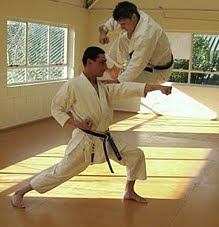
V. Kata: Presently tokui-gata ‘Unsu’ and general training of the 15 shitei-gata (Heian, Tekki, Junro, Bassai-Dai, Kanku-Dai, Empi & Jion). – Generally speaking three kata are practiced each day (three times with regular speed and twice slowly).

VI. Calisthenics: Asai-ha Shotokan-ryu kihon taiso and the typical impact work. The sessions are concluded with isometric stretches and a variety of comprehensive warm downs.


© André Bertel. Christchurch, New Zealand (2012).

Wednesday, 21 March 2012

Matt Brew Sensei back in New Zealand

Matthew Brew Sensei (3rd Dan) has returned the dojo after more than a decade in Tokyo.


We welcome him back to the club with open arms, and also his lovely wife Eiko, and son Luke (pictured next to him) and baby daughter Reona. Matt is now teaching Luke karate-do and has him in the beginners class at the Christchurch Shotokan Karate Club.


Matt was a member of our group (Asai JKA New Zealand in the 1990s) before joining the honbu-dojo in Japan, and has done private training under Shuseki-Shihan Tetsuhiko Asai (10th Dan) and Qi Gung under Mrs. Keiko Asai.

Needless to say, he has extensive knowledge of Asai-ha Shotokan-ryu. Overall, I'm personally thrilled to have him back, as is Christchurch Karate Club shibucho, Lyall Stone Sensei, and all of the members. Osu!


© André Bertel. Christchurch, New Zealand (2012).

Monday, 19 March 2012

The 'art' of karate: Neglecting the `martial' part

It doesn't take a rocket scientist to establish that many of the techniques, movements and positions in karate are clearly not directly transferable for self-defence; however, everything has a purpose and can be readily traced back to a critical aspect of combat. Clearly, such an obscure comment has little weight as "anything" could potentially be related. Nevertheless, this is where intention/focus of one's training comes in.


Whether practicing kihon, kata or kumite we must always think "What is this for?" then train it in accordance with the bigger picture of our target(s). Just "perfecting the moves" is certainly not enough to turn our karate into an effective self-defence system. Likewise, just practicing applications of the moves will not give us the physical prowess needed to apply 'martial arts'.


From this perspective, the classical stances and techniques (such as those depicted) can serve to either improve the body and range of motion, and specific principles/applications for self-defence, or set us up with more things we can't use in reality.


Hence, how we approach our training every time we enter the dojo or self-train ultimately determines the potential effectiveness of our karate. Unfortunately, most dojo do not adaquately address this issue, or only do so from a theoretical perspective, or in an inconsistently novel way. This drops the 'martial' and leaves karate as a merely a form of 'art'.


© André Bertel. Christchurch, New Zealand (2012).

Monday, 5 March 2012

Transforming the impossible into merely difficult

Shulman (2005) states that “Habit makes novelty tolerable and surprise sufferable. The well-masked habit shifts new learning into our zones of proximal development, transforming the impossible into merely difficult” (p. 56).


Greetings and salutations… A lot has happened since I returned from teaching the karate seminars in Europe so this is my first post in a while. Anyway, I thought the aforementioned quote from Lee Shulman would be some great food for thought.


Long overdue in text, here is my present daily training schedule:


Kihon: (1) Chudan oi-zuki; (2) Sambon-zuki; (3) Yoko-kekomi kara yoko-keage; (4) Yoko-keage ashi o kaete yoko-kekomi; (5) Mae-geri kara mawashi-geri; (6) Mae-geri kara yoko-kekomi, mawashi-geri soshite ushiro-geri; (7) Jodan age-uke kara chudan gyaku-zuki; (8) Chudan soto-uke kara chudan gyaku-zuki; (9) Chudan uchi-uke kara chudan gyaku-zuki; & (10) Chudan shuto-uke kara nukite.


Kata: Focus on one kata exclusively each day of the week: Joko issei, Joko-nisei, Joko-sansei, Joko-yonsei; Joko-gosei; Jion; & Unsu.


Kumite: Jiyu-ippon kumite, Oyo-kumite & Jiyu-kumite.

I wish you all the very best in your training and good health. Osu, André.
PS – My next karate seminar will be hosted by the KUA (Karate Association of Australia) in June. For those attending, see you there!

Reference
Shulman, L. S. (2005). Signature pedagogies in the professions. Daedalus, 134(3), 52-59.


© André Bertel. Christchurch, New Zealand (2012).

Wednesday, 22 February 2012

Videos from Germany & Italy

Here are all of the videos from my seminars in Germany and Italy (January/February 2012). When time allows I will post one more, which will feature some different points. Please note that these videos are not on my channel nor were made by me. I was just training and teaching karate-do as usual. The full credit goes to my friends and fellow karateka, Oliver Schomburg, and Silvio Cannizzo (who both also trained very hard). Enjoy and please feel free to make some comments. All the best, Andre

______________


GERMANY 2012 (PART 1)
GERMANY 2012 (PART 2)
GERMANY 2012 (PART 3)
GERMANY 2012 (PART 4)

MIRA, VENICE, ITALY (2012)

© André Bertel. Christchurch, New Zealand (2012).

Monday, 20 February 2012

Andre Bertel 2012 European Seminars (Part Four)

Below is an embedded video from my recent seminars in Mira (Venice Italy) at the new dojo of Mauro Mion Shihan - 7th Dan.


The video was created by my dear friend Silvio Cannizzo Sensei - 5th Dan, and kindly filmed by his son Erik. Domo arigato gozaimasu!


For more information please check Mion Shihan's Italian honbu-dojo website: http://www.jksitalia.it/.


To see the other films from my January/February 2012 seminars in Europe please scroll down the following article: http://andrebertel.blogspot.co.nz/2012/02/andre-bertel-2012-european-seminars.html


© André Bertel. Christchurch, New Zealand (2012).


Sunday, 19 February 2012

Andre Bertel 2012 European Seminars (Part Three)

It was once again a huge pleasure to teach seminars at Mauro Mion Shihan's Italian National Honbu Dojo in Mira (Venice).


This year the core focus was on tai no shinshuku (the contraction and expansion of the body) for effective martial arts karate - as defined by my late teacher Shuseki-Shihan Tetsuhiko Asai. The kata taught was Shotei (Dai). This koten-gata is focused on employing teisho (shotei) and other open hand techniques such as koken (kakuto), haishu, shuto and haito. The focus was on creating `extreme power' which if released, without careful control, is uttery destructive.

I will not outline the seminars, except to say that they were fantastic, and for the members of Mion Shihan's Organisation. IT WAS TRULY A SPECIAL TRADITIONAL KARATE EVENT IN ITALY. Next time, we will cover an even higher level of Asai-ha Shotokan-ryu to compliment the diversity of the previous two courses. Sadly, many could not make it due to the terrible weather conditions in Europe, which unluckily hit Italy during the seminar weekend.


I'd once again like to thank Mion Shihan (7th Dan), Silvio Cannizzo Sensei (5th Dan) both pictured with me above, and all of the karateka who participated in the seminars (also as pictured). Overall, there was strong spirit in the dojo throughout, so I felt like I was at home. Until next time. OSU!


(c) André Bertel. Christchurch, New Zealand (2012).

Saturday, 18 February 2012

Mauro Mion Shihan: Karate master & a gentleman

Mauro Mion Shihan (7th Dan) is not only an Italian master of Shotokan Karate but also an exceptional human being whom I have great respect for.


It was an honour for me to be once again invited to Italy to teach Asai-ha Shotokan-ryu Karate at his fantastic dojo in Mira, Veneto.


As I've said before, his class is a "must do" if you are visiting Venice and are interested in studying traditional Shotokan Karate-Do. Here is a link to his organisations homepage: http://www.jksitalia.it/


I would once again like to thank Mion Shihan very much. Domo arigato gozaimashita!


(c) André Bertel. Christchurch, New Zealand (2012).

Friday, 17 February 2012

Andre Bertel 2012 European Seminars (Part Two)


Along with some images here are a couple of reports on my recent Karate-Do Seminars in Ahrensburg Germany. As more reports are written, and photos/videos are availabl


Report in Italian by Roberto Ricomagno Sensei (Italy) who attended the Germany Seminars: http://takushoku.blogspot.co.nz/2012/02/trasferta-in-germania-per-allenarci-con.html

Report on the Tuam Karate Club homepage by Ben Kelly (Ireland): http://tuamkarateclub.blogspot.co.nz/2012/02/andre-bertel-course-report-germany.html


(c) André Bertel. Christchurch, New Zealand (2012).


Special classes at the Hamburg Karate Dojo.

I once again greatly enjoyed teaching classes at Sensei Stefan Scharnweber’s Hamburg Karate-dojo. I was introduced to Stefan by Oliver and Yan Schomburg two years ago when I taught IJKA Karate there.


Stefan is the kata coach for Northern Germany and besides having excellent Shotokan technique is a really neat guy. Like me, an Unsu man! For example when driving a red light is what he refers to as “cherry green”… He is a classic Sensei, so I can’t wait to host him at my home in Japan when we are back there.


Away from his humorous side he is a direct student of the late Taiji Kase Sensei and has graded to Godan (5th Degree Black Belt) under the legendary Hiroshi Shirai Sensei. And now, for the last two years, he has been studying Asai-ha Shotokan-ryu with me, so with combination of karate “Kase-Shirai-Asai” he has a lot of traditional karate knowledge.


Anyway, the classes I taught at his dojo in Hamburg were focused on the coordination of koshi no kaiten (hip rotation), tai no shinshuku (the contraction and stretch of the body), and junansei (which is basically ‘softness’). Added to this were Miyamoto Musashi’s strategies of Sen No Sen, Go No Sen and in particular, Tai No Sen.


Overall, the sessions were a fantastic set-up for higher level training, which Stefan and I discussed for the development of traditional karate-do in the Hamburg region. When I return there will be a Jokyu (high-level) course of IJKA Asai-ha Shotokan Karate, which will come straight from Asai Sensei’s socho-geiko. This time, I was proven sincerity and strong kokoro. Many thanks to Stefan Sensei, Marcel, Piotr, Thomas and all the other members at the Hamburg Dojo. OSU!


(c) André Bertel. Christchurch, New Zealand (2012).