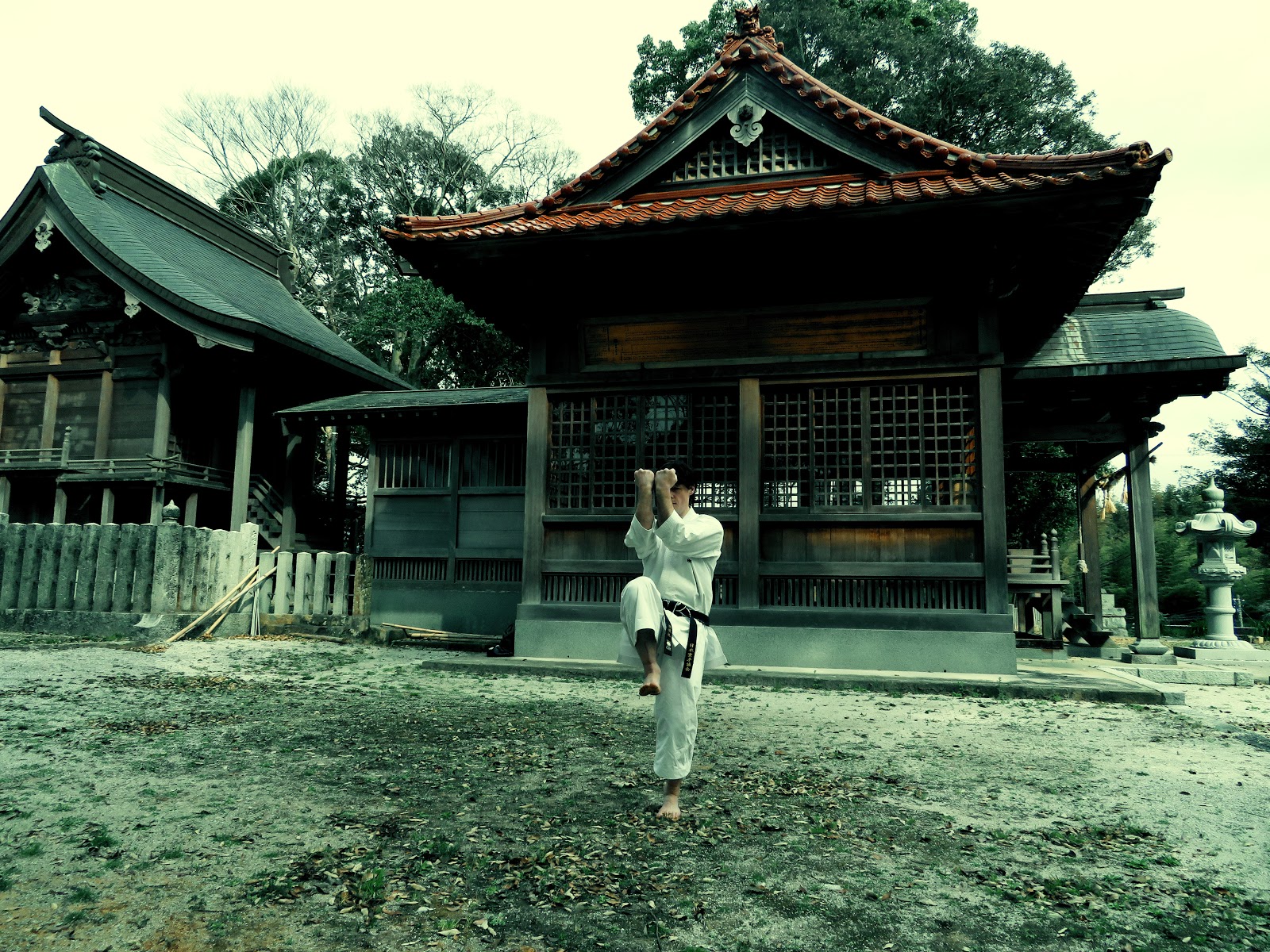
Saturday, 24 June 2017

Updated training regime for Tsuyu


KIHON

A daily and very simple mix of Sonoba-Kihon followed by Ido-Kihon. In sum, the core kihon “with a big of a twist”… My reps at present a quite low ranging between 30-40 including a warm up of each technique 10 times slowly. The overarching theme is `effective high-quality` execution.


KATA

At present I am practicing three different kata per session, the first for my base training, the second for my personal advancement and the third for `technical variation`. I execute each kata at least four times each.


(1)  Each day one of the SHITEI-GATA: either Heian Shodan, Nidan, Sandan, Yondan, Godan or Tekki Shodan.


(2)  Nijushiho


(3)  A random kata: from standard Shotokan-Ryu or a Koten-gata. 

KUMITE

(a)   Kihon Ippon Kumite


(b)  Jiyu Ippon Kumite


(c)   Uchikomi


Kihon Ippon Kumite and Jiyu Ippon Kumite once slowly then twice a regular speed. Attack with, and defense and counters against: (1) JODAN—jodan oi-zuki; (2) CHUDAN—chudan oi-zuki; (3) MAE-GERI—chudan mae-geri keage; (4) YOKO-KEKOMI—chudan yoko-geri kekomi; (5) CHUDAN/JODAN MAWASHI-GERI—either chudan mawashi-geri or jodan mawashi-geri (please announce); and (6) USHIRO-GERI—chudan ushiro-geri kekomi. Just to confirm, yes I am also practicing mawashi-geri and ushiro-geri in Kihon Ippon Kumite, which is not in the syllabus.


Uchikomi: Firstly, standard practice, Kizami-zuki, Chudan gyaku-zuki, Jodan gyaku-zuki, Jodan oi-zuki, various renzokuwaza with tsuki, chudan mae-geri, chudan mawashi-geri, jodan mawashi-geri, legs followed by hands; and finally, creative/spontaneous renzokuwaza.

Taken as a whole, this current training is reflective of the Summer arriving here in Japan. With the rainy season starting, the humidity is once again rising alongside the temprature, making warm ups and stretching easier, and training harder. As the saying goes, “…we must take the good with the challenges”. I personally believe that the good things are bonuses and the challenges are where the real gains can be made. What I am trying to say is that everything can be looked at in a positive light. I wish you the very best from Oita City, Japan. – André

Now in my 40s, with huge support from masters here in Japan, I will focus on Budo Karate without all of nonsensical politics; that is, our objective is to make truly great karateka and karate instructors here in Japan and around the world.
© André Bertel. Oita City, Japan (2017).

Monday, 19 June 2017

10th ANNIVERSARY: WWW.ANDREBERTEL.BLOGSPOT.COM

Today marks a DECADE—yes, literally 10 years—since I made my first post on this blog. Appropriately, the title was ‘Yoroshiku onegaishimasu’. Please look back if you want to understand this site and my Karate path, which is now in its 36th year.


Taken as a whole, I’d like to thank all of my seniors, peers, and students here in Japan, and around the world for your wonderful support.

In sum, pertaining to training, for high level practitioners "...kihon until the body fails is imperative", as 'flashy instruction', lots of talk, and 'feelings', are now commonplace in the world. Needless to say, this theoretical karate will break under overwhelming strength. This is the technical essence of Budo Karate. That is, the Martial Art of Karate-Do.


With much thanks and appreciation from Kyushu, Japan, for those who have supported this site for the last 10 years. I am still surprised that a blog dedicated to hardcore karate, and Shotokan specific, yet still could become so popular. Then again, I am not surprised as many people are still seeking the true martial art of Karate and, even if not, are unable to ignore it.

感謝!!!ありがとうございます!!!

Osu, André Bertel

© André Bertel. Oita City, Japan (2017).

Saturday, 17 June 2017

Trainee from Kazakhstan: Tuleukhan Iskakov


Mr. Tuleukhan Iskakov travelled all the way to Oita City—from Kazakhstan—to be a renshusei on between June 15th and 16th.


I will not disclose what was covered, during Tuleukhan’s time training here in Japan—that is for him to keep and share at his own discretion; however, I will say that it was great to see him improve his karate, moreover, leave with the tools to decisively ’snowball’ these improvements: via diligent practice.

As Tuleukhan booked me several months in advance, he easily managed to be accepted as a renshusei and, more advantageously, flexibly choose his training times. For others,—wishing to be a renshusei—his very early booking is a great example. In this regards you can email me at: andrebertelono@gmail.com


Overall, I would like to congratulate Tuleukhan on completing training here in Oita; furthermore, we wish him the very best in his future Karate-Do endeavours. 押忍, André
© André Bertel. Oita City, Japan (2017).

Wednesday, 24 May 2017

Deutschland Renshusei (May 2017) Video


© André Bertel. Oita City, Japan (2017).

Renshusei from Deutschland

Concluding the first four hours of training: Kihon-Kata-Kumite--the trinity of Karatedo to achive optimal effectiveness.


Four more karateka have come as international renshusei (trainees) here, at my dojo, in Oita-City. The four fromドイツ (Germany) included:  Joerg Arndt (6th Dan): http://www.karate-dojos.de/); Peer Frasch (3rd Dan); and Axel Hoffmeyer (2nd Dan); and, second-time renshusei, Frank Kohler (3rd Dan).
Explaining a key Budo Karate point kept within the elite Shotokan schools here in Japan. Focused faces and great karate spirit!

The focus of the weekend was the correct and elite practice of Kihon, Kata and Kumite - in combination - to achieve effective 'fighting ability', which is at 'the technical heart' of traditional Budo Karate. While I won’t go into details—as these are for Frank, Axel, Peer and Joerg—I will say that extreme technical improvement was made by all four trainees over the eight hours. So I was very impressed by their physical effort, karate no seishin (karate spirit) and overall determination to make changes to improve their karate. Perhaps a short video, giving a few glimpses will come. Osu, André.

At my weekly 'outdoor dojo' here in Oita... Yusuhara Jinja.


© André Bertel. Oita City, Japan (2017).

Thursday, 11 May 2017

Video: Transition from basic tsuki to application


Here is a new video from last year in Mira, Venice (ITALY) where I taught a seminar on Budo Karate. Special thanks to Mauro Shihan and Silvio Sensei for this footage. Osu.


© André Bertel. Oita City, Japan (2017).

Sunday, 23 April 2017

Intensive Private Training in Oita City

Today and yesterday we had intensive training here in Oita City. I practiced and taught the core sonoba-kihon, followed by Gohon Kumite and Kihon Ippon Kumite. Kihon Ippon Kumite was, in fact, the main focus:with atttention to critial details to achieve 'finshing waza'. Kata training bolstered this effort and included Unsu, Sochin, Nijushiho and Sentei-gata Jion.

Overall, in the sense of 'Budo'/'Bujutsu', the training was literally top-level here in Japan. Hard core practice. I think that says a lot; moreover, it is great that authentic Budo Karate is continued without being watered down to sports karate, nor the Western way of theories, lots of talk, "feelings" (= get smacked over in Japan), and mere 'copy-cat movements' (= just movements) with no relation to fighting/self-defense in the real world. Real karate is a real martial art, not just an art. This is the Karate-Do I follow as do other true followers of Karate. Osu, Andre.


© André Bertel. Oita City, Japan (2017).

Thursday, 13 April 2017

桜 (Sakura)


桜 (Sakura) or cherry blossoms, as most know, have a very special cultural significance  here in Japan. Ask any Japanese person “what is your favourite time of the year?” and many will say “Haru” (Spring): often in reference to the exquisite blooming of sakura.
Spring, of course, is literally the season of new life in nature, and the blooming of sakura vividly epitomizes this. What makes sakura more profound is that their life is both beautiful and fleeting: an analogy of human existence.

As the sakura bloom across Japan people have ‘cherry blossom parties’ or   花見 (Hanami), which literally translates as ‘watching blossoms’. They eat and drink heartily with family, friends and/or workmates. It is therefore a time to really appreciate being alive—and the beauties of life—on many different levels.

© André Bertel. Oita City, Japan (2017).

Wednesday, 12 April 2017

Gohon and Kihon Ippon Kumite is KIHON TRAINING


There are two forms of kumite (sparring) purely for the training of kihon (fundamentals), these are: Gohon Kumite—Five step sparring; and Kihon Ippon Kumite—Fundamental one step sparring.

The purpose is ‘KIHON’: While both of these training drills practice the additional aspect of timing and maai (distancing), the focal point is to ‘maintain and employ perfected/classical kihon form’ whilst doing so. For this reason, I have always highly recommended that karateka do not consider Gohon and Kihon Ippon Kumite as ‘kumite’ but, rather, as ‘partner kihon’. In this way, the underpinning purposes of these partner drills can be achieved and not diminished in any way.

Gohon Kumite and Kihon Ippon Kumite WONT TEACH YOU HOW TO FIGHT: Common sense shows that doing these drills, just like doing solo kata training, will not teach you how to fight in isolation. That has never been the objective of these drills/routines; rather, their point is to teach/ingrain and further develop optimal body actions (which, in turn, become functional via ‘specific freestyle training’: uchikomi, jiyu-kumite, oyo-kumite, impact training etcetera). As a whole, Gohon Kumite and Kihon Kumite are training methods—which contribute towards overall effectiveness of karate technique—by strictly practicing the pure/classical fundamental techniques with a training partner.

Training these drills as MATCHES: This is, of course, fine, and is done here in Japan (with Kihon Ippon Kumite); nevertheless, one will not be successful if one turns Gohon and Kihon Ippon Kumite into some form of ‘restricted fight’. As stressed above, doing so, will inevitably compromise kihon—which immediately renders these drills useless. Returning to the point of matches with Kihon Ippon Kumite, in relation to the aforementioned point, the ‘winner’ be the karateka whom demonstrates superior kihon; thus, again elucidating the point of Fundamental ‘Kumite’.
Training this way doesn’t EXPRESS EMOTIONS; rather CONTOLS THEM: One of the big factors between the top level karateka here in Japan—and those around the world—is the difference of emotional expression in training. The Budo Karate Way is ‘poker-faced’. No grizzly expressions—like on the covers of cheesy martial arts magazines and depicted in far-fetched martial arts movies; no ‘post win’ high fives and dancing—as is often seen in sports karate events. Quite simply, no emotional expression. Practicing karate in this way, the proper way, means that far greater internal-control will be achieved. Relating this point, specifically to Gohon Kumite and Kihon Ippon Kumite, we can see some essential mind-body connections. This is especially the case due: to these drills requiring ‘to move the body in very strict ways’. Getting ‘stuck-in’ (forcing and rushing techniques) is an easy way to see poor control of the body and mind. To recapitulate and summarize in a slightly different way, in order to be successful, one needs to be in a very calm state to move correctly—without any technical short-cuts nor superfluous actions; furthermore, to also have ‘strict control over emotions’ (to not ‘over excite’ and, consequently, turn the drill into a quasi-freestyle exercise with one’s training partner). In this way, we can readily see how SHIN-GI-TAI is trained in fundamental kumite and Karate-Do in general.


The most important person in Gohon Kumite and Kihon Ippon Kumite: Besides exact kihon, and having the emotional control required to do so, never forget that “...THE MOST IMPORTANT PERSON IN ALL FORMS OF YAKUSOKU-KUMITE (Pre-arranged Sparring) IS ALWAYS THE DESIGNATED ATTACKER”. There are multiple reasons for this, however, the most critical is “...that always making/using correct maai for one’s attacks must become second nature”. There is no exception to this rule. Second only, to this point, is the need to offer stimuli for one’s training partner to respond. Put another way, an out of distance technique requires no defensive response; thus, if an ukewaza (reception technique) is employed, it is inherently an error.


CONCLUSION: Kihon, kata and all of the different forms of kumite training collectively work together to optimally develop the defensive and offensive capacities of karateka; however, the objective of each drill must be fully understood and followed in physical practice. Failure to do so will waste training time; moreover, groove bad habits. When practicing Gohon Kumite and Kihon Ippon Kumite think about how much they imitate/resemble a real fight. When one does so, it is evident that they do not, nor can, prepare one for jiyu-kumite nor self-defence. Irrespective of this, they are excellent building blocks—when understood and trained correctly—that greatly contribute towards solidifying the foundational skills which (in harmonious combination with kihon, kata, and the other forms of kumite) result in an ever-improving freestyle capacity.

© André Bertel. Oita-City, Japan (2017).

PS – You may have noted that I have not mentioned Jiyu Ippon Kumite: this was intentional. I will write an article about it in the near future. 押忍, André.

Monday, 10 April 2017

Trainees from Germany: Andrea Haeusler and Torsten Uhlemann

On Friday 7th and Saturday 8th of April—Andrea Haeusler Sensei and Torsten Uhlemann Sensei (JKA Germany)—came for private training at my dojo here in Oita City.

As they operate their own dojo, Fuji San Karateschule Münster (click here to visit their clubs homepage: http://www.karateschule-muenster.de/) the sessions were essentially ‘instructor trainings’ focused on key points of top-level Budo Karate here in Japan. Accordingly, kihon was the main aspect—in relation to kata and kumite.
In sum, it was great to see Torsten Sensei and Andrea Sensei do so well over the two days of training here in Oita. I wish you both the very best for your remaining time here in Japan! Osu, André
© André Bertel. Oita City, Japan (2017).