Thursday, 3 February 2022

Do you think that you suck at karate?

Do you ever feel that you can never really be good at karate (or any other endeavor—‘you are attempting to master’, even daily things in life—for that matter)? IF NOT, if you don’t feel this pressure, you are going nowhere. Just standing still on the escalator.


This is not only my point of view, but an irrefutable fact, for  EVERYONE… You, me, literally everyone, must understand that ‘becoming and being good at something requires self pressure’. We face it, or we don’t. The funny thing is that when people don’t face the heat, they tend to get down and lose their self-esteem: sometimes, worse. 


All of this is a waste, so many exceptional people limit themselves, or even ruin themselves, by inner fears and insecurities. If you read this, and feel this is you, I certainly don’t want to pretend to be a ‘motivational speaker’; but rather, to emphasize that you have the motivational fire within yourself. That sounds so cheesy, but it’s a fact. Everyone needs to know that they are awesome, even though we all have limitations. The key here is to ‘go with what you’ve got’. If you are an apple you can try and be an orange, but you will never  be a first class orange. Be yourself, so you can maximize yourself and your life! You can. It's a choice. Sitting back it becomes harder and harder to move. Pushing forward, and keep pushing forward - after a while - results in forward momentum. Enjoy comfort and feel bad, or face the challenge, win or lose, and get adrenalized. The comfort times are a gimme once one crosses their 'uncomfortable zones'.

 The reality is ‘what we do with stress and pressure’ is paramount to our wellbeing and, furthermore, determines how much we advance in our chosen endeavors, work, everything.


Irrespective if you do or don’t do karate, quit karate, or otherwise—WHATEVER YOU DECIDE TO DO—smash through the wall like Bassai. Personal excellence can be attained by everyone, and, by defying self-doubt and facing pressure, people can also build a strong heart and resilience.


These points, of course, transcend karate or any other endeavor.


Face the pressure and endure the fight. Like the dripping tap. Victory eventually comes.

 押忍、アンドレ

© André Bertel. Oita City, Japan (2022).

Wednesday, 2 February 2022

立て手刀中段構え (TATE SHUTO CHUDAN GAMAE)

Before I begin, please note that tateshuto chudan gamae is exactly the same as 立て手刀中段受け (tateshuto chudan uke); moreover, that it is a fundamental ‘yoi’ position in 基本 (Kihon) practice.


HOW TO DO:


(A) Karada no buki

Firstly tateshuto (the vertical sword hand) must be properly formed. This encompasses the level connection of all four digits with the thumb aligned on the side of the hand, and bent at 90 degrees. With this basic form, the strong bending at the wrist, with the fingers pointing vertically as much as possible, constitutes a proper tateshuto. The striking surface—on the outside edge of the hand—runs from just below the base of the small finger to 青龍刀 (Seiryuto).


(B) Waza

From shizentai with ryoken daitai mae (hachiji-dachi or heiko-dachi) slowly assume hidari tateshuto chudan-gamae: uken migi koshi. Do this by:


1. Loading hidari tateshuto at the right wakibara whilst tightly wrapping the right first to the left tricep (with the back of the fist facing upwards).


2. Slowly swing the left tateshuto inside-outward to the inside crease of the left shoulder—the height of the arm should be with “the top of the arm basically inline, with the top of the shoulder, but with a slight incline”; whilst, simultaneously, the right fist is withdrawn to the right hip (uken migi koshi). If in doubt, the key is to make the longest horizontal action as possible without compromising form. It is important that the tateshuto arm is straight; nevertheless, an externally imperceptible bend in the elbow must be maintained.


HOW TO APPLY:


This kamae/waza while mostly performed slowly (in kata and as a preparatory position in kihon) is obviously applied with maximum speed in application. It’s power is “…optimally derived from a swing as opposed to snap”, yet there are exceptions. One such example is 雲手型 (Unsu kata): movements eight, ten, 12 and 14.


The prime 応用 (Oyo) of this waza is from a clinch with an opponent. Wrap over the top of their arm(s)—ensuring to do so on their blindside—and then generically impact to the neck with a large scale ‘furi-uchi’. This is most effectively applied by dropping the weight, just as prescribed in kata, as it causes the opponent to also drop; that is, like so often, “…chudan becomes jodan”.


© André Bertel. Oita City, Japan (2022).

Friday, 28 January 2022

平安二段 (HEIAN NIDAN)

Classic image of Funakoshi Gichin Sensei leading Heian Nidan. A glimpse of 'kata evolution'.

Introduction:

With 26 movements—with the kiai applied on the decisive points of techniques 11 and 26–there are 12 different waza featured in 平安二段 (Heian Nidan). It is the first kata in classical Shotokan-Ryu to feature keriwaza, both yoko-keage and mae-geri. Standout features include six waza which use both hands/arms simultaneously and the use of rear arm defenses rotating into gyaku-hanmi (Zenkutsu). Half the kata, 13 movements, utilize kokutsu-dachi, within which transitions (between hanmi and shomen) must not interfere with stance form; in particular, the sasae-ashi. Furthermore, the correct use and trajectories of the moving leg, and placement of the feet and toes, should be progressively refined. Like the other four Heian kata a lightness in the muscles should be consciously maintained with “…snap being achieved via shime of the joints (as opposed to forced muscle tension) and both swift and precise actions”.


Here are the 12 different waza featured in Heian Nidan:

1. Jodan haiwan sokumen-uke doji ni zenwan hitai mae yoko-kamae (Kokutsu-dachi).


2. Jodan sotonagashi-uke doji ni kentsui sokumen sotomawashi uchi (Kokutsu-dachi).


3. Chudan sokumen-zuki (Kokutsu-dachi).


4. Okuribashi kara ryo ken koshi kamae (Sagi ashi dachi) soshite chudan sokuto yoko-geri keage doji ni jodan uraken yokomawashi uchi.


5. Chudan shuto-uke (Kokutsu-dachi).


6. Chudan te osae-uke doji ni chudan tateshihon nukite (Zenkutsu-dachi).


7. Chudan uchi-uke (Zenkutsu, Gyaku hanmi).


8. Chudan mae-geri keage.


9. Chudan gyaku-zuki (Zenkutsu-dachi).


10. Chudan morote-uke (Zenkutsu-dachi).


11. Gedan-barai (Zenkutsu).


12. Jodan age-uke (Zenkutsu).

Teaching a student Heian Nidan for the first time. A significantly big jump for beginners; yet, for advanced karateka, Heian Shodan is ultimately said (by many master karateka) to be the most difficult kata. In sum, 'the full circle'.

 Some notes on Heian Nidan:

Master Itosu Anko allegedly formulated the five Pinan kata in the very early 20 century, largely based on Kushanku (Kanku Dai). Funakoshi Gichin Sensei relabeled them ‘Heian’ and reversed the order of Shodan and Nidan. It is said that he did this due to Pinan Nidan being ‘more technically difficult’ than Shodan. However, 'more than its movements', “..the applications are of a higher level and more diverse”. In this regard, consider the 12 different waza in Heian Nidan in comparison to the five in Heian Shodan.


Another factor in this regards is that, while strung together and applied as renzokuwaza, Heian Shodan largely consists of single waza with fumidashi; whereas Nidan features four distinct and flowing combinations. In particular, the use of Gyaku-Hanmi with the rear arm uchi-uke stands out; moreover, this is a prototype for Kanku Dai, Kanku Sho, and so forth. Indeed within this waza is the ‘basic’ of 'legs followed by hands'. This blueprint is very important in karate and self-defense as a whole.


As mentioned in the opening, yoko-keage also deserves attention. Besides being the first kick in all of the Shotokan kata it classically peered with a simultaneous uraken yokomawashi uchi (and followed by shuto-uke 180 degrees in the opposite direction). In particular, the hikite (ryoken hidari koshi) must be correct and the timing of uraken delayed—so that it can be perfectly timed with the larger action of the keage. I won't mention the okuribashi here too much, leading into the keage, except to say it "...draws a figurative line in the sand in regards to the applying the central axis and optimal spring (for keriwara) via momentum and positioning". 


I certainly cannot miss discussing movements ‘one to three’ (and, indeed, ‘four to six’ on the opposite side). They have much significance for me, as when I was a child—and first saw, and tried this kata—I thought “I’ll never be able to do this!” These sequences are therefore deeply etched into my personal memory: very early on in my karate life.


Technique-wise, this three movement combination (primarily) relies on:  (a) trajectory, (b) snap, (c) kime, (d) ‘rebound action’, (e) koshi no kaiten, and (e) shime (the strict use of the hikite and its corresponding elbow). Note that “…movements two and five are sideways whipping strikes with kentsui”—not ura zuki; likewise, “…movements three and six are direct/straight sokumen zuki”—not kentsui uchimawashi uchi.


Movement 11, which the first kiai is applied upon, involves a simultaneous osae-uke and nukite. This waza has several effective applications but the overarching concept is the removal of time between defense and counter, or two simultaneous attacks. This is also expressed in movement 22: migi chudan morote-uke.


Please note the introduction of hidari and migi ashi ‘zenkutsu’ in this kata. This stance (actually 'variation'), is a shorter and narrower version of zenkutsu-dachi. The inside of the front foot is roughly in line with the inside of the rear foot. The length can range from “…just slightly less than a regular zenkutsu-dachi to as narrow as a ‘hips width’.” To not confuse readers I’ve used the term ‘zenkutsu’ in this article (which has been the orthodox/mainstream term since the 1980s when I began my karate journey); however, I personally label it as ‘Shokutsu-dachi’ following Asai Sensei’s teaching, which is apparently the original term. 


Lastly, I’d like to highlight movements 24 and 26, which are in zenkutsu (shokutsu-dachi). These are advancing attacks driving forward with jodan age-uke: the second of which has the final kiai. Use propulsion; the moving of the center; and sharp hip action to produce decisive blows. Of course I could go on with other notable points, but I’ll leave it there. Now, let me move on to the complete overview with the command count…押忍!! - André. 

Movement Seven of Heian Nidan performed in the way Asai Sensei taught it: healthy for the knees and hips with more impact power.


                             HEIAN NIDAN OVERVIEW


REI (Musubi-dachi).


YOI: Ryoken daitai mae (Hachiji-dachi).


1. Hidari haiwan hidari sokumen jodan yoko-uke doji ni migi zenwan hitai mae yoko-gamae (Migi kokutsu-dachi).


2. Hidari jodan sotonagashi-uke doji ni migi kentsui hidari sokumen sotomawashi uchi (Migi kokutsu-dachi).


3. Saken hidari sokumen chudan-zuki (Migi kokutsu-dachi).


4. Migi haiwan migi sokumen jodan yoko-uke doji ni hidari zenwan hitai mae yoko-gamae (Hidari kokutsu-dachi).


5. Migi jodan sotonagashi-uke doji ni hidari kentsui migi sokumen sotomawashi uchi (Hidari kokutsu-dachi).


6. Uken migi sokumen chudan-zuki (Hidari kokutsu-dachi).


7. Ryoken hidari koshi-gamae doji uraken jodan yokomawashi uchi doji ni migi sokuto yoko-geri keage (Hidari ashi dachi).


8. Hidari shuto chudan-uke (Migi kokutsu-dachi).


9. Migi shuto chudan-uke (Hidari kokutsu-dachi).


10. Hidari shuto chudan-uke (Migi kokutsu-dachi).


11. Sasho chudan osae-uke doji ni migi chudan tateshihon-nukite (Migi zenkutsu-dachi)—KIAI!


12. Hidari shuto chudan-uke (Migi kokutsu-dachi).


13. Migi shuto chudan-uke (Hidari kokutsu-dachi).


14. Migi shuto chudan-uke (Hidari kokutsu-dachi).


15. Hidari shuto chudan-uke (Migi kokutsu-dachi).


16. Migi chudan uchi-uke (Hidari ashi zenkutsu, Gyaku-hanmi).


17. Migi chudan mae-geri Keage.


18. Saken chudan gyaku-zuki (Migi zenkutsu-dachi).


19. Hidari chudan uchi-uke (Migi ashi zenkutsu, Gyaku-hanmi).


20. Hidari chudan mae-geri Keage.


21. Uken chudan gyaku-zuki (Hidari zenkutsu-dachi).


22. Migi chudan morote-uke (Migi zenkutsu-dachi).


23. Hidari gedan-barai (Hidari ashi zenkutsu).


24. Migi jodan age-uke (Migi ashi zenkutsu).


25. Migi gedan-barai (Migi ashi zenkutsu).


26. Hidari age-uke (Hidari ashi zenkutsu)—KIAI!


NAORE: Ryoken daitai mae (Hachiji-dachi).


REI (Musubi-dachi).

 Migi haiwan migi sokumen jodan yoko-uke doji ni hidari zenwan hitai mae yoko-gamae (Movement four of Heian Nidan).

© André Bertel. Oita City, Japan (2022).

Monday, 24 January 2022

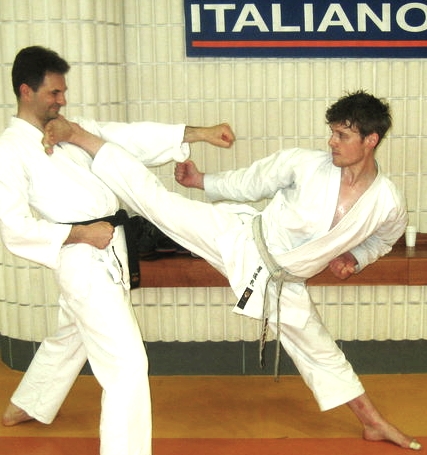
足刀横蹴蹴込 (Sokuto yoko-geri kekomi)

Extension in yoko-geri kekomi is not to 'reach' but to 'go through' the respective target.

足刀横蹴蹴込 (Sokuto yoko-geri kekomi) more commonly and conveniently just referred to as 'Yoko-kekomi; is one of the five main 蹴技 (kicking techniques) of Shotokan Karate. It is also the first ‘thrust kick’ taught. In competition, in my teens and 20s, I have used this waza and stopped several matches due to the opponent not being able to continue, sadly even hospitalized one. In many tournaments it is not scored as the user has inadequate power or incorrect kihon within their kekomi. I’ve also used this waza for defense, when working in security: although, not as a kime-waza, but rather to break the distance. I wish I could say otherwise, but street fighting is different from any form of competition. Today’s article will highlight the key points to practice and develop a highly effective and reliable yoko-geri kekomi. Beyond this I’ll also provide some other information for clarity and some other related aspects. Overall, I hope you find it worth a read and useful for training and teaching.


BASIC IDOKIHON TRAINING (KIBA-DACHI)

Before beginning I want to say that I could have started by discussing stationary training from Heisoku-dachi etcetera; nevertheless, I decided to instead primarily focus on linework in kiba-dachi; that is, 'moving the center'. In other words, the underlying focus in this article is power generation and optimal impact potential. Later, I'll address yoko-kekomi practiced and used in other forms from this baseline. 


1. From kiba-dachi (hands in the freestyle kamae) with the right hip facing shomen, without changing height, draw up the left foot and cross it tightly in front of the right.


2. At this point raise the knee as high as possible as if performing a mae-geri 90 degrees away from shomen. It is essential at this point to keep the left sasae-ashi compressed by remaining bent in contrast with highly raised knee. All of the weight must be transferred to the left leg. It is important to note here that front and side pelvic alignment, back, and head/neck posture must all be straight. Again, the position of a making a proper mae-geri is the best reference point. In sum, this position must optimize shisei (posture) of the johanshin (upper body) in perfect harmony with compression of the kahanshin (lower body).


3. At this point keeping the posture—avoiding leaning back, and keeping the compression of the sasae-ashi—open the hips. This occurs until you sokuto is aimed directly at the respective target. In sum, this is the completion of 'chambering/loading the kekomi'.


4. From this position drive the kicking 'sword foot' in a straight line (imagine the sokuto travelling down a horizontal pipe placed between your chambered position and your target) by straightening the kicking legs knee and expanding/straightening the sasae-ashi. It is critical to fully use ground power via the sasae-ashi. This means that energy must not go upwards but, rather, the hips must driven towards the target. The feeling, when making a correct kick, and I will quote Tanaka  Masahiko Sensei here, is that “…you should aim to drive your hips through your opponent”. To achieve this allow the grounded foot to pivot naturally to allow the hip joint to fully open and permit the knee to optimally function as a hinge joint. Another key point in the extension and impact stage of yoko-kekomi is that the hips will tilt, however, the weight of the upper body must go forwards. Lastly, be sure that the heel is slightly higher than the small toe side of the foot; furthermore, all the toes of the kicking foot are pulled back in the josokutei formation (as in mae-geri). Just an additional tip here... Straighten the knee of the kicking leg, but don't hyper extend! Straightening the leg is not concluded by the bones, joints. ligaments, nor tendons... Certainly not a scientific comment here, but I'm trying to make a point. The straightening/extension of the leg is concluded by muscle alignment upon completion. This gives a couple of millimeters, which means the muscles take care of/buffer things, as opposed to the alternative negatives. 


5. When withdrawing the kicking leg don’t allow the knee to drop; instead, bring it back on a level plane returning to the aforementioned mae geri position. Note as the posture is recovered that the support leg is also once again compressed. This action not only means one’s balance has been recovered but, also, that the body is coiled again. What’s, more it is natural in the stage by stage process of ‘landing your stance’. Of course, points one to five here are all individual aspects that must be properly executed, however, they must seamlessly flow in one continuous action; thereby, not losing momentum. Put another way, each aspect builds up the total momentum, then recovery. From the beginning of kosa-aiyumibashi, the cross stepping action, one complete the following motions in a continuous 'wave-like' action.


After reforming into a good kiba-dachi (here too, you can imagine a receding wave) one repeats the process as many times as directed to do in the class (or as ‘set’ or ‘needed’ in self training). Of course, to practice on the opposite side with the other leg, simply turns their head and kamae 180 degrees.


6. Needless to say, equal practice of both sides is essential in general group classes; however, in self-practice I tend to do around 25% more ‘good repetitions’ of any technique I find that is weaker on one side.

Asai Sensei: Jodan yoko-geri kekomi


A FEW KEYS POINTS


 A. When impacting on a target, opponent or otherwise, the best yoko-kekomi is one you’d break the most boards with. Surface impact is useless and being close is not good. While the board breaking viewpoint may sound unsophisticated, it will guarantee that you’ll gauge and adjust for optimal distancing with your kekomi.


B. Take care when launching yoko-geri kekomi from zenkutsu-dachi and jiyu-dachi. The knee should still be raised like a mae-geri; that is, the body should not turn over too early. Yes, it is true that this telegraphs your kick, but more than that, it’s a very weak position.


C. In kumite beware of kiba-dachi! Whether it’s Yakusoku-Kumite (say Kihon Ippon Kumite or Jiyu Ippon Kumite) or, indeed, Jiyu Kumite, if your opponent defends your yoko-kekomi. Don’t land in kiba-dachi. Make sure you control your recovery and landing so that you are in a front facing tachikata. I can’t count the number of times I’ve seen people have their kekomi deflected by, soto-uke, then observing land in a passive kiba-dachi. My point here is that even in Yakusoku Kumite, where you are only throwing one waza, still “… face them, watch their defense and counter, and mental counter their counterattack or image your immediate follow up”. This recovery period and especially ‘how you recover’ largely determines the power and speed in any follow up waza.


D. When making a kizami yoko-geri kekomi the best waza combines all of the previous points; however, the situation differs for optimal effect. The best kizami yoko-kekomi is when the opponent charges in. In this case, a collision impact can be achieved. Still, if one is not significantly bigger and/or stronger than one’s opponent, this kick will require good kihon to be very effective. Therefore, please practice and keep in mind, all of the aforementioned fundamentals; thereby, making them automatic: irrespective of ‘the type of yoko-kekomi’ you are practicing or applying.


What about gedan kekomi? Lastly, you will have probably noticed that I concentrated on the chudan kick, as opposed to gedan (i.e. – migi sokuto gedan-kekomi in the two Bassai kata, and so forth). This was intentional as they have unique subtleties which, sharing most technical characteristics, also differ in some aspects.

Osaka Sensei making me 'show the exact way'.

What about that big jodan kekomi? Well, I think this is great physical training and, rather than height, is great for the depth/penetration of one’s leg techniques. That is, not reaching, but as Tanaka Sensei stressed ‘going through the target’. When teaching it greatly expresses this point and, in enbu (demonstrations) it establishes that the demonstrator can plant their kicks anywhere they decide. In any case, it is a highly visible display of the Tai No Shinshuku in Karate.


Surely, you can’t forget tobi yoko-kekomi!? Yes, the jumping side thrust kick is a classic/signature showcase waza but, more importantly, (as I’ve discussed in the past on this site) jumping techniques—including tobi keriwaza—are primarily for the strengthening of the body. For example, “…more important than jumping height is how much, and how tight, can one contract their body”. The tighter and more closed in a jump, the more explosive expansion can be made. As a side note and interestingly, with rudimentary physical prowess, such jumping waza are easier than the grounded kihon versions. There is a saying that relates to this: “Show an average gymnast the Unsu jump and they will have a great one almost immediately. But show them an oi-zuki and it will take them years to do it well”.


Kata shouts out a ‘kekomi message’!! I also needed to address that I’ve highlighted before, but will again here. Keep in mind that “…there is no ‘grounded kekomi’ of any sort—in the standard Shotokan kata nor Asai Sensei’s kata—which does not simultaneously pull the opponent in”. The reason for this is for optimal penetration, positioning, off balancing, and the opening of the opponents defense. With decent kihon and base strength, ‘even a not so physically strong karateka can break an opponents upper ribs, sternum or leg’ if tsukami-uke or ryosho tsukami-uke is properly applied. It also means that targeting becomes a far simpler motor skill, which is a critical factor in real fights.


Of course, no article can compensate for practice and training, an excellent instructor, and high level training partners; nevertheless, this article hopefully helps to clarify 'what a yoko-kekomi, in budo karate, is'. Like all techniques in true karate, the constant strive is to seek each action to finish the opponent: ICHIGEKI HISSATSU. Only in this way, we can maximize our potential by seeking the extremities of human potential.

(c) André Bertel. Oita City, Japan (2022).

Sunday, 23 January 2022

慈陰 (ジイン) JIIN

Asai Sensei performing Meikyo which, along with Wankan and Jiin, constitutes the last three kata taught in Japan (from the standard 26 Shotokan kata).

The kata Jiin, which means ‘Charity Shadow’ is said to come from Tomari-Te lens of Tode; however, its Chinese origins—like many other classical kata—is unclear at best, and probably seeped in speculation. Irrespective, in addition to Shotokan, other Ryuha/Kaiha have their own respective versions of it. Asai Tetsuhiko Sensei even used a different second kanji (character) in the writing of its name: 慈韻, which translates as ‘Charity Rhyme’. Irrespective of the ‘original’ kanji, it is clear that this name is connected to Buddhism and/or the dominant philosophical ideologies of its origins. 


Before I go on, like many kata and karate-waza, I often feel frazzled by incorrect pronunciation of names. Jiin is not a ‘Gin and Tonic’ cocktail (as much as I enjoy them, especially when flying pre-corona... Bombay Sapphire, by the way). The correct pronunciation is like the letter ‘G’ (or saying like “Gee” whiz) followed by ‘Inn”. Can I get a good gin at the local inn? This kata has 35 movements, not 35%, with the kiai being applied on techniques 11 and 35. Warning: with too much 'G and T' one might go on to kiai on all thirty five movements, both bows, and off into the sunset. Oh my,  Elvis just left the building... 


In regards to the kanji, I feel that Asai Sensei’s naming gives good sense in regards to the continuous movement (morphing actions) that characterizes Jiin when done optimally. That being said, as you see in the title of this article, I tend to use the kanji for ‘shadow’ as this connects to Funakoshi Gichin Sensei’s unsuccessful bid to rename the kata 松陰 (Shoin)—Pine Shadow. Regardless of these trivial facts, the two names perhaps put some metaphorical light of how the kata should be performed.


In recent years some organizations and individuals have ceased to formally practice Jiin; nevertheless, while not as popular as many of the other kata, it is still widely practiced amongst senior Shotokan yudansha. Having drinks with Naka Tatsuya Sensei and he came to the subject of Asai Sensei’s kata and then his own innovations. He went on to say that in his personal group, Taishijuku, he also teaches Jiin and 百八歩 (Hyakuhachiho).


Whoever reads this article will know that Jion, Jitte and Jiin are commonly classified as a series of related kata. This is because they share the same opening and closing Kamae (左掌右拳下顎前)—‘sasho uken shita ago mae’; moreover, they share many of the same techniques, themes, and self-defense methodologies.


One thing I personally learned from Osaka Yoshiharu Sensei is that movements nine to eleven are contentious. Like most of you I’m sure, I was originally taught this being three shuto chudan sotomawashi uchi advancing in kiba-dachi. Accordingly, to Osaka Sensei, this is ok, but probably not the original. The older variation, is the same as movements 23-25 in 慈恩 (Jion) and movements five to seven in 十手 (Jitte). To quote him directly: “I’m not sure which is the most ‘original’; however, based on consistency with Jion and Jitte, and other renditions of Jiin in other Shotokan groups and ryuha, it’s most probably teisho”. He also said that in this case “…it can also be an attack utilizing kumade”.


The ‘signature waza’ of Jiin is ‘Chudan uchi-uke doji ni gedan-barai’, which of course is a ‘simultaneous mid-level inside outward reception and downward sweep’. This waza is the first action of the kata and is repeated for a total of five times in Jiin


More importantly four of these times are in zenkutsu-dachi with the uchi-uke being executed with rear arm. This is unique to this kata, yet has some relationship to Kanku Sho and Gojushiho Sho; albeit, their respective rear arm uchi-uke are to the side and, also, utilizing kokutsu-dachi. 


In Jiin these waza are delivered once stepping rearward (movement one) in isolation; three times on the spot following  defenses followed by combination attacks with tsukiwaza and mae-geri (movements 16, 21 and 30); and turning into kiba-dachi (movement 31).


It can’t go without mention that Niren-zuki appears four times in this kata, three times in combination with mae geri and once directly. These cover all three generic forms of maai: long distance, middle range and infighting. That being said, all of these are adapted accordingly; this, in all oyo, enables fluidity in defense and offense. This, of course, is imperative, as set attacks never come and fixed responses do not work in the mess and intensity of a street fight. In my karate, and from practical experience, I find all of these differing waza are for the infight, which is where all unarmed fighting takes place. But this can be addressed elsewhere on this site.


On the surface, Jiin has no particularly difficult waza; that being said, it is an advanced kata and contains a lot of high level karate as elucidated in the aforementioned point (alluding to actual self-defense applications). Besides 'the shadowing of movements' in Jiin, perhaps this is what its name is alluding to? Who knows! 


In traditional Shotokan schools, it is not taught until after attaining Shodan at the earliest. Usually, however, it is not practiced until at least Sandan. Under Asai Sensei’s direction, the last three of standard 26 Shotokan kata taught are Meikyo, Wankan and Jiin


An interesting point, which is expressed by many senior instructors (the real old boys) here in Japan, is that “…the 'Funakoshi Gichin Sensei version of Jiin', with the exception of tachikata (stances) is the oldest rendition of this kata”. The versions practiced by Shito Ryu, for example, are more modern versions. Of course, this is not giving a ‘one up’ to Shotokan but, rather, elucidates that different masters had different ideas. And more than this, via their karate history, extensive research and training, they developed their own karate paths.


I’d like to wrap up on an interesting point. Some of the most senior Shotokan Karateka here in Japan, say that Jiin was Funakoshi Gichin Sensei’s favorite advanced kata. Nevertheless, as everyone knows, it was not included in his ’15 core kata’, which I think raises many questions. One theory, in regards to this, is that the 15 core Shotokan kata, are for the masses. Those who were deemed to attain an elite level may have been taught the more advanced kata. Whether this is true or not, it is possible, in light of Japanese culture—especially at the time—and subsequent events (in regards to the expansion of the official Shotokan kata).


Irrespective of all the points that I’ve put down for you here, I hope that this article better helps you understand and practice Jiin. Okay, on to an overview! Osu André Bertel.


Jiin (Overview)


Rei (Musubi-dachi).


Yoi (Heisoku-dachi) Sasho uken shita ago mae


1. Hidari chudan uchi-uke doji ni migi gedan-barai (Migi zenkutsu-dachi.


2. Migi jodan sokumen jodan uchi-uke doji ni hidari sokumen gedan-uke (Migi kokutsu-dachi).


3. Hidari jodan sokumen jodan uchi-uke doji ni migi sokumen gedan-uke (Hidari kokutsu-dachi).


4. Hidari jodan age-uke (Hidari zenkutsu-dachi).


5. Migi chudan oi-zuki (Migi zenkutsu-dachi).


6. Migi jodan jodan age-uke (Migi zenkutsu-dachi).


7. Hidari chudan oi-zuki (Hidari zenkutsu-dachi).


8. Hidari gedan-barai (Hidari zenkutsu-dachi).


9. Migi teisho migi sokumen chudan yoko-uke (Kiba-dachi).


10. Hidari teisho hidari sokumen chudan yoko-uke (Kiba-dachi).


11. Migi  teisho migi sokumen chudan yoko-uke (Kiba-dachi)—KIAI!


12. Chudan kakiwake-uke (Hidari zenkutsu-dachi).


13. Migi chudan mae-geri keage.


14. Uken chudan oi-zuki (Migi zenkutsu-dachi).


15. Saken chudan gyaku-zuki (Migi zenkutsu-dachi). Note — movements 14 and 15 are ren-zuki.


16. Hidari chudan uchi-uke doji migi gedan-barai (Migi zenkutsu-dachi).


17. Chudan kakiwake-uke (Migi zenkutsu-dachi).


18. Hidari chudan mae-geri keage.


19. Saken chudan oi-zuki (Hidari zenkutsu-dachi).


20. Uken chudan gyaku-zuki (Hidari zenkutsu-dachi). Note — movements 19 and 20 are ren-zuki.


21. Migi chudan uchi-uke doji hidari gedan-barai (Hidari zenkutsu-dachi).


22. Kaiten-shinagara migi kentsui uchimawashi uchi (Kiba-dachi).


23. Kaiten-shinagara hidari kentsui uchimawashi uchi (Kiba-dachi).


24. Migi kentsui uchimawashi uchi (Kiba-dachi).


25. Hidari chudan tateshuto-uke (Hidari zenkutsu-dachi).


26. Uken chudan gyaku-zuki (Hidari zenkutsu-dachi).


27. Saken chudan maete-zuki (Hidari zenkutsu-dachi). Note — movements 26 and 27 are ren-zuki.


28. Migi chudan mae-geri keage.


29. Uken chudan gyaku-zuki (Hidari zenkutsu-dachi).


30. Migi chudan uchi-uke doji hidari gedan-barai (Hidari zenkutsu-dachi).


31. Hidari chudan uchi-uke doji migi gedan-barai (Kiba-dachi).


32. Hidari gedan-barai (Kiba-dachi).


33. Chudan kakiwake-uke (Kiba-dachi).


34. Saken chudan choku-zuki (Kiba-dachi).


35. Uken chudan choku-zuki (Kiba-dachi)—KIAI! Note — movements 34 and 35 are ren-zuki.


Naore (Heisoku-dachi) Sasho uken shita ago mae.


Rei (Musubi-dachi).


Time to head to the dojo for my daily self-training and, if the wife allows (after returning home), I just might just enjoy a glass or two of not Jiin, but Bombay Sapphire (with some tonic water, and fresh lemon, lime or the legendary OITA KABOSU). Train hard and enjoy life. OSU!

 © André Bertel. Oita City, Japan (2022).

Monday, 17 January 2022

The 40 ‘standard kihonwaza’ tested in the mainstream Shotokan syllabus

PART ONE — INTRODUCTION: 

Today I will address ‘the big 40 kihonwaza’—which is actually 80 (as they examined on both sides)—in standard/mainstream Shotokan. It’s important to note that these waza are not only attacks and defenses but, also include stances and footwork.


Moreover, they are the kihon which optimally underpins all of the other waza in karate; that is, while this is a limited number of various techniques, they train (and unveil) one’s skill in all of the others. It is said that this 'system' was initially developed by Gichin Funakoshi Sensei and Funakoshi Yoshitaka (Gigo) Sensei. However, there is no question that it was later (painstakingly, scientifically and brilliantly) refined by Nakayama Masatoshi Sensei.


While other experts have added their own aspects, the kihon has remained relatively the same: in regards to Shotokan testing. This is important, as Isaka Akihito Sensei said to me to me in 2006: "... Shotokan Ryu is second to none, insofar as kihon is concerned". Furthermore, he dispelled the mixing of karate styles, which I totally agree with. In this regard, something that Osaka Yoshiharu Sensei also said to me in recent years perfectly resonated with this. Nonetheless, for now, I'll leave that there.


Obviously, within Shotokan, there have been (and are) some dramatic variations, which "...elucidates the training and research of various senior instructors". In particular, the excellence of Kanazawa Hirokazu Sensei and Yahara Mikio Sensei come to mind. However, today I will focus on the aforementioned standard 40 waza and avoid crossing over in wonderful innovations (from this exquisite base).


PART TWO — THE ‘BIG 40 STANDARD KIHONWAZA’:

 Before proceeding please note — (a) Kamae such as the freestyle position of the hands, tateshuto chudan-gamae and ryoken sokumen gedan-gamae; also (b) Actions within movements i.e. – transitioning from shomen to hanmi; and (c) Other such aspects within the execution of techniques are included within the respective 40 ‘waza’.


突き技 (Tsukiwaza: Thrust techniques)

1. Chudan choku-zuki, 2. Jodan choku-zuki, 3. Chudan oi-zuki (Chudan jun-zuki), 4. Jodan oi-zuki (Jodan jun-zuki), 5. Chudan gyaku-zuki, 6. Jodan gyaku-zuki, 7. Chudan maete-zuki, 8. Jodan kizami-zuki and 9. Nukite (Chudan tateshihon-nukite).


受け技 (Ukewaza: Reception techniques)

1. Jodan age-uke, 2. Chudan soto-uke, 3. Chudan uchi-uke, 4. Gedan-barai and 5. Chudan shuto-uke.


蹴り技 (Keriwaza: Kicking techniques)

1. Chudan mae-geri keage, 2. Jodan mae-geri keage, 3. Chudan yoko-geri keage, 4. Chudan yoko-geri kekomi, 5. Chudan mawashi-geri, 6. Jodan mawashi-geri, 7. Chudan ushiro-geri kekomi and 8. Chudan kizami mae-geri.


打ち技 (Uchiwaza: Striking techniques)

1. Chudan yoko enpi-uchi, 2. Jodan uraken yokomawashi-uchi, 3. Jodan shuto sotomawashi-uchi and 4. Jodan shuto uchimawashi-uchi.


立ち方 (Tachikata: Stances)

1 . Hachiji-dachi, 2. Musubi-dachi, 3. Heisoku-dachi, 4. Zenkutsu-dachi, 5. Kokutsu-dachi, 6. Kiba-dachi, 7. Kosa-dachi and 8. Jiyu-dachi.


運足 (Unsoku: Leg movements/Footwork)

1. Aiyumibashi (Fumidashi), 2. Kosa-aiyumibashi, 3. Yori-ashi (Yose-ashi), 4. Okuribashi, 5. Tsugi-ashi and 6. Tenshin.


 PART THREE — WHY THESE 40?

 As already stated above, these waza are representative of all the others; for example, age-uke = tate-enpi, mae-geri = mae hiza-geri etcetera. Nonetheless, that’s not all. Think back to Funakoshi Gichin Sensei’s point that “… by understanding one waza, one can understand many others”; hence, this limited number of kihon sufficiently covers all foundational basic skills. Consequently, this is why they were used as magnifying glasses, and since have been well proven over decades: to establish a ‘near complete understanding’ of each individuals overall karatewaza prowess. But what do I mean by ‘near complete understanding’?


 PART FOUR — MY ANALYSIS AND IMPROVEMENTS

 Form-wise, and for 'performance explosiveness', if we look at all of the mainstream organizations—they are great. That being said, the lack impact testing of kihonwaza (in the syllabus/exam kihon) IS A SERIOUS FLAW. This is something I changed years ago and also incorporated joint locks, chokes, takedowns and throws into the grading syllabus—but preceded and concluded by percussive blows.


In this way, karate is not limited to merely being effective within the dojo and karate competitions. This is where we pragmatically draw in the knowledge we have, from within the various kata.


Moreover, this makes Shotokan “…a complete art of self defense for people who seek the ability to protect themselves”.


PART FIVE — CONCLUSION

 The standard kihon is utterly imperative, but effective impact capacity cannot be disregarded in the assessment of percussive blows. Furthermore, the tegumi aspects of karate must be included within the training and assessment of kihon. Thankfully, all of the Budo/Bujutsu Shotokan organizations and dojo follow this way now. We are not the mainstream, but together, we are keeping authentic Shotokan Karate alive.


With these points firmly in mind, and put into practice, Shotokan is literally second to none.


© André Bertel. Oita City, Japan (2022).