Wednesday, 30 September 2020

蹲踞 (SONKYO)

蹲踞 (SONKYO) is a methodology of basic sitting in which the body is curled up and crouched—in Japanese; in other words, the knees are folded and the hips are lowered.

In Sumo and Kendo, it is posture of courtesy made prior to the engagement in a match. In the case of Sumo, it is the state where “… the hips are placed on the heels whilst standing on josokutei (the balls of the feet). The hips are lowered, the knees are splayed open, and the johanshin (upper body) is raised. Kendo follows a similar process.


In karate, especially the form I was taught we have many 蹲踞技

(SONKYO-WAZA). In particular, 蹲踞 突き (sonkyo-zuki); but also, uke, keri, ashi-barai, and uchi from this position. All of which are extremely useful exercises for Budo/Bujutsu development.


This is because these waza, and renzokuwaza, force one to move with the correct form; moreover, in a relaxed manner because the Sonkyo position is comparitively destabilized and, hence, demands relaxation, control of balance, and certainly 'mindfulness'.


We have official Sonkyo exercises—in the IKS (International Karate Shotokan)—which are are not for ‘looking nice’ but, rather, to immensely lift the level of people’s karate. These range from stationary drills, ido-kihon, tenshin (rotation/spinning without superfluous actions), use of jumping and  combinations of all these elements.


Lastly, I will reiterate… Sonkyo-waza are not a means to ‘feel good’ or ‘look nice’. Instead, they are training exercises to find weaknesses then provide an avenue to refine one’s skills, balance, core strength and later power, and the relaxation of the right muscles at the right times (especially pertaining to the limbs).


Sonkyo training masters kiba-dachi and centralization.

Best wishes from Japan's Autumn/Fall. Osu, André

© André Bertel. Oita City, Japan (2020).

Friday, 25 September 2020

三本連突き


Today I thought to write a base article on 三本連突き (SANBON REN-ZUKI). This is from the perspective of my seniors in Japan, past and present, and the INTERNATIONAL KARATE SHOTOKAN.

Sanbon ren-zuki is the combination of a ‘drive in’ with jodan oi-zuki followed by two consecutive chudan punches (chudan gyaku-zuki and chudan maete-zuki). The weapon applied, in all three of these linear tsukiwaza, is seiken which comprises of the knuckles of the index and middle fingers. The targets for jodan is the jinchu  and, for chudan, the suigetsu; furthermore, the aim is through the target. A saying here in Japan is that ‘one should punch in a way in which you could break a couple of hard boards’.


 Generally speaking, the power of the initial oi-zuki is derived from the ‘large scale transfer of weight’ and ‘drive of pilar leg’; the ‘moving of the center’; the ‘driving of the hips into shomen’; and “…the harmonious connectivity between the lower and upper body, quick hand speed through snap/relaxation, and a strong and full hikite”.


The gyaku-zuki in this position utilized a very slight unlocking of the hip then, to execute the third tsuki, a reverse rotation back into shomen. These two tsuki are naturally not as strong as the first, as they are stationary; therefore, one must maximize ‘ground power’ and the correct rotational axis for both of them. The gyaku-zuki rotates on the lead hip/shoulder axis and the drive of the rear hip; whereas, the maete-zuki rotates on the rear hip/shoulder axis. The oi-zuki and gyaku-zuki both utilize the rear heel. Contrastingly, the maete-zuki uses the front heel.


All three punches when training solo have the inside edge of the extended fist on the seichusen; moreover, to reach this position each time, the trajectory of each tsuki must be as direct as possible. Think of three thrusts with a yari (spear). This has two dimensions of understanding. The first is safety; that is maximizing reach/distance in relation to your opponent(s). The second, and more important, in actual fighting (for efficacy), is ‘target penetration; thus, the extension of the technique is not primarily to reach but 'penetrate the target' for optimum percussive effect.


To achieve this directness—in basic karate training—one should slide/graze the wrists, elbows and forearms against the sides of the body; furthermore, instead of focusing on twisting the wrist on the completion of each waza, the focus should be on twisting the forearms as solid units.


When pulling back the arm for each hikite the fist should be facing upward for as long as possible. Conversely, when extending the arm to hit, keep the back of the fist facing downward for as long as possible. In this sense, the pulling back of the fist is concentrated on the stronger part of the hand (the thumb side, whereas the punching hand concentrates on the weaker—small finger—side. There is a grappling variation to this, but I will talk about that in another post.


Insofar as the legs go, the main power comes from the sasae-ashi (pillar leg) which is initially the lead bent leg in zenkutsu-dachi but becomes the rear leg; that is, ‘in kihon’ one shouldn’t drive with the initial rear leg and that leads to punching in two actions: including the breaking of posture. I always explain this via ‘using zenkutsu-dachi correctly’, as opposed to the arm actions. The point here is that you want to attack your opponent with your stance. The aim is to use the contracted bent front knee, to the maximum, by initially pulling with it then expanding it (straightening) to drive the hips forward. When this is done correctly with the support foot set and, without a change in height, tai no shinshuku can be properly applied to produce a swift and powerful tsuki. Essentially, Osaka Sensei explains that the rear heel, through the torso, to the fist become "...one leg arm".


The reverse rotation into shomen combined with kakato-chushin (centering on the heel and sokuto of the rear foot) helps to give oi-zuki a significant increase in impact power.


Another important aspect of sanbon-zuki is timing. The basic timing is just the 'waza no kankyu' (rhythm of technique). This is one; two—three.  However, many get lost when it comes to the second and third punches. In particular, the gyaku-zuki is not fully committed. This is wrong. All three punches must have kime (decisiveness) and seek ‘ippon’. No, not a point but to finish off one’s hypothetical opponent. Of course, in actuality, ichigeki-hissatsu is to maximize your potential as opposed to merely seek mediocrity. This meaning should be understood and put into practice each time one trains, if one is serious about their karate. When karate technique is practiced as a form of 'jutsu', ichigakki-hissatsu is always the ultimate aim of technique. 


The second aspect of timing is more advanced. Let me take a step back for a moment from sanbon-zuki. As I have already stated, I teach zenkutsu-dachi as an attack, which came from my senior here in Japan. Let's think about it, of course, zenkutsu-dachi is certainly not a normal fighting position but, rather, the extended point of a technique. However, that is generally speaking. There are in fact, three main forms of timing. The first is the basic one we use in Shotokan. Te-ashi onaji (the hands and feet finish together). The second is that we move/transition, then fire the technique, which is common in Okinawa. The third, is that hands precede completion of the stance… This third version is the more advanced and superior version; nevertheless, it requires training in the first methodology and, is better applied, with understanding of the second (in application). The first method is a basic training technique, a guide if you will. The second, again generally speaking, is for short movements i.e. – yoriashi (also to cause the opponent to mistime their defenses or interfere with their attacking rhythm). And the third method, combines maximum hand speed (velocity) and the maximum amount of your weight behind the technique (mass).


Obviously the two middle level punches do not utilize this third methodology but, rather by default, utilize the second method as they are stationary waza (furthermore, close range and smaller scale, which is further verifies my comments in regard to this methodology).


That brings me to breathing in sanbon ren-zuki… I was taught by Asai Tetsuhiko Sensei to breath naturally. In this way, due to lack of real clarity, it is better for me to say ‘how not to breath’. Firstly and most obviously, do not hold your breath. Inhale through your nose and exhale out of your mouth. Secondly, do not exhale all of your breath out. Unless recovering from exhaustion or from being ‘winded’ from a body blow or fall, always keep about 10 percent of oxygen in your tanden. Thirdly, when exhaling for techniques, it is ok to make a sound; that being said, superior skill is to not be audible. While I have repeated this story many times, I will say it again... Once when sitting next to Asai Sensei during a grading he stood up and stated (to one of the Sandan candidates) “You are Darth Vadar!” This hilarious comment occurred after the guy performed Hangetsu with Sanchin style breathing. In sum, use your exhalations to move more explosively and recover quicker, but breath naturally!


Don’t forget, when practicing sanbon ren-zuki to also do it 'stationary in various stances', 'moving in different stances' and, most importantly, ‘hitting things with it’ and using it in jiyu-kumite. When doing this try to apply the aforementioned points to increase your impact power, speed, timing, accuracy and awareness. Like with all other techniques and renzokuwaza, only then will the movements and fine details have meaning. Train to be functional. Our group IKS (International Karate Shotokan) is highly technical, however, "...the main point of technique is always for optimal application".


I could go on about Sanbon ren-zuki, but I will leave it there for today. I think this brief article reasonably outlines why we assess this combination for all three brown belt grades (Sankyu, Nikyu and Ikkyu); also, both of the IKS Dan Examinations which feature kihon independent from the other testing elements. Overall, to conclude “…Sanbon ren-zuki is a representative technique combining linear tsukiwaza and utilizing the core/foundational methodologies of power. From this perspective it provides valuable on-going training, and, equally important, a valuable tool for self-evaluation and external evaluations (in the assessment of others)”.


I hope there was something useful in this basic article. Greetings from beautiful Oita City, Kyushu.

Osu, André

 © André Bertel. Oita City, Japan (2020).

Wednesday, 16 September 2020

カキエ

カキエ (Kakie) is an important practice method for developing sensitivity to one’s opponent. Commonly referred to as ‘Pushing hands’ or ‘Sticky hands’ it is predominantly found in the Chinese arts, such as Tai Chi and the various forms of White Crane Fist; accordingly, it naturally entered into the Tode/Karate of Okinawa. It is well known that Kakie became integral part of the classical Okinawan wrestling: 手組 (TEGUMI) / 無刀 (MUTO).


 It is actually said that, the refined punching, kicking and striking techniques entered karate later; nevertheless, based on humans fighting throughout history, percussive blows were certainly there: but possibly not so refined. Irrespective, of what came first, and what degree of sophistication everything evolved, one thing is clear: punches, striking and kicking were always mixed with grappling and, indeed, vice-versa. Kata irrefutably verifies this fact.


I need to clarify here that I’m not referring to the ‘bunkai’ (‘analysis’) that was largely put together after the Second World War but, rather, the pre-WW2/pre-competition bunkai: the OYO (which were/are practical ‘applications’)


What makes this basic understanding so important, is that it allows one to really understand and practice karate as a complete defensive art. That is, real fighting/self-defense has never been compartmentalized. Compartmentalization, by nature, has come from having rules; thus namely, from adaptations for ‘sports competition’. The purpose of this being: (a) to make the respective matches more entertaining for spectators; (b) safety; and (c) a combination of both of these.


Of course, on Okinawa, many styles still practice kakie and tegumi. Ironically, the Okinawan styles also benefit from the dynamic elements of ‘mainland Japanese karate’ when the emphasis is on budo/bujutsu (that is, to achieve ichigeki-hissatsu). These dynamic refinements—when not watered down into sports karate—demonstrate a positive evolution of the art. In sum, in regards to this: neither the karate of Okinawa nor that of mainland Japan are superior—that being said, “…there are, certainly superior ways to practice if the aim is to develop reliable karate for self-defense”.


For those in Shotokan wishing to decompartmentalize their karate and return it to the complete form, Kakie is certainly a good starting point; furthermore, a useful element of training irrespective of skill level and experience. Much like ‘Jiyu Ippon Kumite bridges to Jiyu Kumite’, Kakie connects us to the grappling techniques (and links this to striking). Osu, André

© André Bertel. Oita City, Japan (2020).

Sunday, 6 September 2020

後の先 (GO NO SEN)

 後の先 (GO NO SEN) is a ‘strategy/technique; also, a state of mind’ in karate, and budo in general: it is best described as ‘the post initiative attack’. This is where the budoka acts after the opponent has launched their respective offensive maneuver; however, it is not simply hangeki (counterattacking). Rather, it is controlling the attacker even before they begin to move. For exampling physically and, more often than not, mentally pressuring or manipulating the opponent to attack. Irrespective, ‘go no sen’ utilizes the energy and momentum of the attacker. While this all might sound airy-fairy, it works! 


In actuality, when fighting ‘go no sen’ is my tokui: my specialty. Furthermore, away from success in dojo jiyu-kumite and competitions, I consistently used it in real fights during my years in the security industry.


As I have already explained, Go no sen is not simply defense, it is 'before'—it is a concentrated activity with a strategic goal, and in harmonization with the opponents attack. So, it appears merely like a defense or counterattack.

A downside to Go no sen is that it is harder to perfect than Sen no sen and Sen sen no sen, as it requires much greater sense and consequently more physical training. However, in the case of smaller people like myself (175cm and 74kg), it is a superior methodology—especially in a real confrontation. To develop Go no sen requires years and years of quality repetitions under a highly skilled mentor (or mentors). Looking back now, I know that coming here to Japan in 1993 really was the beginning of that process for me.


Aside from the combative aspect of Go no sen we can also see the philosophy of 空手に先手なし (Karate ni sente nashi)—there is no first attack in karate... Nonetheless, this does not necessarily include the preemptive attack—which is often essential in the real world, nor mental provocation, which is also an imperative skill.


As a karateka, I am still developing my skill in GO NO SEN. I am very thankful to all of my seniors who have personally guided me in this regard; in particular, the following Sensei: Asai Tetsuhiko, Tanaka Masahiko, Osaka Yoshiharu and Nakamura Masamitsu.

 Osu, André 

© André Bertel. Oita City, Japan (2020).

Friday, 4 September 2020

Going 'outside the comfort zone' and DELIBERATE PRACTICE

Since September 1st (the beginning of Fall/Autumn here in Japan) I have been really pushing myself, especially in regards to 'going outside my comfort zone'. This type of training along with the unmerciful 'Deliberate Practice' always gets results. In fact, it shows what talent actually  is... It is literally an overrated trait.

With these points in mind I thought I'd leave some stills from training. This was probably my hardest self-training this year, and it exposed many of my weaknesses when I was fatigued; hence, I've provided stills from the completion of full speed movements after many repetitions. It is true, that eventually OUR FORM BREAKS when we are exhausted. However, that is when OUR REAL KARATE SHOWS. This is the karate we use when we are under real pressure/threat/fear. 

Accordingly, training to breaking point is periodically necessary for the serious budo practitioner.

 I wish you the very best in your progression and development through karate training. 

Osu, AB


© André Bertel. Oita City, Japan (2020).

Sunday, 30 August 2020

39 years of karate: from my beginnings

 Today I trained on my 39th year of Karate, literally today. I'm still just a beginner, but more keen than ever in my own training and as a teacher. Osu!

基本 (KIHON)


Today I practiced the following five single kihon waza and our basic combination of elbow strikes.


1.    Jodan age uke (heiko dachi and zenkutsu dachi).

2.    Chudan soto uke (heiko dachi and zenkutsu dachi).


3.    Chudan choku-zuki (heiko dachi).

4.    Jodan choku zuki (heiko dachi).

5.    Chudan mae-geri keage (heisoku dachi).


6.    Renzokuwaza: Tate enpi uchi kara ushiro enpi uchi, mae enpi uchi soshite yoko enpi uchi (heiko dachi).


While it would be dishonest to provide the numbers of repetitions I did, I can say that ‘I did a lot’. For each waza and the final renzokuwaza. The focus was on high quantity of high-quality techniques. The focal points were: (a) technical form and trajectory—‘technique within technique; (b) softness/flexibility/fluidity; (c) fixing of the eyes; (d) ground power; (e) use of the hips/abdomen/core; (f) explosive speed; and (g) zanshin with ‘recovery’. All simple, yes… Well, not really…


(KATA):


For the last couple of days, I’ve been reviewing 浪手 (Roshu), which is one of the five so-called ‘natural element forms’. Like, many of the others, I was fortunate to have been taught this kata directly (one-on-one) from Asai Tetsuhiko Sensei. Consequently, the version I practice and teach, is significantly different.


Technically speaking, Roshu mimics the motion of waves in both defense and counteroffensive techniques. Asai Sensei stated that this kata incorporates “…ebbing, flowing, swirling, rising and crashing down of ocean waves”.


Unfortunately, this aspect of the kata has been lost. The version practiced and taught now probably shouldn’t be called ‘ROshu’ but, rather, ‘ROBOTshu’ as the ‘wave like motion’ has been removed.

 
Osu, André


© André Bertel. Oita City, Japan (2020).

Sunday, 23 August 2020

The 3 LEVELS of JIYU IPPON kumite development

Today I thought I’d focus on Jiyu Ippon Kumite and its three levels of development (and a fourth level, actually not an 'additional level', but some ‘variations’). To initiate this process, let me stress that sufficient skill in Kihon Ippon Kumite is imperative for this training to be productive. Otherwise, the karateka is apt to have insufficient technical form and kime in their techniques. There is also the danger factor… In this form of kumite, the maai (distancing) is not fixed and the attacker comes at you hard, even though the counterattack must be controlled. So again, a sufficient stage of kihon must be possessed. In fact, it is said that “…in the standard forms of Shotokan-Ryu kumite, Jiyu Ippon Kumite is the most dangerous as the attack is seriously launched”. Put another way, if your defense fails you will get injured; consequently, you are pressured to make it does! In sum, Jiyu Ippon Kumite exemplifies the concept of ‘ichigekki-hissatsu’ in karate. With this in mind, and whether reaching such a level or not, the karateka will make the most of each and every waza in their training; thus, maximize their individual potential. This is the most important meaning of Ichigakki Hissatsu: Intent and commitment to optimize your techniques destructive potential.
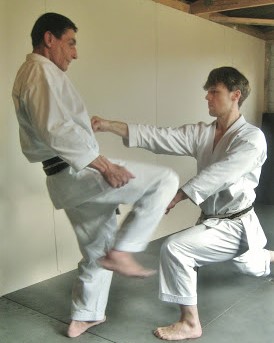
Countering my student Lyall Stone (4th Dan).
Countering Lyall Stone (4th Dan) using DEAI.

So, let’s begin… I hope you find ‘The Three Levels of Jiyu Ippon Kumite’ valuable for your training in this aspect of our art. Osu, André


FIRST LEVEL JIYU-IPPON KUMITE

In the first level of Jiyu Ippon Kumite. The role of the attacker and defender is pre-determined. The designated attacker announces their attack before launching it. The six set attacks are as follows and in the following order:


SET ATTACKS:

1.     Jodan oi-zuki;

2.     Chudan oi-zuki;

3.     Chudan mae-geri keage;

4.     Chudan yoko-geri kekomi;

5.     Chudan mawashi-geri or jodan mawashi-geri (note: chudan or jodan must be specified at this Level of training); and

6.     Chudan ushiro-geri kekomi.


DEFENSE AND COUNTERATTACKS:

At a basic level the foundational ukewaza followed by gyaku-zuki are used. For example: against the jodan tsuki, jodan age-uke kara gyaku-zuki; against the chudan tsuki, chudan soto-uke kara gyaku-zuki; mae-geri, gedan-barai kara gyaku-zuki; yoko-geri, chudan soto-uke kara gyaku-zuki; mawashi-geri, jodan or chudan uchi-uke kara gyaku-zuki; and ushiro-geri, gedan-barai kara gyaku-zuki.

In the case of the keriwaza, tai sabaki is often utilized with the fundamental strategy of optimally avoiding any potential follow up attacks. This is habit is grooved by this practice; that is “… this is the formal beginning of this practice).


A major difference—besides freely being to move around and the fluctuating maai (distancing)—from Kihon Ippon Kumite is that “…both attacker and defender have a freestyle kamae (in Jiyu-dachi); furthermore, after countering the punches are immediately snapped back to the kamae”. Some karate groups no longer do this practice, “…they leave their tsuki extended”, therefore, “…their Jiyu Ippon Kumite is in fact to closer to Kihon Ippon Kumite”. In saying that, this methodology is a good ‘Pre-First Level Jiyu Ippon’. The only problem with this is that some karateka stay at this level of practice. Keep in mind that Jiyu Ippon Kumite’s goal is “…bridging kihon and yakusoku/prearranged-kumite to Jiyu Kumite”; that is, “…transitioning to free style without losing kime in techniques”. Keep this point in mind as we move on to Level Two…


SECOND LEVEL JIYU-IPPON KUMITE

The next phase of Jiyu Ippon Kumite training is the same as the previous methodology. The same six attacks, in the same order, are first announced then launched; however, this time, any method/technique of defense and any counterattack may be utilized by the defender.

After using an ukewaza and/or taisabaki the defender must counterattack with the best technique in that moment; that is, the best technique based on you and your opponent’s position, maai, your physique (i.e. – arm/leg reach), and the one which would potentially cause the most damage. I’d like to address the last point in greater detail as many people fail in this regard and, unless this point is understood, it is better to go back to ‘First Level Jiyu Ippon’.

Let me provide an example… I had a senior karateka, whom I was teaching, who keep kept countering with uraken yokomawashi uchi. While this technique can potentially finish a fight; in most circumstances, it will not. Therefore, unless the aspect of collision, or some other transfer of mass is involved, it is usually not the best option. This is just an example, but my point is to select the technique, which is strongest. Yes, it might be a snapping uraken in specific circumstances, but usually a large-scale power technique will be ‘the correct choice’. This is Budo Education in which “…the karateka must instantaneously/instinctively launch the most devastating technique”. This training is not a test of one’s creativity; rather, it is for optimal effect.

At this second stage ‘kensei-waza’ (feints) can be formally introduced and practiced; furthermore, if the defenders counterattack fails, the attacker can attack again.


THIRD LEVEL JIYU-IPPON KUMITE

As you can imagine, while the defender and attacker are pre-determined, attacks are not announced. I recommend doing this in two ways. Firstly, using the only the six attacks as before, but in a random order. There are two reasons for this. Firstly, the quality of the attack. Oiwaza are the strongest techniques due to the radical transfer of bodyweight/movement of the center; furthermore, their immense propulsion/momentum. Secondly, deviating from these attacks sometimes causes the quality of the attacks deteriorate.

Once this can be done with excellence, any attack can be used. It is worth noting that “…if the quality of technique in attack and defense/counterattack lessens, it is better to return to the aforementioned ‘standard’ attacks.

In this form of Jiyu Ippon Kumite, one will find kenseiwaza to be naturally more effective (due to the defender not knowing what attack is going to come). Nonetheless, in the circumstances of overuse of feinting, or exposure of one’s kamae, the defender is permitted to launch a pre-emptive attack. This often happens when the designated attacker presses into attacking distance without attacking in the attempt to pressure the defender.

As one can see, by this stage (even though it is still a ‘one step drill’) this form of Jiyu Ippon Kumite is almost Jiyu Kumite.


FOURTH LEVEL – ‘ADAPTIONS OF JIYU IPPON KUMITE’

The third level of Jiyu Ippon Kumite is in fact the final stage, the highest level of Jiyu Ippon Kumite. However, I thought I’d provide some of my favorite variations. The first is adding a second (or more) technique(s) in the one step, that is, a renzokuwaza. For example, mae-geri followed by jodan oi-zuki; Jodan gyaku-zuki kara jodan gyaku-zuki; mae-geri followed by mawashi-geri with the same leg; etc… The second variation is to make an attack with a tsuki, keri or uchi and follow up with a hold, lock or strangulation technique (or vice-versa). This is great practice for applying these techniques and, indeed, foiling them. The third variation is doing the aforementioned ‘Third Level of Jiyu Ippon Kumite’ then after the opponent’s counterattack, have short bursts (say five seconds) of Jiyu Kumite. The fourth and final variation, is the younger sister of Jiyu Ippon Kumite: Kaeshi Ippon Kumite. Kaeshi Ippon Kumite is where the initial attacker counterattacks the defenders counterattack… In this form of kumite, one can follow the same process of ‘Level One to Level Three Jiyu Ippon Kumite’ to ensure that the foundational techniques are not undermined.


In ALL CASES, especially in the case of variations, we must make sure that the training is effective. If the drill or exercise does not result in skill development, it is time wasted. Obviously, in some cases, certain training methods can even lead to the regression of good technique/skill. From my experience, I have found this not so much due to the drill itself, but the level of the karateka. If a drill, is too difficult (seen by the deterioration of KIHON and weakness(es) in KIME, take a step back. I think this way adequately highlighted inside my descriptions of the three Jiyu Ippon levels. You and/or students can always go back to a more basic level. This type of systematic training will result in the best use of time to continue advancing one’s karate prowess. In this way—in the immediate, short-term, and long-term—real results will be achieved.


Lastly, if you are a regular follower of this site, you will notice an article earlier about the 'stages of jiyu ippon'. I recommend that article in connection to this one if you wish to maximize your training! Don't get bogged down with the terms of 'levels' and 'stages' but, rather, the defining differences in actual training. Best wishes and best training. Osu!!!

Countering Matt Brew (4th Dan) with TAI-SABAKI.

© André Bertel. Oita City, Japan (2020).

Sunday, 16 August 2020

気法拳

Today my training focused on junansei (softness) and kokyu (breathing). Accordingly, the kata of my practice was 気法拳 (Kihouken) and lots of core-strength based stretching, which Asai Sensei utilized to soften his body. 


I also worked on lots of diaphragmic breathing:  https://andrebertel.blogspot.com/2020/08/diaphragmic-breathing-health-strength.html


This training was a central aspect of Asai Tetsuhiko Sensei's self practice and was a huge emphasis from his wife, Mrs. Asai Keiko. Yesterday marked Asai Sensei's passing. So I did a special training based on these aforementioned points. My thoughts are with the Asai Family in their mourning.


© André Bertel. Oita City, Japan (2020).
Thursday, 13 August 2020

TECHNICAL ADAPTABILITY

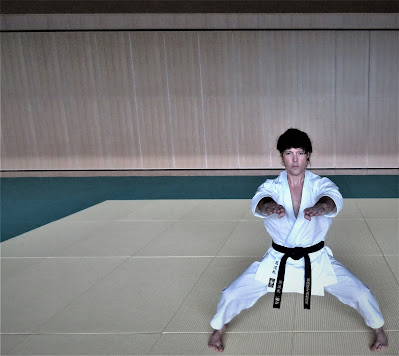
Kumite with my student Matt Brew (Yondan)
Jiyu Kumite at the seaside with my student Matt Brew (Yondan).

 I was recently asked why I can hit people with such a wide variety of techniques in Jiyu Kumite (I’ve often been asked this type of question in various ways over the years). The reality is that, from Asai Sensei, Tanaka Sensei, Osaka Sensei and other instructors, I simply LEARNED THE RIGHT WAY! So what is the right way?


The reality is that people think I have a ‘large arsenal’ in free sparring, but, in reality; I only have a handful of techniques. So, what is behind this phenomenon? The answer is 

‘TECHNICAL ADAPTABILITY’.


That is, to be able to effectively use your techniques optimally in relation the environment, stimuli, opponent(s), and so forth. In this way, one technique becomes many—because the karateka can automatically adapt it for optimal effect.


Do not get confused here. It is NOT JUST ADAPTING TECHNIQUES. For example, trajectory changes in an attack. Rather it is adapting techniques autonomously ‘in an instant’ with optimal effect. This is a skill that requires true mastery of the fundamentals and, consequently, being able to apply them in a freestyle context.


On the contrary, many people have a wide range of techniques, which require very specific circumstances to be successful. Such techniques are what I can only refer to ‘underdeveloped technique’s’. This type of karate is inferior to boxing and kickboxing. In actuality, this type of karate is not real karate.


Jiyu Kumite with David from Spain during his time as a Renshusei.
Jiyu Kumite in Japan, HENKA MAWASHI-GERI, ippon!

Jiyu Kumite is essential to develop the overarching skill of TECHNICAL ADAPTABILITY. Needless to say, this skill is imperative in all fighting arts. This also raises a big question……. Many people teaching karate now ‘demonstrate well’, but can they do what they teach against a non-cooperative and strong opponent? This is my professional asset and the key to what effective fighting karate is. 

押忍

© André Bertel. Oita City, Japan (2020).

Wednesday, 12 August 2020

Diaphragmic Breathing

 I was asked “What are the first things I teach in Karate?” So, in the same light, of my last post I thought I'd answer that here today. Before I go on, now (due to my schedule in Japan) I only teach instructors and elite competitors at my dojo here in Oita City. Nonetheless, I taught total beginners for many-many years. 

Well, at the beginning of the first lesson, I'd initially teach the following: How to make a correct fists (seiken) and stand correct with a good posture (shisei) in shizentai. From there, I teach the ryo ken daitai mae position. In this regard, I teach people to drop their shoulders and ‘sink the energy down into the lower abdomen’. Basically, TO RELAX and rely of the kahanshin (lower body). This is physically achieved by diaphragmic breathing and consciousness awareness of where human energy intrinsically is. Next, I always teach to fix the eyes on one point directly in front the trainee (as a basic reference for them) and begin the practice of receptibility; that is, having an empty/open mind to all stimuli that surrounds them. Please remember, this is the beginning. But like all beginnings, these aspects are ‘constants’ for the karateka. In fact, they eventually expand and differentiate the levels of people.


Just to clarify, in my teaching, this training precedes the standing ojigi and seiza, as it is perquisite to performing these formalities. Furthermore, as already alluded to, these foundational skills underpin everything else.


Today, let me to briefly focus on just one of these points…DIAPHRAGMIC BREATHING.


1.0 What is the Diaphragm? The diaphragm is a muscle at the base of our lungs which is shaped like a dome. When one inhales the diaphragm contracts and moves downwards creating a space, in your chest cavity, that allows your lungs to expand. When one exhales, the diaphragm relaxes and moves upwards into the chest cavity. Reading this, tai no shinshuku in karate should immediately come to mind.


1.1 What is the Diaphragmic Breathing and what are its benefits? So, what then is diaphragmic breathing? It is belly or ‘abdominal breathing’ which allows a full trade of incoming oxygen and outgoing carbon dioxide. In other words, it is ‘high quality breathing’. Diaphragmic breathing has long been known as scientifically beneficial for people with various diseases. However, it is also known to lower blood pressure and heart rate; reduce stress, anxiety, and anger; enhance mental clarity; and indeed, improve physical performance and recovery from exertion.


1.2 Basic exercise to learn how to do Diaphragmic Breathing: To begin practicing diaphragmic breathing lie flat down on your back with your knees bent. Place one hand on your upper chest and the other on your lower abdomen—just below your rib cage. Inhale slowly and steadily through your nose with the intent of getting the air deeply down into your lower abdomen. The hand on your chest should remain motionless, whilst the hand on your stomach should rise. Tighten your abs and allow them to fall inwards as you exhale from your mouth. The hand on your abdomen should move down to its original position.

1.3 Applying Diaphragmic Breathing to one’s Karate: The next phase to replicate this breathing, but in the standing position, as described as the start of this article (with the hands—instead of being placed on the chest and belly—being in the ryo ken daitai mae position). From here, this breathing methodology is appropriately applied and in harmony in all karate techniques; thereby, optimizing physical and physiological capacity.


The first thing we do when we enter the world is breath. And it will be the last thing we do. Accordingly, “…the quality of our breathing—between times—is ‘pretty important’.” I will conclude on that note!


© André Bertel. Oita City, Japan (2020).