Friday, 22 April 2022

Updated training regime

Here's my current training regime. 


Also two announcements: 

1. My first karate textbook is nearing completion. 

2. It is possible that international seminars will resume soon.


OK, on to training...


KIHON

1. (Jiyu-dachi) Kizami zuki kara sanbon renzuki.

2. Jodan age uke kara chudan soto uke, gedan barai soshite jodan gyaku zuki.

3. Shuto chudan uke (Kokutsu dachi) kara chudan kizami mae geri soshite tateshihon nukite.

4. Chudan uchi uke (Kokutsu dachi) kara chudan kizami mawashi geri soshite chudan gyaku zuki.

5. Kizami mae geri kara mae geri keage soshite nidan geri.

6. Kizami mawashi geri kara mawashi geri.

7. Yoko geri keage ashi o kaete yoko geri kekomi (Kiba dachi).

8. Ushiro geri kekomi kara ura mawashi geri soshite ushiromawashi geri


KATA

Tekki Shodan, Tekki Nidan, Tekki Sandan, Hyakuhappo, Ansan (Saturday and Sunday: Free choice kata).


KUMITE

A. Jiyu kumite no renzokuwaza to hangekiwaza.

B. Impact training (Oizuki, gyakuzuki, urazuki, tatezuki, kagizuki, kakezuki, enpiuchi, hizageri, kingeri, and kaiten uraken).


© André Bertel. Oita City, Japan (2022).


Monday, 18 April 2022

When's the next international seminar?

 
Many people have asked when will the next seminar outside Japan be? There are, as everyone knows, many set events; however, the timing is dependent on Japan's corona policies, and that of host countries. As soon as possible, Technical Seminars, which were set prior to the pandemic, will resume.

One thing I promise is that the next wave of seminars will more than make up for lost time.

OSU, AB

© André Bertel. Oita City, Japan (2022).

Friday, 15 April 2022

中山 正敏先生

 Today marks 35 years since the passing of Nakayama Masatoshi Sensei. Sadly, I never got to meet him; however, I've been very fortunate to spend much time with his top students here in Japan. Needless to say, the late Asai Tetsuhiko Sensei and Osaka Yoshiharu Sensei really stand out for me.


Over 20 years ago one of my senior students stayed at the Hoitsugan, which was Nakayama Sensei's private dojo in his building.


In sum, I'm really sad that I never got to experience a class under the direction of Nakayama Sensei; yet, nevertheless, I feel indebted via a variety of avenues.

 © André Bertel. Oita City, Japan (2022).

Monday, 11 April 2022

少しずつ前進

Due to the return of beautiful weather, here in Kyushu, I have returned to supplementary outdoor training.

The IKS Sandan Kihon; Kata (Tekki, Jion, and a random Koten-gata); and Jiyu Kumite summarizes my present technical focus.

40 years on, it is still 'STEP BY STEP'. Big things to come. OSU!!


© André Bertel. Oita City, Japan (2022).

Thursday, 7 April 2022

An unprecedented level of speed thanks to a return to lifting

In recent months I've increased my supplemental training.

As many will know, since corona I began an extra running program, which I've been following since early 2020. It is nothing radical, but I run at least three times a week and often up hills and, occasionally, mountains.


This year I extended this by returning to the gym and 'moving lots of plates around'. I'm following a 'strength functional routine' and further intensified my diet (I have always been strict, but I've gone to the 'next phase'). To be honest it has been great to get back to pumping iron in the gym.


Today I made a breakthrough. I executed the fastest tsuki I've ever made. It's very interesting with the increased muscle mass. It really proves that muscle and weight gain doesn't necessarily mean loss of speed. Indeed, on the contrary.


All of this, of course, is common sense; however, it is exciting to experience a higher level of explosiveness than ever before. Literally, a BREAKTHROUGH thanks to weight training. It's also a joy to personally experience the benefits of contemporary sports science.

While I still continue the body weight exercises, the return to lifting has given an edge.

The other aspect is that my muscles are bigger, so I'm heavier; therefore, I have more mass, in addition to the increased speed. Clearly, no need to explain basic physics here. My message here is that if you want to move faster, and impact harder, you need to increase muscle strength and weight, in addition to using relaxed physical action and movement of the center. These points combined with ever-improving technical skill will result in optimal waza.


All I can say is that I am training hard, feeling lots of pain, and having fun doing so.

TRAIN HARD AND TRAIN SMART.

© André Bertel. Oita City, Japan (2022).

Monday, 4 April 2022

Streamlined online activities

I've streamlined my online activities by removing Messenger, Facebook and Instagram. My target was to do this on the 15 anniversary of returning to Japan (March 26th, 2022); however, my schedule disallowed this.


This does not mean I am not available! On the contrary, I am fully accessible via my email: andrebertelono@gmail.com ; also, my YOUTUBE Channel, which you can click here: ANDRE BERTEL - YouTube


All the very best, André Bertel

© André Bertel. Oita City, Japan (2022). 

Monday, 28 March 2022

Official YouTube Channel

For those wishing for video updates please subscribe to my OFFICIAL YouTube channel: 


© André Bertel. Oita City, Japan (2022). 

Tuesday, 15 March 2022

足の小指

The 足の小指 or small toes are very important in karate, in regards to the direction of one’s feet. Of course, I could list all the 立ち方 (tachikata)/stances of karate; however, by merely using the three main ‘extended stances’ in kihon practice—騎馬立ち(kiba-dachi), 前屈立ち(zenkutsu-dachi) and 後屈立ち (kokutsu-dachi)—this aspect will be more than clear. I’ll also clarify some other related points in this article, but I’ll address those later.

Allow me to explain why the 小指  (small toes) are so important in karate… 


Firstly and obviously, they are weakest toes of the feet.


Secondly, as said above, the direction they are pointing is what really establishes the direction of your feet (as a general rule, please note this, on my kokutsu-dachi point, which I'll state at the end of this article). Firstly think of kiba-dachi. If your ‘pinkies’ are perfectly pointing straight ahead, there is actually a slight inversion of both feet. This is the same with the pillar (rear) leg of kokutsu-dachi. That is, the small toe is ideally 90 degrees so that, like in kiba-dachi, there will be a slight inversion of the foot towards the front. As stated before, I will leave the lead leg of kokutsu-dachi for now, and that will become obvious why later. 

Looking at zenkutsu-dachi the front foot is, of course slightly inverted. Again, this position is dictated by the koyubi. That is, by just pointing the foot generically forward is insufficient. Rather, it is the small toe pointing forward; thus, resulting in the inversion of the entire foot. Indeed, we must also look at the rear foot in zenkutsu-dachi as well. Again, ideally speaking, the rear foot is less than, and no greater than, 45 degrees to the front; moreover and once again, the focus here should again be on the koyubi.


Thirdly, why is all this the case? Well, as stated this part of the foot is the weakest, therefore, we must use it in harmony with the stronger toes: the strongest, of course, being the big toe. 

Furthermore, there is another very important point: 足刀 (sokuto). In Shotokan, a critical basic in kihongeiko is “keeping the entire foot as flat on the floor as possible”. The main focus, in this regard, is keeping ‘sokoto down’ as opposed to the common error of ‘rolling them over’, which results in instability of the respective leg in question. 


This rule is only in classical training, nevertheless, when strictly adhered to, when engaging in freestyle, it makes one’s natural movement much easier. In this regard, optimal is the best word. Put another way, standing in a natural jiyu dachi, it is like ‘taking the breaks off’ (when moving with agility and reactively is the priority). In addition to this, it allows one “…to retain and recover balance when  executing full speed and full power techniques against an opponent”, or any other physical target (sandbag, focus mitts,  etc. Notice something here??


What I’m elucidating here is “…that when ‘throwing techniques into the air’ (I.e. – solo kihon and kata) we keep the feet flat”; that is, sokuto down. Now, please always keep in mind that this intrinsically relates to the 小指  (koyubi). The only exception to this is the classical Yakusoku-Kumite: 五本組手 (Gohon Kumite), 基本一本組手 (Kihon Ippon Kumite), and the most basic form of 自由一本組手 (Jiyu Ippon Kumite). To put this in context, these methods of Kumite must be recognized for what they really are: ‘Partner Kihon Drills’ which “…train the classical techniques of karate—with another person/opponent—and progressively bridge the gap closer towards Jiyu Kumite: whilst mitigating the loss of kime in techniques”.

So, we can see that sokuto is not only for kicking… Moreover, the importance of the 小指 (small toes) for precise foot directions, which not only result in beautiful foot positions in stances but optimize the feet for explosive speed and power; balance and recovery; and generically speaking, fine tuned bodily control.


OK, so if you closely read above, you will notice that I purposefully left out the lead leg of kokutsu-dachi. Well, I did that on purpose as it is what I personally term as ‘a rule breaker’, which is a constant in karate and all forms of budo for that matter. In this case, the entire foot points forward as opposed to the small toe. This is because the prime focus is on the compression of the rear leg and the front foot establishes one’s line for power transition as opposed to being directly for function itself. This also enables a neutral position for a kizami-geri; however, this somewhat deviates from the focal points of this article.


To conclude, by properly understanding, and applying of your koyubi, you can readily achieve professional classical stances with Japanese flavor; furthermore, these classical positions and the resulting unsoku/footwork from them, will greatly enhance one’s Jiyu Kumite and ability to defend oneself.

© André Bertel. Oita City, Japan (2022).

Friday, 11 March 2022

平安初段 (Heian Shodan)

Introduction and commentary:

Purposefully, I decided to conclude this series of five articles on each of the Heian with Heian Shodan. My hope is that the readers gain from this, via the content of all five articles. Okay! So let's begin. With 21 movements 平安初段 (Heian Shodan) is the first in this series of five kata; however, as you will know, the original the order was reversed.


While most people are aware of this, and know ‘why Funakoshi Gichin Sensei switched the first two (Heian/Pinan)’, I will concisely state ‘why he did this’ this here: based on his various writings about it. Essentially, he changed the order “…because ‘the original Nidan’ was easier to teach and learn”. Yes, it’s that simple!


However, significantly fewer people know that “the original order of the Heian gata was based on their respective levels of 応用 (Oyo/Application). This was the work of the kata’s creator, Itosu Anko Sensei.


So, the order that Shotokan uses, “…begins with Pinan Nidan (our Heian Shodan), which is a kata for practicing/applying ‘flinch responses’. That is dealing attacks coming in at us. Whereas, Pinan Shodan (our Heian Nidan) practices/applies ‘responses after connection to the opponent’”. This could be カキエ (Kakie) or 手組 (Tegumi)/無刀 (Muto).


Therefore, to summarize: “Shotokan has a more systematic/logical order for initial teaching and learning; whilst, the original order is more logical in regards to an exchange with an opponent/self defense”. In my opinion—during the initial stages of learning—Master Funakoshi’s switching of these two kata was a very positive thing for karate; nonetheless, ‘it is still essential to understand the reversed order in regards application’. This may seem an overly simplistic approach, but as the Funakoshi Sensei famously said: “Victory and defeat are determined by simple matters”.


Here are the five different waza featured in Heian Shodan:

Before I list those five waza I want to reiterate and expand on Funakoshi Sensei’s ‘educators logic’ in switching the first and second Heian/Pinan (which is largely shown by the numbers of waza encompassed in these kata). Whilst the ‘original Shodan’ featured 12 different waza, the ‘original Pinan Nidan’ only has only five. Moreover, Funakoshi Sensei allegedly deemed ‘applying keriwaza’ as being “…more complex actions for beginners and of lesser importance for them, than tewaza (in the very early stages of training)”. In addition, the ‘original Heian Nidan’ has “…far more ‘single waza in single steps’. There is literally only one (movements three and four: gedan-barai kara kentsui)”. Whereas, the original  Heian Shodan features five (renzokuwaza/combination techniques).


Still, from bujutsu/practical oyo perspective, regardless of the aforementioned points, the Heian Shodan (of Shotokan) is often only applied in “the secondary phase in a self defense situation”; that is, if the initial attacks are percussive blows as opposed to connecting. Hopefully that matter is clarified now. OK, so allow me to move on to the five waza in our Heian Shodan (Pinan Nidan).


1) Gedan-barai (Zenkutsu-dachi).


2) Chudan oi-zuki (Zenkutsu-dachi). Also commonly labeled as ‘Jun-zuki’.


3)  Kentsui jodan tatemawashi uchi (Zenkutsu-dachi).


4)  Jodan age-uke (Zenkutsu-dachi).


5)  Shuto chudan-uke (Kokutsu-dachi).


To expand on details of the kihonwaza, in the ‘Shotokan Heian Shodan’, I recommend this article just over five years ago. It has a few technical tips: https://andrebertel.blogspot.com/2017/01/first-article-for-2017-few-notes-on.html 


           HEIAN SHODAN OVERVIEW


REI (Musubi-dachi). 


YOI: Ryoken daitai mae (Hachiji-dachi).


1. Hidari sokumen hidari gedan-barai (Hidari zenkutsu-dachi).


2. Migi chudan oi-zuki (Migi zenkutsu-dachi).


3. Migi gedan-barai (Migi zenkutsu-dachi).


4. Migi kentsui tatemawashi uchi (Migi zenkutsu-dachi).


5. Hidari chudan oi-zuki (Hidari zenkutsu dachi).


6. Hidari gedan-barai (Hidari zenkutsu-dachi).


7. Migi jodan age-uke (Migi zenkutsu-dachi).


8. Hidari jodan age-uke (Hidari zenkutsu-dachi).


9. Migi jodan age-uke (Migi zenkutsu-dachi)—KIAI!


10. Hidari gedan-barai (Hidari zenkutsu-dachi).


11. Migi chudan oi-zuki (Migi zenkutsu-dachi).


12. Migi gedan-barai (Migi zenkutsu-dachi).


13. Hidari chudan oi-zuki (Hidari zenkutsu-dachi).


14. Hidari gedan-barai (Hidari zenkutsu-dachi).


15. Migi chudan oi-zuki (Migi zenkutsu-dachi).


16. Hidari chudan oi-zuki (Hidari zenkutsu-dachi).


17. Migi chudan oi-zuki (Migi zenkutsu-dachi)—KIAI!


18. Hidari shuto chudan uke (Migi kokutsu-dachi).


19. Migi shuto chudan uke (Hidari kokutsu-dachi).


20. Migi shuto chudan uke (Hidari kokutsu-dachi).


21. Hidari shuto chudan uke (Migi kokutsu-dachi).


NAORE: Ryoken daitai mae (Hachiji-dachi).


REI (Musubi-dachi).


I know from now, that I'll seemingly self contradict (some of my points made above), but what I’ve discovered—as I’m sure you have also—is that parallel knowledge always exists. The aforementioned aspects of ‘ease of teaching/learning’ still apply,  as does ‘the oyo/applicative order’… So, why then do most of the top Shotokan karate experts see Heian Shodan as ‘the ultimate kata’? The beginning and the end. Well, the idea is simple, yet important to know. The full circle in Budo represents technical completeness, but with no ending: this is Heian Shodan.


Taken as a whole, Heian Shodan is a kata which leaves nothing to hide in one’s kihon and karate in general. Even though there are no kicks, ‘keriwaza ability’ is shown via the unsoku. Intrinsically and collectively, the first Heian (in Shotokan) is a challenge: irrespective of technical level and experience.   

© André Bertel. Oita City, Japan (2022).

Monday, 7 March 2022

Are you looking for SPECIFIC CONTENT on this site?


I often get asked, where’s the SEARCH Function? Well, it’s always here, but if you are using a mobile phone it’s not visible unless you change to what's called the 'VIEW WEB VERSION'.


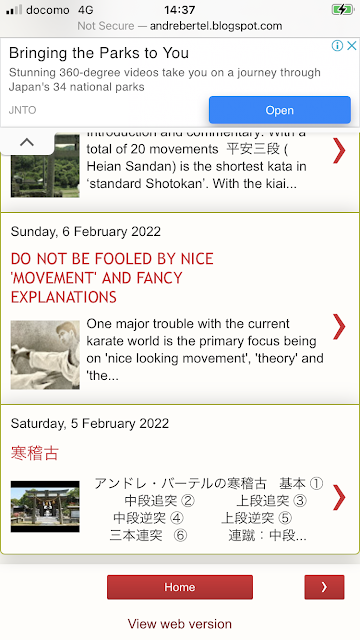
To do this scroll down on your phone to the near bottom of the page until you find the red bar which says ‘Home’ in white (you can see this by checking the bottom of the next photo).


Immediately, under this is ‘View web version’. 

Click on this, and you will find the SEARCH function at the very top left corner of the page.

Click on the 'View web version' immediately above.

 Type in what you are searching for between the orange and white BLOGGER logo on the left, and the little magnifying glass on the right (shown in the image directly below).


It’s that simple and from there you can easily comb through 15 years of articles here on the site. 

Emails: Still, if you have any questions you are welcome to email me at: andrebertelono@gmail.com I tend to receive a large amount of emails each day, so I can’t physically answer them all. It would literally be impossible. That being said, when ‘a specific theme becomes requested enough’, I will usually answer via an article. An example of this is the recent Heian articles.


Of course, when possible or deemed necessary, I also answer people and groups back personally: via email.


Overall, I hope that this post allows you to better navigate the site. I’d also like to thank the thousands of Budo Karateka, here in Japan and around the world, who have supported and followed this site. There are lots of great things to come and many projects in the works.

 押忍 ― André 


© André Bertel. Oita City, Japan (2022).