Thursday, 29 April 2010

Oliver & Yan Schomburg

The organizers of the seminars and classes I taught in Germany were Oliver and Yan Schomburg. Oliver and Yan hosted us at their home in Ahrensburg, just outside of Hamburg for two weeks, and looked after us very well!
______

This also meant I could give them private tuition on a daily basis, in addition to the lessons at their dojo, and the open seminars at the stadium. Every day Mizuho and I enjoyed their company and we had very nice times together. In addition to all of the karate practice, between times we were taken to many places to enjoy the sights, local cuisine and society in general. Included in our tours were Lubeck, Luneburg, Schwerin Hamburg and Bremen.

Besides regularly eating out we also enjoy some great meals prepared by Yan, not to mention the seemingly endless German beer and wine being bartended by Oliver! The only words which come to mind are "prost" and "kampai"!
_______

Above and beyond everything else we were very happy to foster a great friendship with Yan and Oliver, and their family, through karatedo!


Yan and Oli, domo arigato gozaimashita. Keep practicing, Osu!

© André Bertel, Japan 2010.

Tuesday, 20 April 2010

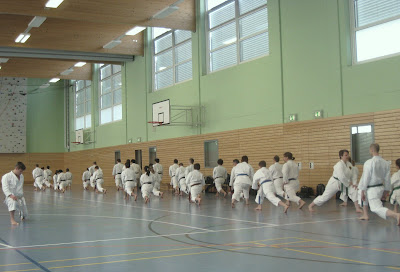
Photos from the Ahrensburg Seminars

Here are some photos from the Asai-ha Shotokan-ryu Karate seminars I taught in Ahrensburg, Germany, just outside of Hamburg.
______
It was also a great pleasure to meet, Jan Spatzek Sensei (JKS 7th Dan) and students Jesper and Michael from Denmark. I mention this because Jan Sensei was also a personal student of Asai Sensei. What's more, at 7th Dan he continues to train and talk with his karate. A master karateka and great person!
Also many thanks to the organisers Yan and Oliver Schomburg, and all of the other karateka who trained. OSU!
_______

© André Bertel, Japan 2010.


Wednesday, 7 April 2010

Training for time

I can’t believe that we are already a week into April! But as the saying goes “time goes fast when you're having fun.”
______

Between karate training and teaching, things often get blurred in my life. However, one thing that never changes is the clarity found in daily karate practice, something that anyone who seriously trains in traditional karate-do, will fully understand. I’ve always felt that time slows down in the dojo, especially when suffering from hard training, or working on an subtle technical aspect. Time seems to stop! This is one reason why I am so determined to practice every day of my life, without fail. The gains far outweigh any losses, especially when it comes to minutes, seconds and hours.
_______

When your schedule is out of control, still make time to TRAIN! Don’t skip practice, but rather push yourself harder to go! Karate keiko will really slow down your clock and give you more energy for other things in your life. Osu!
© André Bertel, Japan 2010.

Saturday, 3 April 2010

Newly uploaded footage of Asai Sensei

Here is some nice footage of my late teacher Tetsuhiko Asai Sensei introducing his basic shoulder, elbow and wrist snap to the Ukraine (in 2002). And also his method of hip rotation/body power. Click here to check it out: http://www.youtube.com/watch?v=ECvVO26nIts

I've been composing an article on the different methods of hip power, so this clip is a nice compliment prior to the publication of the article (which is still uncompleted, as we just moved into a new apartment).

Of particular value in this clip is everything... However, a very easy aspect to point out is the difference between sports karate teisho in Jion and the real version. One is for tidiness and outward appearance of power. The other is a highly potent block or attack which has enormous impact. And just uploaded, some other points from Jion... Follow this link: http://www.youtube.com/user/dottore574#p/a/u/0/TL25Ob4LyQA
_______
Best training and wishes from Oita, Japan.
© André Bertel, Japan 2010.

Tuesday, 30 March 2010

Sakura

As promised here are some hanami pictures. The sakura this year were typically breath taking! Here Mizuho and I are wearing traditional Japanese kimono at Nakatsu-jo.
_______

After my yudansha-geiko at the Renshinkan dojo we went to the castle, for photos with the sakura, and the 'usual customs'. Needless to say, we had a wonderful time.

Best wishes from Nakatsu, Oita Prefecture, Japan.
© André Bertel, Japan 2010.

Saturday, 27 March 2010

Sakura covered Nippon

This week has been very busy with karate. Training and teaching daily as usual, nothing extra, but also karate nomikai (drinking parties), which is typical at this time of the year in Japan.
_________

My practice is going well (translated into English, “still trucking”), but I’m currently sporting two minor injuries which have been somewhat annoying, and the occasional sake induced hangover. A special session on just mae-geri and yoko-keage was excellent a few days back. It was all stationary work from heisoku dachi and zenkutsu-dachi. I lost count in somewhere close to 1000 kicks…The only word which comes to mind is ‘grueling’! Yet another practice was dedicated to continuous repetitions of Heian-nidan, Heian-yondan, and Heian-godan. These sessions were particularly beneficial for me, as they took me away from my current routine, and "gave my body a shock". Without trying to sound impressive, I have to say the Heian kata are “by far the hardest kata in Shotokan-ryu”. Every kata is difficult for me, but in all honesty, and as mentioned in the past, I’ve always found them to be the most technically difficult, and more importantly, the most revealing. If you think you have good karate, just do the Heian series! If you still do, you are either perfect or…

As a point of reference, if you want to see great Heian kata (or any 'proper' Shotokan kata for that matter) check out Osaka Yoshiharu Sensei. To me, he still sets the ‘standard’! Effective form equating to beautiful kata, as opposed to merely polished movements for aesthetics. Here’s a quick link: http://www.youtube.com/watch?v=pWTspBwfKwk

Finally the sakura (cherry blossom) trees are in full bloom and many people here are enjoying hanami with their family, friends and work colleagues. I have been lucky to have been in Japan for the last five years during hanami, also many times during the 1990’s. For me, nothing beats sakura alongside the traditional architecture of Japan... So by now you are probably asking yourself "where the heck are the sakura pics?" Well, I promise to post some in the next few days, perhaps with a kimono or two thrown in...
_______

OK, to conclude, I’d like to update our email information. In the next few days our OCN email account will be closed. Therefore if you wish to contact me, please send your email to this address: andre.mizuho@hotmail.co.jp Likewise if our old 'bertelono' email is still in your address book, to avoid any miscommunication, please delete it and update! My best wishes to you from sakura covered Nippon.
_______
© André Bertel, Japan 2010.

Friday, 26 March 2010

Three years in Japan

Three years ago today we arrived back in Japan. As my wife Mizuho is Japanese, returning to Japan is coming home for her. But in so many ways, Japan has been home for me too, even since my teens. So much of my life, prior to the last three years, was spent coming to Japan, to study karatedo at the source. The most memorable times were certainly with the Matsuno J.K.A. (Japan Karate Association).
_________

Memories of my personal teacher Asai Tetsuhiko (Chief instructor), Yahara Mikio (Assistant Chief instructor), Yamaguchi Toru (Senior advisor), Abe Keigo (Technical director) and others firmly come to mind. Phenomenal training, onsen, karaoke, and lots of kampai ring bells (very loud bells) in my head. Asai Sensei singing "Just walking in the rain" and "Don't worry be happy" is unforgettable... I'm smiling as I write this. Yahara Sensei punching a fish dead was another memory... Not to mention his explosive energy which filled every corner of the dojo! And another about Abe Sensei, which out of respect, I can not say publicly. All history, and all taught me about the Shotokan karate world, its excellence, and in some cases, its negativity's.
_________

What really counts is that I was taught amazing karate from these masters in this great nation, especially from Asai Sensei, who kindly took me on as his deshi. This privilege alone literally changed my entire life. More than this, it really balanced my perspective of karate, as a professional, and allowed me to put it in the right place (in my life). Belief, values and family first, profession and maintaining values in it, second... Then everything else follows naturally.
_________

The last three years in Japan has allowed me to physically translate my last 20+ years of karate training and technically refine many subtle skills. When people ask me "How can you follow karate like this? That is my dream life!" I tell them, "We must maximize our lives as human beings, suffer, and take multiple risks to do so. If we are fortunate, we either create chances, or cower. If we are unfortunate, we have no choices. If one has a chance, a dream, and 'decides not to chase it', the only certainty is regrets.

Today marks three years in Japan, following my karate dream, and now is a time for celebration. My best wishes to you all from Nakatsu-shi, Oita-ken, Japan.

Osu!
_________

© André Bertel, Japan 2010.

Monday, 22 March 2010

Special training for Bryan Dukas and Paul Kallender in Kyushu

Some of you may have read my June 2009 post on Mike Dukas Shihan (please click on the following link to access it: http://andrebertel.blogspot.com/2009/06/great-interview-with-mike-dukas-shihan.html). Well, on Monday the 8th of March, Bryan Dukas Sensei (Yondan) and Paul Kallender (Shodan) travelled all the way from Tokyo to Nakatsu to meet up, and study Asai style Shotokan Karate at my dojo.
_____

Upon arrival at Kitakyushu airport straight away I spotted my good friend Paul, and then Bryan (whom I've never met before). From the moment of meeting Bryan I knew that we’d get along very well, my first impression was very positive, truly a very modest and knowledgeable karateka. Great guy! After the fairly long drive back to Nakatsu, we immediately travelled to the Renshinkan Dojo for training.

Bryan and Paul wanted to study Tetsuhiko 'Asai Style' Shotokan Karate, so I ran them through several of Sensei's introductory kihon exercises, and methods of power generation, which somewhat differ from that of the KWF/Yahara Karate. We also covered Kakuyoku-shodan and nidan kata several times (also Kakuyoku-sandan a little). During our warm up we briefly ran through Unsu (Bryan's tokui kata), Bassai-dai (Paul's tokui kata), Suishu (Mizu no te) requested by Bryan as he learned it from Asai Sensei in the 90's, Roshu (Nami no te) and Kaminari-arashi kata.
_______

Kata applications for jissen-kumite: Another thing I quickly injected into the lessons were some of Asai Sensei's bunkai/oyo-jutsu of several so-called "redundant Shotokan kata movements". With limited time I only gave examples from the last movement (repeated twice) of Jion, Manji uke (featured in Heian-godan, Bassai-dai, Kanku-dai, Jion etc), and ura zuki in the three Tekki. Bryan and Paul were clearly impressed by these applications, just as I was, when Asai Sensei first taught them to me. These, according to Sensei, were the original meanings, so I hope this small taste of Asai-ryuha Shotokan bunkai was enlightening. I only wish we had more time to cover all of the applications and to train them via oyo-kumite.
_______

The 'Gammy Leg' & relaxed movement: I was very pleased that Paul, even though he is still suffering with his ‘gammy leg’ still got into his dogi and trained. With more relaxed movement I was greatly impressed by his flow of power. So I'm sure, with practice on this and strict attention to shisei (posture), his karate will readily get to nidan standard.

South African or Nihonjin? Bryan’s karate is literally world class, definitely the best non-Japanese karateka I’ve seen for several years. He is a world level competitor and numerous times South African National Champion (JKA, KWF and WKF All-styles), but better than this, is the fact his karate is 100% traditional (pure budo/martial arts karate). So I was very pleased to teach him some Asai-ryuha, and hope that he introduces, what we covered, to South Africa. He is the first South African karateka to properly study Asai Sensei's technique in a session 'technically similar' to socho-geiko (special 'morning training'). I was thrilled to pass on some of Tetsuhiko Asai Sensei's karate to him, as his karate put a smile on my face.
_______

My advice to anyone in South Africa, is to go and study karate from Bryan Dukas Sensei, he has much to offer anyone, who is serious about learning traditional Shotokan. Unlike most gaikokujin karateka, Bryan truly does karate the Japanese way, and at a level rarely seen outside of the very best clubs, here in Japan.
_______

Thanks Paul and Bryan for coming down, it was a pleasure to host you here in Oita Prefecture, and an honor to be friends with you both through Karate-Do. Mizuho and I hope you had a great time, and that you benefitted from the karate keiko here.

OSU!
© André Bertel, Japan (2010).

Australian instructors visit

Australian Shotokan karate instructors Ken and Helen Bainbridge visited Nakatsu on Sunday morning (March 21st). It was nice meeting and doing some training with them. Also taking them for some sightseeing around Nakatsu and Usa.
_________

With limted time I took them through some fundamental aspects of Asai style Shotokan karate (in both kihon and kata application). The kihon I introduced included correct chushin for choku-zuki, and testing of this, which can then be applied to all other techniques. Also dentouteki koshi no kaiten (traditional hip rotation) for gyaku-zuki; oi-zuki timing; and Asai-ryuha kihon tachikata.
Oyo-jutsu (practical application) of kata included the final movement of Jion and some others. I hope all of this kihon, and the applications, will be of great benefit, for their students back in Western Australia.
_________
Mizuho and I really enjoyed meeting Helen and Ken. It is always a pleasure to make new friends through the art of Karate-Do. We wish them both the utmost best, for their remaining time here in Nippon.
© André Bertel, Japan (2010).

Thursday, 18 March 2010

My kanji

Some people have curiously asked me "Which kanji have been used for your name?" (on my dogi and obi) so I thought I'd quickly answer that in this post. Nothing serious all good fun here!
______
OK, the three kanji which form my name are 'On' (which means favor, obligation and/or kindness); this character is the same used for the kata Jion. 'Do' is the same as karatedo (literally path, road or way). And 'Rei' is translated as bow, thanks or gratitude; this is the same as reigi or politeness/courtesy.
______
Kindest regards and respect from Nippon,
Ondorei

© André Bertel, Japan 2010.