© André Bertel. Oita City, Japan (2017).
Wednesday, 24 May 2017


Renshusei from Deutschland
 |
| Concluding the first four hours of training: Kihon-Kata-Kumite--the trinity of Karatedo to achive optimal effectiveness. |
Four more karateka have come as
international renshusei (trainees) here, at my dojo, in Oita-City. The
four fromドイツ (Germany)
included: Joerg Arndt (6th Dan): http://www.karate-dojos.de/); Peer Frasch (3rd
Dan); and Axel Hoffmeyer (2nd Dan); and, second-time renshusei, Frank Kohler
(3rd Dan).
 |
| Explaining a key Budo Karate point kept within the elite Shotokan schools here in Japan. Focused faces and great karate spirit! |
The focus of the weekend was the
correct and elite practice of Kihon, Kata and Kumite - in combination - to
achieve effective 'fighting ability', which is at 'the technical heart' of
traditional Budo Karate. While I won’t go into details—as these are for
Frank, Axel, Peer and Joerg—I will say that extreme technical improvement was
made by all four trainees over the eight hours. So I was very impressed by
their physical effort, karate no seishin (karate spirit) and overall determination
to make changes to improve their karate. Perhaps a short video, giving a few
glimpses will come. Osu, André.
|


Thursday, 11 May 2017
Video: Transition from basic tsuki to application
Here is a new video from last year in Mira, Venice (ITALY) where I taught a seminar on Budo Karate. Special thanks to Mauro Shihan and Silvio Sensei for this footage. Osu.
© André Bertel. Oita City, Japan (2017).
Sunday, 23 April 2017
Intensive Private Training in Oita City


Today and yesterday we had intensive training here in Oita City. I practiced and taught the core sonoba-kihon, followed by Gohon Kumite and Kihon Ippon Kumite. Kihon Ippon Kumite was, in fact, the main focus:with atttention to critial details to achieve 'finshing waza'. Kata training bolstered this effort and included Unsu, Sochin, Nijushiho and Sentei-gata Jion.
Overall, in the sense of 'Budo'/'Bujutsu', the training was literally top-level here in Japan. Hard core practice. I think that says a lot; moreover, it is great that authentic Budo Karate is continued without being watered down to sports karate, nor the Western way of theories, lots of talk, "feelings" (= get smacked over in Japan), and mere 'copy-cat movements' (= just movements) with no relation to fighting/self-defense in the real world. Real karate is a real martial art, not just an art. This is the Karate-Do I follow as do other true followers of Karate. Osu, Andre.


Thursday, 13 April 2017
桜 (Sakura)

桜 (Sakura) or cherry blossoms, as most know,
have a very special cultural significance
here in Japan. Ask any Japanese person “what is your favourite time of
the year?” and many will say “Haru” (Spring): often in reference to the exquisite
blooming of sakura.

Spring,
of course, is literally the season of new life in nature, and the blooming of
sakura vividly epitomizes this. What makes sakura more profound is that their
life is both beautiful and fleeting: an analogy of human existence.


As the
sakura bloom across Japan people have ‘cherry blossom parties’ or 花見 (Hanami), which
literally translates as ‘watching blossoms’. They eat and drink heartily with
family, friends and/or workmates. It is therefore a time to really appreciate
being alive—and the beauties of life—on many different levels.


Wednesday, 12 April 2017
Gohon and Kihon Ippon Kumite is KIHON TRAINING

There
are two forms of kumite (sparring) purely for the training of kihon
(fundamentals), these are: Gohon Kumite—Five step sparring; and Kihon Ippon
Kumite—Fundamental one step sparring.
The purpose is ‘KIHON’: While both of these training drills practice the additional aspect of timing and maai (distancing), the focal point is to ‘maintain and employ perfected/classical kihon form’ whilst doing so. For this reason, I have always highly recommended that karateka do not consider Gohon and Kihon Ippon Kumite as ‘kumite’ but, rather, as ‘partner kihon’. In this way, the underpinning purposes of these partner drills can be achieved and not diminished in any way.

Training
these drills as MATCHES: This is, of course, fine, and is done
here in Japan (with Kihon Ippon Kumite); nevertheless, one will not be
successful if one turns Gohon and Kihon Ippon Kumite into some form of
‘restricted fight’. As stressed above, doing so, will inevitably compromise
kihon—which immediately renders these drills useless. Returning to the point of
matches with Kihon Ippon Kumite, in relation to the aforementioned point, the
‘winner’ be the karateka whom demonstrates superior kihon; thus, again
elucidating the point of Fundamental ‘Kumite’.
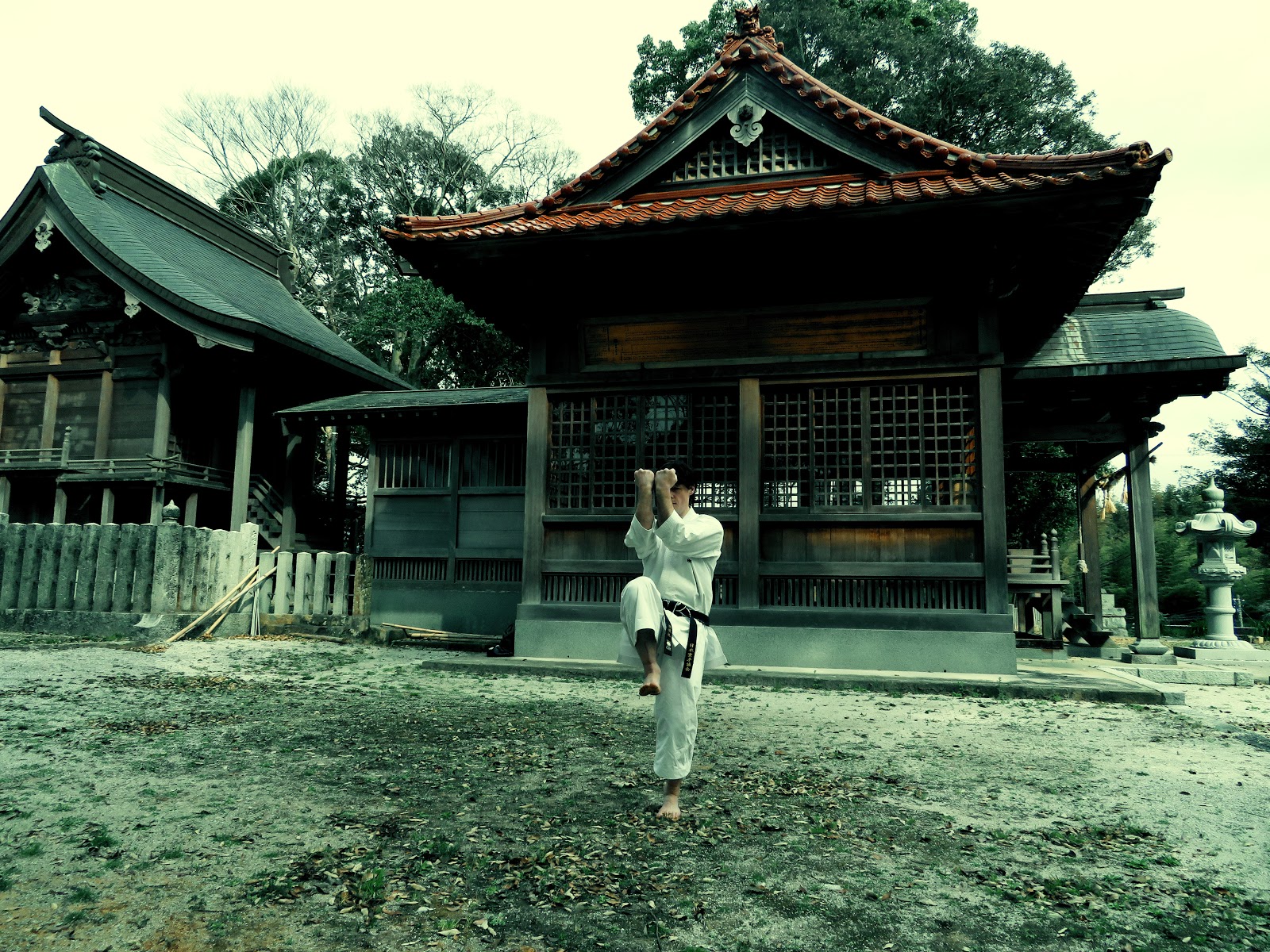
CONCLUSION: Kihon, kata and all of the different
forms of kumite training collectively work together to optimally develop the
defensive and offensive capacities of karateka; however, the objective of each
drill must be fully understood and followed in physical practice. Failure to do
so will waste training time; moreover, groove bad habits. When practicing Gohon
Kumite and Kihon Ippon Kumite think about how much they imitate/resemble a real
fight. When one does so, it is evident that they do not, nor can, prepare one
for jiyu-kumite nor self-defence. Irrespective of this, they are excellent building
blocks—when understood and trained correctly—that greatly contribute towards
solidifying the foundational skills which (in harmonious combination with
kihon, kata, and the other forms of kumite) result in an ever-improving
freestyle capacity.

©
André Bertel. Oita-City, Japan (2017).
PS –
You may have noted that I have not mentioned Jiyu Ippon Kumite: this was
intentional. I will write an article about it in the near future. 押忍, André.


Monday, 10 April 2017
Trainees from Germany: Andrea Haeusler and Torsten Uhlemann
On Friday 7th and Saturday 8th
of April—Andrea Haeusler Sensei and Torsten Uhlemann Sensei (JKA Germany)—came
for private training at my dojo here in Oita City.


As
they operate their own dojo, Fuji San Karateschule Münster
(click here to visit their clubs homepage: http://www.karateschule-muenster.de/) the sessions
were essentially ‘instructor trainings’ focused on key points of top-level Budo
Karate here in Japan. Accordingly, kihon was the main aspect—in relation to kata
and kumite.

In
sum, it was great to see Torsten Sensei and Andrea Sensei do so well over the
two days of training here in Oita. I wish you both the very best for your remaining time here in Japan! Osu,
André

©
André Bertel. Oita City, Japan (2017).
Monday, 27 March 2017
WANKAN KATA VIDEO
One of my personal students after learning 王冠 (Wankan) requested that I perform it slowly online. Wankan is a kata that I merely know - not one that I presently practice; therefore, I am regretful that I cannot give it the justice it deserves. Irrespective, I hope that this helps people seeking to learn Wankan correctly - in the technical sense - as I have seen many strange versions posted online, which is, of course, very regretful. Best wishes from Japan, Andre Bertel.
SUMMARY OF WANKAN KATA
·
Naore
(Ryoken daitai mae, Hachiji dachi)
·
Rei
(Musubi dachi)
·
Yoi
(Ryoken daitai mae, Hachiji dachi)
1.
Ryoken chudan kakiwake uke (Migi kokutsu dachi)
2.
Ryoken chudan kakiwake uke (Hidarii kokutsu dachi)
3.
Ryozenwan jodan hasami uke (Hidari ashi dachi)
4.
Migi ashi ippo mae
5.
Hidari ashi ippo mae
6.
Hidari tate shuto chudan uke (Migi zenkutsu dachi)
7.
Uken chudan zuki (Migi zenkutsu dachi)
8.
Saken chudan zuki (Migi zenkutsu dachi)
9.
Sasho gedan sukui uke/Usho koko gedan osae (Hidari ashi mae neko ashi
dachi)
10. Hidari tate shuto chudan uke (Migi
zenkutsu dachi)
11. Uken chudan zuki (Migi zenkutsu
dachi)
12. Saken chudan zuki (Migi zenkutsu
dachi)
13. Sasho gedan sukui uke/Usho koko gedan
osae (Hidari ashi mae neko ashi dachi)
14. Hidari tate shuto chudan uke (Migi
zenkutsu dachi)
15. Uken chudan zuki (Migi zenkutsu
dachi)
16. Saken chudan zuki (Migi zenkutsu
dachi)
17. Migi kentsui chudan uchi mawashi uchi
(Kiba dachi)
18. Hidari chudan mae geri keage (Migi
ashi dachi)
19. Hidari chudan jun zuki (Hidari
zenkutsu dachi)
20. Migi chudan mae geri keage (Hidari
ashi dachi)
21. Migi chudan jun zuki (Migi zenkutsu
dachi)
22. Hidari chudan mae geri keage (Migi
ashi dachi)
23. Hidari chudan jun zuki (Hidari
zenkutsu dachi)
24. Saken chudan uken gedan yama zuki (Migi ashi mae fudo dachi) “EI!”
·
Rei
(Musubi dachi)
© André Bertel. Oita-City, Japan (2017).Monday, 13 March 2017
RENSHUSEI FROM GERMANY: Oliver Schoemburg

Over the weekend Oliver Schoemburg, from Ahrensburg (Northern Germany) trained at my private dojo here in Oita City. I will not detail the
time outside of the dojo with him and his lovely family, but I will briefly give an overview of the training.
Kihon was a large part of the practice, however, the overarching theme was 'technical moderation' and, at the heart of this, simplification. The three core techniques of Karate-Do: jun-zuki (oi-zuki), gyaku-zuki, and chudan mae-geri keage were given the greatest attention. Furthermore, zenkutsu-dachi and its various aspects (transitions from shomen, hanmi, gyaku-hanmi and unsoku/ashi-hakobi) in sonoba-kihon, ido-kihon and kumite were thoroughly addressed.
Supporting this training was a couple of imperative points in Kihon Ippon Kumite and the base understanding of the freestyle kamae in Jiyu Kumite; also, advanced practice of kata: Heian Shodan, Tekki Shodan and Hangetsu. Another theme trained, via kata, was "...waza no kankyu to achieve kime in every technique; in particular, during the execution of renzokuwaza". Indeed, all of these aspects were combined to work towards the physical aim of Budo Karate: Ichigeki-hissatsu.

In sum, Oliver did extremely well and
has plenty of homework to take back to Germany for himself (and his students). おめでとうございます,
押忍! André.

© André Bertel. Oita City, Japan
(2017).
Tuesday, 7 March 2017
2017 SEMINAR in KREFELD, GERMANY

For those wishing to ensure that they get a place on the course, you should contact the organizers—Dojo Nakayama Krefeld e.V.—by email: alex@karate-Krefeld.de. As in all of my other open seminars, I advise people to book early to avoid disappointment.
Here is a link to the homepage of the host dojo: www.karate-Krefeld.de For those who will be attending, see you in Germany. 押忍, André
© André Bertel. Oita City, Japan (2017).
Subscribe to:
Posts (Atom)