Monday, 28 June 2010

Why Karate?

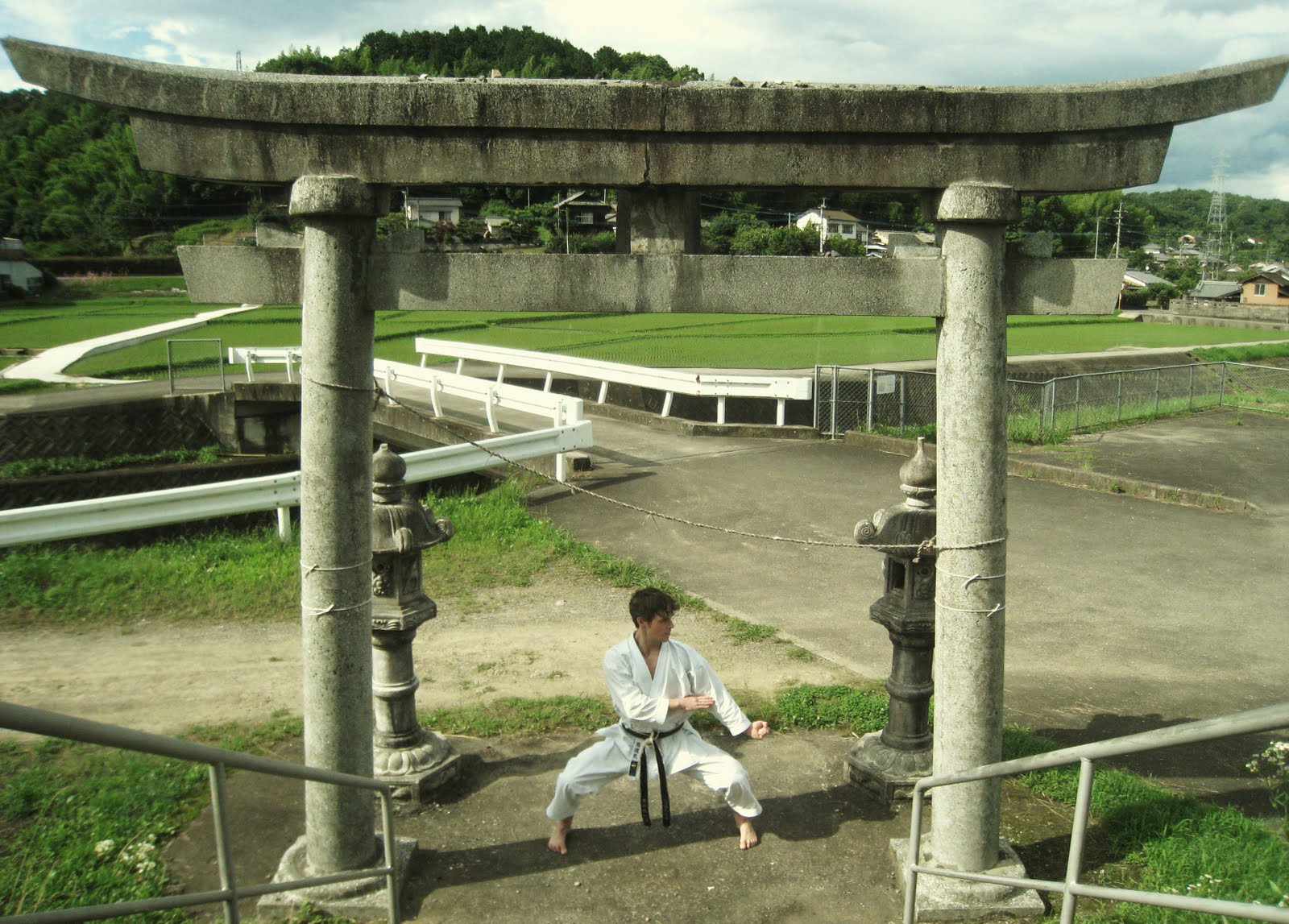
One question I have been asked by so many people over the years, and many times recently, is “Why do you do practice karate?” This is especially the case, here in Japan, as Japanese people are often surprised that I do a traditional Japanese martial art.
___________
On the subject of sports rather than budo, coming from “consistently” the strongest rugby province in New Zealand (Canterbury), and the nation of the All-Blacks, it must seem certain that growing up would automatically include the acquisition of ‘cauliflower ears’. Fortunately for me, and my ears, my mother put me into Shotokan karate at five years old for my discipline. Why? Because she was rightfully impressed by Japanese reigi-saho (etiquette) and the physical balance of karate (as an unparalleled physical art and means of self-defense). So as it turned out, I found myself in the dojo engaging in jiyu-kumite, as opposed to tackling people, or being in a scrum.
_________
THE REAL QUESTION! “Why are you still doing Shotokan karate well into your 30’s?” Here are the first six points which immediately come to mind. These are the core things that have kept me motivated for three decades, and continue to do so:
________
(1) Youthful looks and range of motion/flexibility: Karate training keeps people young looking and allows them to improve their suppleness. This results in flexible movement throughout life, which also combats "stiffening up at the hinges so to speak". I don’t know about you but I like looking young and hope to be moving like Asai Sensei when he was 70!
________

(2) Sculpted muscles and physical strength: Karate strengthens and beautifully tones the entire body in a balanced and systematic manner. Whilst you won’t ‘bulk up’ or start looking like a bodybuilder, with consistent training, your body is tightened and chiseled. Thus you look, and feel better. The strength that you gain is karate specific, enabling you to effectively apply your techniques. Call it vanity, but keeping in good shape is highly motivational (if you don't already, tap into this 'energy' to motivate yourself). One’s technical skill and physique reflects their training. Proper karate will get, and keep you in good shape, and if it doesn’t, it is lacking the physical intensity needed to be an effective martial art.
________
(3) Effective self-defense regardless of size: Karate is ideal for everyone who wishes to develop effective self-defense skills. This is because it utilizes highly refined techniques, as opposed to merely applying brute force (or requiring practitioners to be physically big or to “become fighters”). This comes from the fact that fundamental Shotokan uses the power of the entire body, in particular that of the waist/hips (maximum horizontal torque) and the legs (maximum vertical compression). Wasted motion is eradicated, therefore, “all of this collective power goes in” and king-hits on the opponent. This is the physical trademark of authentic Shotokan karate technique, which is known as “ichigeki-hissatsu” (to finish the adversary with a single blow).
________

(4) Mental well-being: Karate combats psychological problems such as stress, anxiety and depression. By practicing karate, people’s self-esteem is greatly enhanced, and therefore they do better in their daily lives. Related to this is the fact that training also results in increased physical energy, enhanced concentration and better sleeping patterns.
________
(5) The combination of fitness and art form: Karate is not merely exercise, it is also a traditional Japanese art form, which requires a lifetime of study to perfect. This means that the body (movement and breathing) and mind are completely engaged, and therefore it never becomes boring. Trying my best to perfect kihon (the fundamentals) and kata (formal exercises) is a never ending challenge. This by itself is extremely motivational.
________

(6) Lifetime activity: You can train all of your life in karate and keep physically improving yourself!” Compare this to say rugby, football, gymnastics and other physical activities. A great example of this is my late teacher Shuseki Shihan Tetsuhiko Asai, who reached his physical peak in his late 60’s!
_______

One word which comes to mind about Karate-Do is HARMONY. Karate as an activity is all about the harmony of physical movement, breathing and self-control of the mind. These elements can be used for the bettering of the individual, both physically and mentally, whilst perfecting a powerful martial art of self-defense. So I reply, to anyone who asks me “Why do you practice karate?” by politely asking “Why don’t you!?”

© André Bertel, Japan (2010).

Thursday, 24 June 2010

Hangetsu, Jitte & Gankaku

My late karate teacher Tetsuhiko Asai Sensei referred to Bassai (Dai), Kanku (Dai), Empi, Jion, Jitte, Hangetsu and Gankaku as "The Seven Core Shotokan Kata".
_______

Today rather than also talking about "The Big Four", which I have done numerous times before, I'd like to comment on Hangetsu, Jitte and Gankaku, which were covered extensively in a special practice today. I will also add some pointers on these three kata I learned from Asai Sensei.
_______

Hangetsu (Half Moon): The original name of the kata is Seishan, however like many other kata, it was renamed by Funakoshi Sensei in mainland Nihongo to describe its footwork and techniques which are predominantly circular. Hangetsu masters the coordination of technique, leg movements and breathing, and has many excellent close range applications. One point, which Asai Sensei stressed, was that "The breathing in the Nihon Karate Kyokai (J.K.A) Hangetsu must not be audible like that of the Naha-te Sanchin, it must be deep and undetectable." On at least two occasions I saw Asai Sensei fail dan examinees as they used Goju-ryu styled 'ibuki' breathing. One of these times he said to the examinee in question "You... You are Darth Vadar". Needless to say, many people in attendance had trouble not laughing.

________

Jitte (Ten Hands): The name Jitte is often said to have come from the legend, that if done correctly, this kata has the strength of ten men. Asai Sensei said "the real meaning of Jitte is that there are ten practical fighting applications within this kata. But all of these use the body heavily but with the limbs light". Technically, of particular importance is the use of the hips to generate power with the torso as a single unit. Jitte is characterized by it boldness and is best suited 'application-wise' for a person who has a solid physique. The karateka who comes to mind, with a wonderful Jitte, is Imura Takenori Sensei of the Japan Karate Association.
_______

Gankaku (Crane on a rock): The original name of this kata was Chinto, apparently the name of master who created this formal exercise. Allegedly Funakoshi Sensei selected this name, as the sequences of standing balanced on one leg 'resemble a crane on a rock'. As Masatoshi Nakayama Sensei explained, the nucleus of this kata is the simultaneous use of uraken yokomawashi uchi and yoko keage, which is very useful for discovering "mixed use of snapping and thrusting techniques". Asai Tetsuhiko Sensei was infuriated by the changing of yoko keage to yoko kekomi (amongst many sports karate competitors). His belief was that the yoko keage in Gankaku was a refined/improved side kick from the original (which was a mae geri to the side, still found in many styles today). He explained that "the yoko keage means you kick the opponents testicals, who is next you without having to turn your body at all. The upward trajectory of yoko keage, and the distancing with this kick, means that uraken uchi can easily be used offensively or defensively."

______

Like all other advanced kata, Hangetsu, Jitte and Gankaku each require a life time to master. But clearly this life time of practice means more than an empty shell of precise movements and athleticism. As Asai Sensei stressed "Kata is for actual self-defense and must be studied for this, then drilled in kumite". This was the bujutsu (martial art) karate, which he dedicated his life to passing on. Today when we practiced these kata, I thought about the depth of these words, and remembered his renditions of each of them, move-for-move, and his no-nonsense bunkai/oyo-jutsu. I will keep all of these things in my mind and strive to perhaps one day get somewhere close. Regardless of whether I can do this, or not, it is a target which is inspirational. - OSU!

_____

© André Bertel, Japan (2010).

Saturday, 19 June 2010

The 3rd Anniversary of Andre Bertel's Karate-Do

Three years ago today I started this karate training blog and published my first post. Since that time I've been honored to have well over 660,000 visitors, and literally thousands of emails from around the world. I thought for this third anniversary of my blog, that I would share one from last week with you.
________

"Dear Andre Sensei, the written content on your blog has been very useful for our training. Your blog is not only talk, as it is backed by the combination of photographs and video footage. It is the very best karate website on the Internet and your skill level truly reflects your in depth training under Shihan Asai. We hope that you continue to produce articles."
________

Such comments I receive every day, and I sincerely appreciate them. I'd like to thank everyone who has visited my dojo here in Oita-ken over the last three years, contacted me via email and other means, attended my classes or seminars (here in Japan, New Zealand, or in other countries, such as Germany and Italy, where I taught earlier this year), and also to those who have supported me over the last three decades of Shotokan karate training, in particular my long time students and colleagues in Christchurch City New Zealand, seniors, family and friends. Domo arigato gozaimashita!
_______

Best wishes from Oita City, Japan.
_______

© André Bertel, Japan (2010).

High humidity here in Japan

Today concludes an intensive week of karate training which has really pushed my body to the limit. The high humidity here in Japan has not helped, but on the bright side, junbi-undo (preparatory exercises/warming) up has been effortless.
________
My 'current set schedule' was traditionally broken to deal with several re-emerging technical weaknesses in my skills, and more importantly, to ensure my physical ability to apply these skills in reality. This resulted in the staunch practice of several kata I haven't worked on for a while. Kumite-wise, we've utilised gohon-kumite variations, which were formulated by Asai Sensei as stepping stones for oyo-kumite. For kihon training, simply high repetitions of the three core 'linear attacks' of standard JKA (Japan Karate Association) Shotokan. Anyway, here's what the week has included.
________

KIHON: Oi-zuki, gyaku zuki, zenshin mae geri. Three sets of 50 repetitions of hidari and migi oi-zuki seperately (stationary gyaku zuki and oi-zuki alternatively 'compressing and thrusting forward' from heiko-dachi). Zenshin mae geri one hundred times up and down the dojo (emphasis on maintenance of 'perfect posture' whilst properly raising the kicking knee as high as possible. With all three techniques snap, maximum transfer of body weight and complete zanshin. The photograph here of 'correct distancing' (for kihon gyaku zuki) is demonstrated by my late karate teacher Tetsuhiko Asai. A crucial point, in actual application/self-defense, is that "the punch hits the vital point before the stance is landed". This ensures, that in addition to punching snap, that your body weight 'meets and goes through the target like breaking boards'. In the picture shown here, Asai Sensei is using the hikite in the traditional manner (to ensure the impact is "not lessened"). Both versions must be practiced daily to ensure they are natural. However, neither are compatible with modern karate-do, as they are not related to 'winning points'. Needless to say, this is a major different between standard Shotokan and Asai-ha Shotokan-ryu.
________

KATA: This week the training of Heian, Junro, Tekki, Kibaken & Senka has dominated my kata-geiko. Applying the fundamental points practiced via oi-zuki, gyaku-zuki and mae-geri has been of prime importance. Also seeking 'softer action' and control of the tanden, in all body shifts, to ensure maximum effect in jissen-kumite/goshin-jutsu. It is worth noting here that "one must visualise the correct timing of impact whilst executing kata". This, as opposed to polishing kata merely for aesthetics, is vital for reinforcing effective martial arts skills.
________

KUMITE: Presently we are training Gohon kumite with free-choice ukewaza for example kakuto age uke, teisho yoko uke, kake shuto uke, gedan teisho barai and so forth. The attacks utlized include jodan and chudan oi-zuki; jodan shuto yokomawashi uchi; jodan and chudan gyaku zuki; and chudan mae geri. We are also practicing these techniques in sanchin dachi and shokutsu-dachi countering with close range 'ate-waza' (such as hiza-geri, empi-uchi, atama-uchi etc).
________

In addition to karate training we've been doing ample variations of seiken-tate (push ups on the fore fists) and spending long periods of time "relaxing" in kiba-dachi. This has been particularly challenging after all of the work on the Tekki and Kibaken kata. Oh the joys of karate training here in Japan! Done like this in other countries, I am sure you would agree, that probably most karate clubs would be empty. Osu, André.
________
© André Bertel, Japan 2010.

Friday, 18 June 2010

Visit to Yusentei Garden in Fukuoka

Mizuho and I were once again kindly invited to stay at Gen and Momoka’s house in Fukuoka. Momoka is Mizuho’s best friend and I really value Gen’s friendship also. They are an awesome couple, and as always, we had a wonderful time hanging out with them. In the evening we watched Japan’s unexpected win over Cameroon in the FIFA World Cup. Needless to say we enjoyed some “thirst quenching beverages” and a delicious meal fastidiously prepared by Momoka. The next morning they took us to the gorgeous Yusentei Garden. Breathtaking is the only word which comes to mind.
_________

Rather than write in my own text, here is an official description of the Yusentei gardens and villa, from the Fukuoka-prefectural government. “Yusentei villa was originally built in in 1754 by Tsugutaka Kuroda, the sixth feudal (Samurai) lord of the Kuroda Clan. In 1980 Fukuoka City rebuilt this graceful villa as a circuit style landscape garden. Ultimately in 1998, this park was officially declared a ‘Scenic Beauty of Fukuoka City’. It is a discreet beauty of today from years bygone.”
__________

I’d like to thank Gen for the excellent photos, some of which are featured here. He is an excellent photographer, so you will easily be able to tell which photos he took (especially if you click on the pictures). Ironically Gen’s aunt is married to Kaicho Tadashi Nakamura, the founder of Seido Karate based in New York. And more ironically, Seido has a major branch in central Christchurch City, New Zealand, which is my hometown. This club is directed by Shihan Renzie Hanham (8th Dan). A great karateka and fantastic person, whom I deeply respect. What a small world!
__________

Gen and Momoka it is a great privilege to be friends you both. Mizuho and I really love you guys, and look forward to seeing you again soon. Domo arigato gozaimashita for another fantastic time in Fukuoka.
_________
© André Bertel, Japan 2010.

Friday, 11 June 2010

More video footage from my Asai-ha Shotokan-ryu clinics in Europe

A second video of me teaching Asai-ha Shototokan-ryu Karate (in Germany) has been uploaded onto the internet.
_______

Once again I'd like to thank Oliver Schomburg for kindly providing this footage. Domo arigato gozaimasu Oliver! I'd also like to thank Stefan Scharnweber Sensei (5th Dan) for hosting me to instruct at his dojo, which is based in central Hamburg. Stefan is an excellent karateka and great guy, as a result he has a really nice group of people practicing at his club! A big thanks and wishes to you all from Oita City, Japan. Osu, André.
_______

Click on the following link to watch the latest video:
http://www.youtube.com/watch?v=oBHfwT0n8I8

Also if you haven't seen the first Asai-ha Shotokan-ryu Karate video in Germany you can click here: http://www.youtube.com/watch?v=3LW-UgZECcY&feature=related

And for the Asai Karate seminar video in Italy, click here: http://www.youtube.com/watch?v=hjWjasrt2qw&feature=related

© André Bertel, Japan 2010.

Monday, 7 June 2010

I.J.K.A

One question I have been asked countless times in the last few months has been “Why are you not a member of the IJKA?” Well if Asai Sensei was still with us, he would have turned 75 years old today, so I thought on this occasion that I’d ‘publically answer this question’. Admittedly, I’ve been a little afraid to do so, as I no longer wish to get involved in karate conflicts (which cannot be ‘sorted out’ in the dojo), nor hurt people’s feelings. However, it seems that this question will never go away until I confirm my current position, and the possible actions that I may take, as a personal student of Tetsuhiko Asai Sensei. Before I go on I’d like to say I sincerely hope that this post does not offend anyone. This is probably the most intense article I’ve ever made on this blog, and after more than 650,000 visitors, I firstly hope that all of you understand that “I talk with my karate technique and heart”. And secondly, that “I have been an intensely dedicated follower of my late sensei, Shuseki-Shihan Tetsuhiko Asai”. Please keep these points in mind as you read this. Osu, André Bertel.
________

Two groups calling themselves IJKA and then there’s that Asai-ha Shotokan-ryu instructor André Bertel… As I am sure you are all well aware, there are two groups claiming the name of I.J.K.A (which I’ve already written about). One, which is led by Mr. Sadashige Kato in the UK, and the other, which is directed by Mrs. Keiko Asai. Mrs. Asai’s group is known as ‘International Japan-Martial Arts Karatedokai Asai-Ryu’ whilst Mr. Kato’s group is known as the ‘International Japan Karate Association’. Then there’s me, Asai Sensei’s apprentice, André Bertel.
“Mr. Bertel, I want to be in your IJKA.” Everyone knows I am an I.J.K.A/Asai-ha Shotokan-ryu instructor (trained and qualified by Shuseki Shihan Tetsuhiko Asai himself). More than that, as Sensei would say, my karate is ‘physically and technically 100% Asai-ha Shotokan-ryu’. Therefore it is natural that many people all over the world want to know, which group am I in (or like the regular question stated above "Why am I not a member?"). The other point, which people around the world know, is that I gave Asai Sensei his final international interview (published just a few months before he passed away in Shotokan Karate Magazine), where he stated ‘what I must do after he’s gone, within the I.J.K.A’. Sadly, this has yet to happen as both I.J.K.A groups have been far too vague. It seems that what Asai Sensei wanted no longer matters.
________

A nice new I.J.K.A dan certificate is nice, but it’s certainly not enough!
Well, the unclear deals I‘ve been offered from I.J.K.A of sending me a newly registered rokudan certificate and homologating my instructor, examiner and judge licenses, is not enough, especially in regards to clarity. That is all very nice, but I don’t need these (as I already have them from Tetsuhiko Asai Sensei himself). For me karate practice/training, the organization’s mission, and liberty as a professional karate instructor are the priorities.
So what do I specifically need? Well firstly, I will only ever be in a group sincerely promoting and preserving Asai Karate (with the priority being on karate training/practice itself, not just an empty brand label). And secondly, I need to have my freedom to teach karate internationally, as a professional instructor. If both of these points were met, then the new dan certificate, and re-registered qualifications, would mean something. I can honestly say that if either of the IJKA groups agreed to these terms, they’d have my full support and cooperation. And let’s face it, if either of the existing IJKA organizations were “authentically Asai karate focused” and not politically minded, this would eventuate. My question is why hasn’t it?
_______

A third IJKA!? It is a great compliment that many people want to join the IJKA organization “which I am in”, however at present, regardless to any claims, I’m still neutral. I am not with Mrs. Asai or Mr. Kato, because I really don’t know who is right or wrong, and I’ve had no formal explanation. All I’ve had, from both sides, have been ‘informal requests’ to share my technical knowledge of Asai-ha Shotokan-ryu, with the only formal offer being to re-register my qualifications by one side. Therefore, in the near future, I may decide to establish a third IJKA group, to proactively ensure that Asai Sensei’s karate is preserved. This is especially important in regards to the many koten kata and bunkai/oyo-jutsu, which Sensei taught me.
_______

It doesn’t matter so much to me, if I have to establish a third I.J.K.A, or if I enter either of the existing I.J.K.A groups. What does matter is training, correct practice, and a sincere preservation of Asai Sensei’s Karate-Do. However, if my instincts serve me well, based on the actions of leadership, in both existing I.J.K.A organizations, a third group will most probably need to be established.
_______
If anyone wishes to contact me on this matter you can email me at the following address: andre.mizuho@hotmail.co.jp
Alternatively you can call me directly in Japan. TEL: 81 (80) 3947-5600.
_______

© André Bertel, Japan 2010.

Tuesday, 1 June 2010

Focusing on what really matters

I am deeply thankful that my late teacher Shuseki Shihan Tetsuhiko Asai many times advised me on "How to teach karate correctly". And probably the biggest point that he emphasized when instructing others, was 'focusing on what really matters'.
______

Asai Sensei didn't mind if you did things a little differently, as long as it didn't 'interfere too much' with the application he wanted to teach you. Probably needless to say, this is 'very unique amongst traditional Japanese karate instructors of his generation', (who often get fixated on correcting the most irrelevant details, typically seeking "the look" they prefer). And now, more problematically, merely to "win the gold medal".
________
As a result, Sensei could teach many variations of techniques and kata as his focus was on the practical application of karate movements, as opposed to merely appearing sharp, or looking a certain way to win shiny plastic cups. This is something I have always assimilated as an instructor. Of course precise form still matters, but this, more than often goes overboard, especially within Shotokan circles. Beyond shodan (first degree black belt) form must not swallow up the effectiveness of karate itself (as a practical martial art of self-defense).
_______

I'd like to conclude by saying that I am by no means claiming "form is not important", of course it is! Sure, we must constantly seek to move more efficiently, and more precisely. However, this should not cause karate instructors, and more experienced practitioners in general, to become so consumed by precision that, in actuality, effectiveness is low-priority within ones training agenda. Whether training or teaching others, first and fore mostly, "focus on what really matters", then everything else will fall into place.
_______
Best regards from Oita, Japan. - André

© André Bertel, Japan 2010.