For more information please read my previous post.
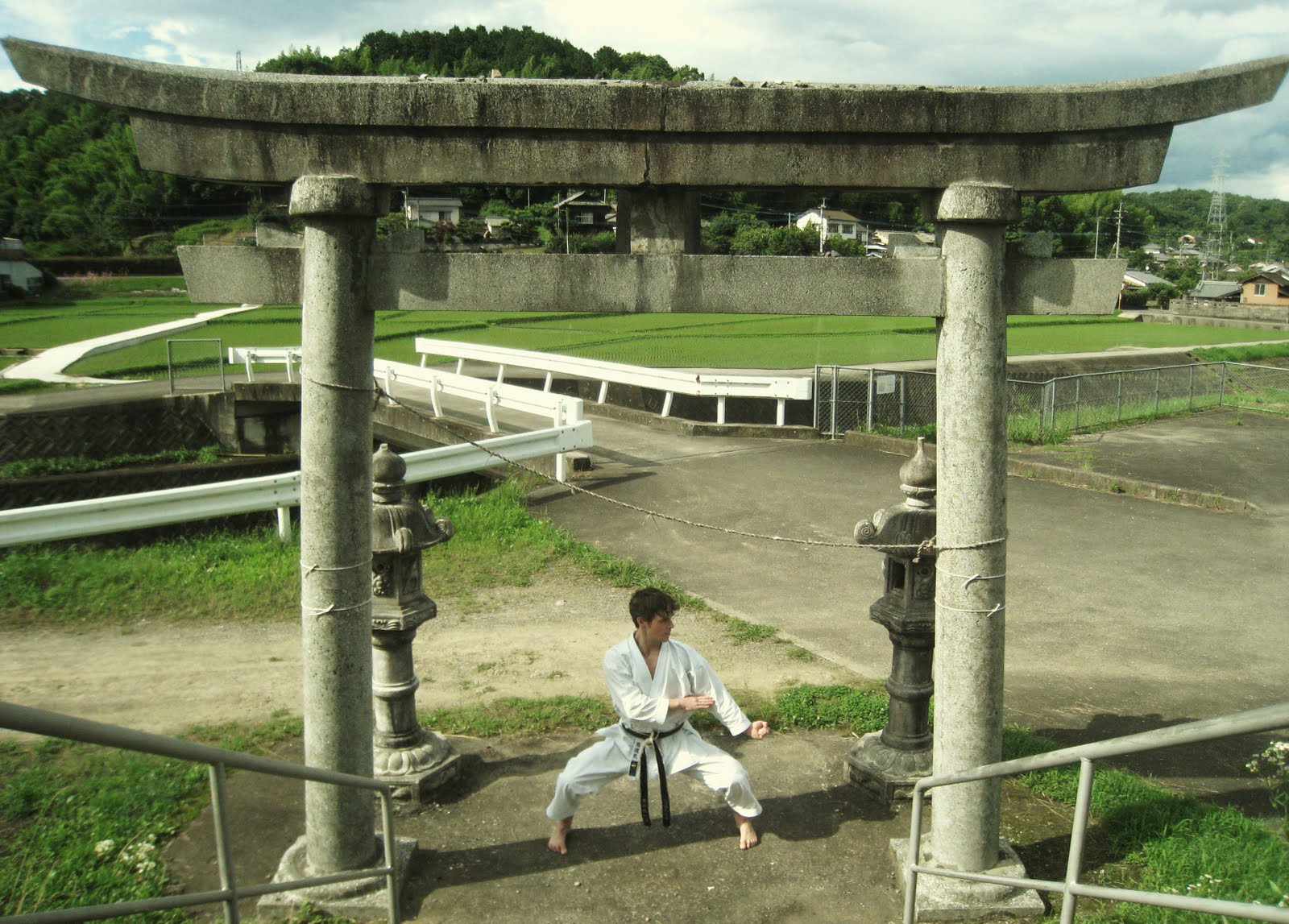
This site is based on my daily practice of Shotokan Karate-Do here in Oita City, Japan. More than anything else, unlike the majority of other karate websites, this page is primarily dedicated to Budo Karate training itself; that is, Karate-Do as a vehicle for holistic development.
Monday, 19 July 2010
Christchruch Shotokan Karate Club website
For more information please read my previous post.
Tuesday, 13 July 2010
KYU EXAMINATION CURRICULUM
Kihon: (1) Chudan oi zuki; (2) Jodan age uke; (3) Chudan soto uke; (4) Chudan uchi uke; (5) Gedan barai; (6) Chudan shuto uke (kokutsu dachi); (7) Chudan mae geri; (8) Jodan mae geri; (9) Yoko keage (kiba dachi); & (10) Yoko kekomi (kiba dachi).
Kata: (8 Kyu) Heian-shodan; (7 Kyu) Heian-nidan.
Gohon kumite: Jodan & chudan
6, 5, 4 Kyu – Midori obi
Kihon: (1) Chudan oi zuki; (2) Jodan age uke kara chudan gyaku zuki; (3) Chudan soto uke kara chudan gyaku zuki; (4) Chudan uchi uke kara chudan gyaku zuki; (5) Gedan barai kara chudan gyaku zuki; (6) Chudan shuto uke (kokutsu dachi) kara nukite; (7) Mae geri kara chudan oi zuki; (8) Mawashi geri; (9) Yoko keage (kiba dachi); & (10) Yoko kekomi (kiba dachi).
Kata: (6 Kyu) Heian-sandan; (5 Kyu) Heian-yondan + Junro-shodan; (4 Kyu) Heian-godan + Junro-nidan.
Kihon ippon kumite: (6 Kyu) Jodan , chudan & mae geri; (5 Kyu) Jodan,chudan, mae geri & yoko kekomi; & (4 Kyu) Jodan, chudan, mae geri, yoko kekomi & mawashi geri.
3, 2, 1 Kyu – Cha obi
Kihon: (1) Sanbon zuki; (2) Jodan age uke kara chudan gyaku zuki; (3) Chudan soto uke kara yori ashi (kiba dachi) yoko empi uchi; (4) Chudan uchi uke kara jodan kizami zuki soshite chudan gyaku zuki; (5) Tenshin gyaku zuki (Kaiten shinagara gedan barai kara chudan gyaku zuki); (6) Chudan shuto uke (kokutsu dachi) kara mae ashi mae geri soshite nukite; (7) Ren geri: Chudan mae geri kara jodan mae geri; (8) Mawashi geri kara gyaku zuki; (9) Ushiro geri; & (10) Yoko keage ashi o kaete yoko kekomi (kiba dachi).
Kata: (3 Kyu) Tekki-shodan + Junro-sandan; (2 Kyu) Sentei-gata* + izureka Heian gata matawa Tekki-shodan + Junro-yondan; (1 Kyu) Sentei-gata* + izureka Heian gata matawa Tekki-shodan + Junro-godan.
Jiyu ippon kumite: Jodan, chudan, mae geri, yoko kekomi, mawashi geri & ushiro geri.
_____________________________
Supplementary notes
1.0
© André Bertel. New Zealand, 2010.
Wednesday, 7 July 2010
Returning to New Zealand to support the Christchurch Shotokan Karate Club
The Christchurch Shotokan Karate Club has a long history with Asai Sensei from the Japan Karate Association days, right through to the present time: I would like to talk about this more here. It is the ONLY CLUB IN NEW ZEALAND with a history of "more than two years with Asai Sensei!" The club followed Asai Sensei since the original Japan Karate
Christchurch Shotokan Classes: The general classes of the Christchurch Shotokan Karate Club are held in the central city, in the gym of the in Christchurch Polytech Institute of Technology. These are held on Tuesday's and Thursday's starting at 6pm sharp. Daily advanced classes are also held, however these require application to attend. If you wish to contact me for private lessons, do so via my email: andrebertelono@gmail.com come to the dojo, train, and talk to me afterwards.
Monday, 28 June 2010
Why Karate?
_________
(4) Mental well-being: Karate combats psychological problems such as stress, anxiety and depression. By practicing karate, people’s self-esteem is greatly enhanced, and therefore they do better in their daily lives. Related to this is the fact that training also results in increased physical energy, enhanced concentration and better sleeping patterns.
________
(6) Lifetime activity: You can train all of your life in karate and keep physically improving yourself!” Compare this to say rugby, football, gymnastics and other physical activities. A great example of this is my late teacher Shuseki Shihan Tetsuhiko Asai, who reached his physical peak in his late 60’s!
_______
One word which comes to mind about Karate-Do is HARMONY. Karate as an activity is all about the harmony of physical movement, breathing and self-control of the mind. These elements can be used for the bettering of the individual, both physically and mentally, whilst perfecting a powerful martial art of self-defense. So I reply, to anyone who asks me “Why do you practice karate?” by politely asking “Why don’t you!?”
Thursday, 24 June 2010
Hangetsu, Jitte & Gankaku
Hangetsu (Half Moon): The original name of the kata is Seishan, however like many other kata, it was renamed by Funakoshi Sensei in mainland Nihongo to describe its footwork and techniques which are predominantly circular. Hangetsu masters the coordination of technique, leg movements and breathing, and has many excellent close range applications. One point, which Asai Sensei stressed, was that "The breathing in the Nihon Karate Kyokai (J.K.A) Hangetsu must not be audible like that of the Naha-te Sanchin, it must be deep and undetectable." On at least two occasions I saw Asai Sensei fail dan examinees as they used Goju-ryu styled 'ibuki' breathing. One of these times he said to the examinee in question "You... You are Darth Vadar". Needless to say, many people in attendance had trouble not laughing.
________
Jitte (Ten Hands): The name Jitte is often said to have come from the legend, that if done correctly, this kata has the strength of ten men. Asai Sensei said "the real meaning of Jitte is that there are ten practical fighting applications within this kata. But all of these use the body heavily but with the limbs light". Technically, of particular importance is the use of the hips to generate power with the torso as a single unit. Jitte is characterized by it boldness and is best suited 'application-wise' for a person who has a solid physique. The karateka who comes to mind, with a wonderful Jitte, is Imura Takenori Sensei of the Japan Karate Association.
_______
Gankaku (Crane on a rock): The original name of this kata was Chinto, apparently the name of master who created this formal exercise. Allegedly Funakoshi Sensei selected this name, as the sequences of standing balanced on one leg 'resemble a crane on a rock'. As Masatoshi Nakayama Sensei explained, the nucleus of this kata is the simultaneous use of uraken yokomawashi uchi and yoko keage, which is very useful for discovering "mixed use of snapping and thrusting techniques". Asai Tetsuhiko Sensei was infuriated by the changing of yoko keage to yoko kekomi (amongst many sports karate competitors). His belief was that the yoko keage in Gankaku was a refined/improved side kick from the original (which was a mae geri to the side, still found in many styles today). He explained that "the yoko keage means you kick the opponents testicals, who is next you without having to turn your body at all. The upward trajectory of yoko keage, and the distancing with this kick, means that uraken uchi can easily be used offensively or defensively."
______
Like all other advanced kata, Hangetsu, Jitte and Gankaku each require a life time to master. But clearly this life time of practice means more than an empty shell of precise movements and athleticism. As Asai Sensei stressed "Kata is for actual self-defense and must be studied for this, then drilled in kumite". This was the bujutsu (martial art) karate, which he dedicated his life to passing on. Today when we practiced these kata, I thought about the depth of these words, and remembered his renditions of each of them, move-for-move, and his no-nonsense bunkai/oyo-jutsu. I will keep all of these things in my mind and strive to perhaps one day get somewhere close. Regardless of whether I can do this, or not, it is a target which is inspirational. - OSU!
_____
© André Bertel, Japan (2010).
Saturday, 19 June 2010
The 3rd Anniversary of Andre Bertel's Karate-Do
________
"Dear Andre Sensei, the written content on your blog has been very useful for our training. Your blog is not only talk, as it is backed by the combination of photographs and video footage. It is the very best karate website on the Internet and your skill level truly reflects your in depth training under Shihan Asai. We hope that you continue to produce articles."
________
_______
_______
High humidity here in Japan
________
________
zanshin. The photograph here of 'correct distancing' (for kihon gyaku zuki) is demonstrated by my late karate teacher Tetsuhiko Asai. A crucial point, in actual application/self-defense, is that "the punch hits the vital point before the stance is landed". This ensures, that in addition to punching snap, that your body weight 'meets and goes through the target like breaking boards'. In the picture shown here, Asai Sensei is using the hikite in the traditional manner (to ensure the impact is "not lessened"). Both versions must be practiced daily to ensure they are natural. However, neither are compatible with modern karate-do, as they are not related to 'winning points'. Needless to say, this is a major different between standard Shotokan and Asai-ha Shotokan-ryu.________
KUMITE: Presently we are training Gohon kumite with free-choice ukewaza for example kakuto age uke, teisho yoko uke, kake shuto uke, gedan teisho barai and so forth. The attacks utlized include jodan and chudan oi-zuki; jodan shuto yokomawashi uchi; jodan and chudan gyaku zuki; and chudan mae geri. We are also practicing these techniques in sanchin dachi and shokutsu-dachi countering with close range 'ate-waza' (such as hiza-geri, empi-uchi, atama-uchi etc).
Friday, 18 June 2010
Visit to Yusentei Garden in Fukuoka
Rather than write in my own text, here is an official description of the Yusentei gardens and villa, from the Fukuoka-prefectural government. “Yusentei villa was originally built in in 1754 by Tsugutaka Kuroda, the sixth feudal (Samurai) lord of the Kuroda Clan. In 1980 Fukuoka City
__________
I’d like to thank Gen for the excellent photos, some of which are featured here. He is an excellent photographer, so you will easily be able to tell which photos he took (especially if you click on the pictures). Ironically Gen’s aunt is married to Kaicho Tadashi
__________
Gen and Momoka it is a great privilege to be friends you both. Mizuho and I really love you guys, and look forward to seeing you again soon. Domo arigato gozaimashita for another
_________
Friday, 11 June 2010
More video footage from my Asai-ha Shotokan-ryu clinics in Europe
Once again I'd like to thank Oliver Schomburg for kindly providing this footage. Domo arigato gozaimasu Oliver! I'd also like to thank Stefan Scharnweber Sensei (5th Dan) for hosting me to instruct at his dojo, which is based in central Hamburg. Stefan is an excellent karateka and great guy, as a result he has a really nice group of people practicing at his club! A big thanks and wishes to you all from Oita City, Japan. Osu, André.
_______
Click on the following link to watch the latest video:
http://www.youtube.com/watch?v=oBHfwT0n8I8
Also if you haven't seen the first Asai-ha Shotokan-ryu Karate video in Germany you can click here: http://www.youtube.com/watch?v=3LW-UgZECcY&feature=related
© André Bertel, Japan 2010.
Tuesday, 1 June 2010
Focusing on what really matters
______
_______
and fore mostly, "focus on what really matters", then everything else will fall into place. © André Bertel, Japan 2010.
.jpg)