This site is based on my daily practice of Shotokan Karate-Do here in Oita City, Japan. More than anything else, unlike the majority of other karate websites, this page is primarily dedicated to Budo Karate training itself; that is, Karate-Do as a vehicle for holistic development.
A few days ago ‘André Bertel’s Karate-Do’ exceeded one million visits. Needless to say, I think that’s a fair few people! I’d like to take this opportunity to thank everyone around the world that has supported me, since I started this website/blog.
There are many upcoming articles, projects and international seminars, so stay tuned!
Both videos from the seminars are now on youtube (updated today: 28 June, 2012). Please follow the links below. For those who participated I will briefly outline the two seminars here. By the way, if you are wondering why I'm doing kentsui/tetsui on the table, Abe Sensei was telling me 'why uchiwaza was his specialty'. If you get a chance to ask Abe Sensei about this, there is an interesting story (regarding kumite against Mikami Sensei in 1960s), which he was very keen to talk about. OK, on to the seminars!
DAY ONE: `ESSENTIAL KIHON’
On the first day Abe Sensei has us work on just a handful of fundamental techniques many times over. These were chudan oi-zuki, jodan oi-zuki, gyaku-zuki, kizami-zuki, age-uke and soto-uke. The focus was on repetitions and speed. Correct koshi no kaiten (full and smaller actions) and aiyumi-bashi were also extensively worked on.
A personal highlight for me was that Abe Sensei used a partner drill, to improve footwork, that I experienced him teaching at the JKA honbu-dojo (back in the 90s). Natsukashi desu ne! Using an obi your partner rigorously `assists you’ to get ‘the correct feel’ for lunging forward in zenkutsu-dachi. Whilst, there are many such drills, Abe Sensei’s version is a little different as he is looking for specific (very subtle) actions, which make his all the more challenging.
Needless to say, by the end of the session everyone was drenched, but also we learned some extremely ‘fine-tuned’ aspects of karate-do.
DAY TWO: JIYU-KUMITE, KATA, BUNKAI
Day two Abe Sensei briefly reviewed the first day’s practice, and then we transferred the skills to jiyu-kumite. This began with uchikomi training—kogeiki, then hangeki—all focused on achieving the traditional sense of an `ippon’.
After this practice we engaged in a few rounds of jiyu-kumite. Finally, Abe Sensei took us through Bassai-Sho Kata, which needless to say, he performed in Volume Nine of ‘Best Karate’. This was concluded with some bunkai to make sure our fundamental movements were correct.
Overall, the seminars were absolutely fantastic! DOMO ARIGATO GOZAIMASHITA ABE SENSEI!!!
I’ve been sent numerous emails asking for video links of my karate. While these links are not everything freely available on the internet, there are a significant number here. Irrespective of this, as I wrote in an article earlier this month “karate is a work in process”, so for me, these videos are naturally disappointing—Karate-Do is path of constantly moving forward—as Asai Tetsuhiko Sensei always said “today must be better than yesterday, and tomorrow better than today.”
In June when my workload at the University of Canterbury is a lower I promise to post a lot more. Nonetheless, I appreciate the hundreds of emails I receive each month, and apologise for not enough time to reply to everyone.
Osu, André Bertel
ANDRE BERTEL - ASAI HA SHOTOKAN-RYU KARATEDO VIDEO LINKS
A full list of videos I’ve uploaded on my channel:
Keigo Abe Sensei conduct two seminars in Christchurch on the 5th & 6th of May 2012.
This course will be OPEN for all karateka irrespective of style or association. For those wishing to attend please email me ASAP at:andrebertelono@gmail.com or call me on (021) 295-8669.
How can anyone who practices karate-do think they are “great”? It is impossible if one has an honest view of themselves. Irrespective of competitive wins, tenure, rank and other accolades, Karate-Do is always about “where to next?” Intrinsically, the Japanese concept of ‘Do’ (way or path) does not imply a destination, only a journey.
Like all things, I believe there must be a balance, harmony. We are innately weak, so we cannot always be magnifying our deficits—sometimes—when deserved, we need to acknowledge our improvements. Nevertheless, these little truck stops where we reach our goals are not places of growth, but a point where we “get reinvigorated and set our next goal”… This means that it is time to make a renewed plan to start walking again.
One of my weaknesses when I was younger was that I was far too hard on myself in the dojo, especially in my childhood and teens (probably why I didn’t like karate very much for many years). Looking back now, I can clearly see it was due to my immaturity and a perfectionist attitude, based on my ‘boyish pride’. While these things can obviously be used to channel motivation, they can also stump development as well… And at times for me, they certainly did. During my 20s I sometimes found myself wrestling with these issues, and by my early 30s, I came pretty much to the point I am now.
Now, my approach to karate now is far better because of ‘balance’ and ‘self-honesty’. The combination of these attributes motivates practice through `step-by-step’ technical improvement, the construction of constant challenges, and the occasional truck stop where long-term goals are reached; nevertheless, the contemplation of oneself being “great” can never be a part of this equation.Overall, the idea of ‘great’ to me is a dead end… Train well and enjoy your improvements, but the only thing, that is great in Karate-Do, is the thought of “Where to next with your practice?” That truly is great! Osu, André.
On Thursday night I enjoyed participating in one of HanshiRenzieHanham’s black belt classes (at the SeidoShibu on Barbadoes Street, in the Christchurch CBD). It was super to catch up with the Kyoshi Ellen Hampson and Sensei Tony Cope both of whom I haven’t seen in 20 years! Also, I was honoured to meet many other senior club instructors and fellow karateka. Many thanks to Kyoshi Harry for the ride and the beverages after class.
I can truly say that the karateka at Christchurch Seido exemplify the precept: “Karate-Do wareinihajimari, reiniowarukotowowasuruna” (Karate-Do begins and ends with courtesy). Overall, I would like to thank everyone at Seido for their kind hospitality. Domoarigatogozaimashita. Osu!
In addition to training in the general class at the Christchurch Shotokan Karate Club (CPIT dojo) here is the current instructors class training. Please note: the exception of the tokui-gata, which of course dependent on the individual.
I. Junbi-undo: Light jiyu-kumite progressively building in intensity and range of motion/lowering of the hips followed by dynamic stretches.
II. Stationary kihon: (1) Sanbon-zuki (hachinoji-dachi); (2) Hidari jodan kizami-zuki kara migi chudan gyaku-zuki; (3) Migi jodan kizami-zuki kara hidari chudan gyaku-zuki; (4) Hidari chudan maeashi mae-geri kara migi jodan mae-geri; & (5) Migi chudan maeashi mae-geri kara hidari jodan mae-geri. – 50 maximum speed repetitions of “1-3” for a total of 250 tsukiwaza and 30 repetitions of “4 & 5” for a total of 120 keriwaza.
III. Ido-kihon: (1) Sanbon-zuki; (2) Jodan age-uke kara mae-geri soshite chudan gyaku-zuki; (3) Chudan soto-uke kara yori-ashi (kiba-dachi) yoko empi-uchi, uraken yokomawashi uchi soshite chudan gyaku-zuki; (4) Chudan shuto-uke (kokutsu-dachi) kara mae-ashi mae-geri soshite nukite; (5) Chudan uchi-uke kara kizami-zuki soshite gyaku-zuki; (6) Tenshin gyaku-zuki (Kaiten-shinagara gedan-barai kara chudan gyaku-zuki); (7) Ren-geri: Chudan mae-ashi mae-geri kara mae-geri; (8) Chudan mae-ashi mawashi-geri kara mawashi-geri; (9) Ushiro-geri; & (10) Yoko-keage ashi o kaete yoko-kekomi (kiba-dachi). – A minimum of 10 reps of every technique with maximum speed.
IV. Kumite: (a) Jiyu ippon kumite (jodan, chudan, mae-geri, yoko-kekomi, mawashi-geri & ushiro-geri); & (b) Kaeshi ippon kumite (as per jiyu-ippon kumite attacks). – Changing partners at least three times for both forms of kumite.
V. Kata: Presently tokui-gata ‘Unsu’ and general training of the 15 shitei-gata (Heian, Tekki, Junro, Bassai-Dai, Kanku-Dai, Empi & Jion). – Generally speaking three kata are practiced each day (three times with regular speed and twice slowly).
VI. Calisthenics: Asai-ha Shotokan-ryu kihon taiso and the typical impact work. The sessions are concluded with isometric stretches and a variety of comprehensive warm downs.
Matthew Brew Sensei (3rd Dan) has returned the dojo after more than a decade in Tokyo.
We welcome him back to the club with open arms, and also his lovely wife Eiko, and son Luke (pictured next to him) and baby daughter Reona. Matt is now teaching Luke karate-do and has him in the beginners class at the Christchurch Shotokan Karate Club.
Matt was a member of our group (Asai JKA New Zealand in the 1990s) before joining the honbu-dojo in Japan, and has done private training under Shuseki-Shihan Tetsuhiko Asai (10th Dan) and Qi Gung under Mrs. Keiko Asai.
Needless to say, he has extensive knowledge of Asai-ha Shotokan-ryu. Overall, I'm personally thrilled to have him back, as is Christchurch Karate Club shibucho, Lyall Stone Sensei, and all of the members. Osu!
It doesn't take a rocket scientist to establish that many of the techniques, movements and positions in karate are clearly not directly transferable for self-defence; however, everything has a purpose and can be readily traced back to a critical aspect of combat. Clearly, such an obscure comment has little weight as "anything" could potentially be related. Nevertheless, this is where intention/focus of one's training comes in.
Whether practicing kihon, kata or kumite we must always think "What is this for?" then train it in accordance with the bigger picture of our target(s). Just "perfecting the moves" is certainly not enough to turn our karate into an effective self-defence system. Likewise, just practicing applications of the moves will not give us the physical prowess needed to apply 'martial arts'.
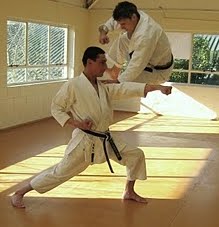
From this perspective, the classical stances and techniques (such as those depicted) can serve to either improve the body and range of motion, and specific principles/applications for self-defence, or set us up with more things we can't use in reality.
Hence,how we approach our training every time we enter the dojoor self-trainultimately determines the potential effectiveness of our karate. Unfortunately, most dojo do not adaquately address this issue, or only do so from a theoretical perspective, or in an inconsistently novel way. This drops the 'martial' and leaves karate as a merely a form of 'art'.
Shulman (2005) states that “Habit makes novelty tolerable and surprise sufferable. The well-masked habit shifts new learning into our zones of proximal development, transforming the impossible into merely difficult” (p. 56).
Greetings and salutations… A lot has happened since I returned from teaching the karate seminars in Europe so this is my first post in a while. Anyway, I thought the aforementioned quote from Lee Shulman would be some great food for thought.
Long overdue in text, here is my present daily training schedule:
Kihon: (1) Chudan oi-zuki; (2) Sambon-zuki; (3) Yoko-kekomi kara yoko-keage; (4) Yoko-keage ashi o kaete yoko-kekomi; (5) Mae-geri kara mawashi-geri; (6) Mae-geri kara yoko-kekomi, mawashi-geri soshite ushiro-geri; (7) Jodan age-uke kara chudan gyaku-zuki; (8) Chudan soto-uke kara chudan gyaku-zuki; (9) Chudan uchi-uke kara chudan gyaku-zuki; & (10) Chudan shuto-uke kara nukite.
Kata: Focus on one kata exclusively each day of the week: Joko issei, Joko-nisei, Joko-sansei, Joko-yonsei; Joko-gosei; Jion; & Unsu.
I wish you all the very best in your training and good health. Osu, André. PS – My next karate seminar will be hosted by the KUA (Karate Association of Australia) in June. For those attending, see you there!
Reference Shulman, L. S. (2005). Signature pedagogies in the professions. Daedalus, 134(3), 52-59.


.JPG)




 Shulman (2005) states that “Habit makes novelty tolerable and surprise sufferable. The well-masked habit shifts new learning into our zones of proximal development, transforming the impossible into merely difficult” (p. 56).