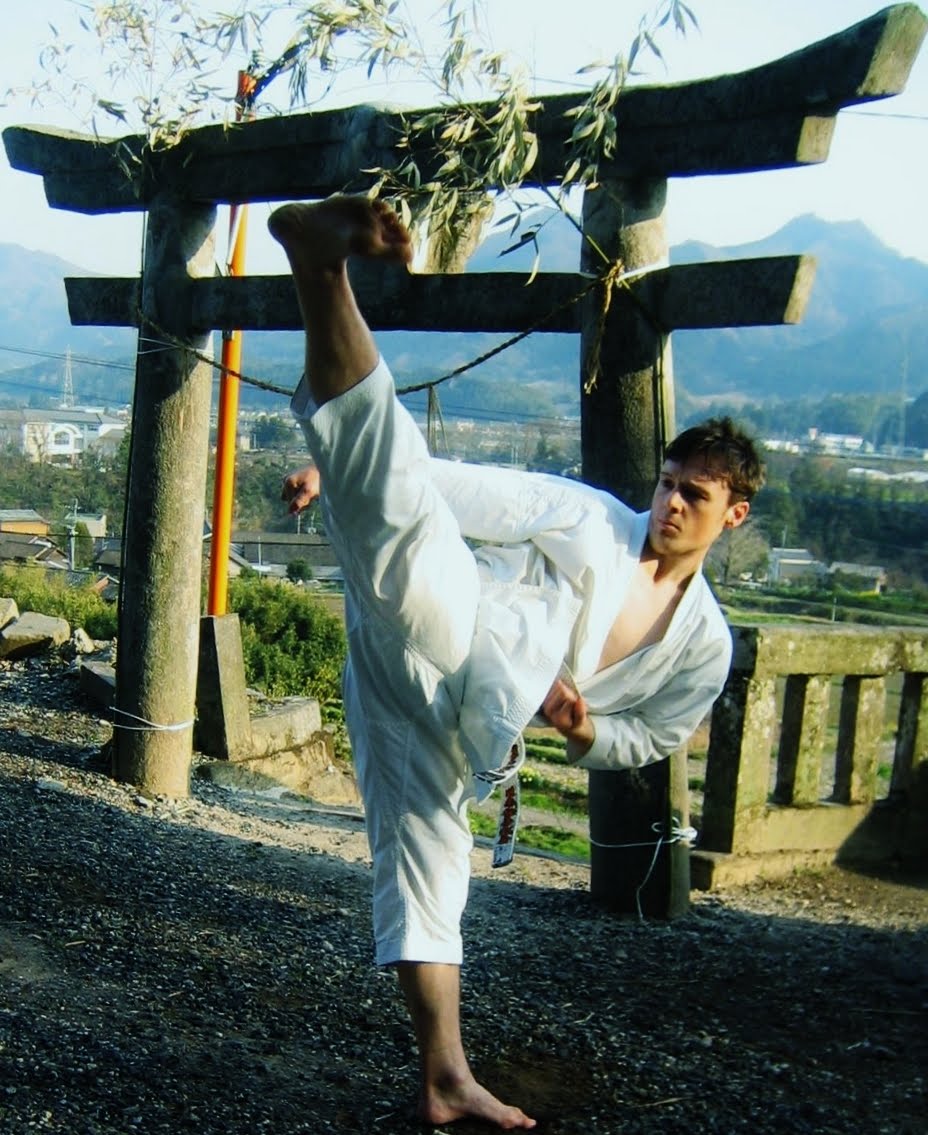
Wrapping up both Saturday and Sunday sessions with several hundred mae-geri and gyaku-zuki and I'm ready to blast into November! Practice, practice and more practice is certainly needed! I have some big targets before the end of the year; however, regardless of whether or not I achieve them, I will push my body, mind and spirit to the limit.
© André Bertel (2011). Christchurch, New Zealand.
Dedicated to the memory of Tetsuhiko Asai Sensei (10th Dan) the nucleus of this site is my personal focus on the Shotokan of the old JKA (Japan Karate Association) and the highly effective developments engineered by Asai Sensei. Following Sensei's example, this online resource will also include some of the innovations I've worked on as a Japan trained and internationally qualified instructor and examiner. Welcome, relax and please enjoy!
Sunday, 30 October 2011
TO THE LIMIT
Thursday, 27 October 2011
The difference between sports and traditional (martial arts) karate
(click here: http://andrebertel.blogspot.com/2011/03/real-kata-is-ruled-by-oyo.html). There have been numerous other articles in
Overall, unless one has a complete system of training, as explained above, their karate will never be optimally functional. This is what clearly establishes the difference between sports and traditional (martial arts) karate.
Wednesday, 26 October 2011
Kumite
Tuesday, 25 October 2011
Tokui-gata evaluation
© André Bertel (2011). Christchurch, New Zealand.
Monday, 24 October 2011
My seminar schedule for the next 12 months
- January 2012: FREE.

© André Bertel (2011). Christchurch, New Zealand
Sunday, 23 October 2011
Typical kihon-geiko
Perform each technique in 10 times slowly then 30-50 times with maximum snap whilst maintaining precise form. Please note: Although not included, it is customary to also practice other techniques here (i.e. - the various attacks with uraken, kentsui, shuto, empi/hiji, haito, yama-zuki, ushiromawashi-geri etc.). However, the following kihonwaza are most typical.
Shinzentai
1. Chudan choku-zuki
2. Jodan choku-zuki
3. Sanbon-zuki
4. Chudan oi-zuki
5. Jodan age-uke
6. Chudan soto-uke
7. Chudan uchi-uke
8. Gedan-barai
9. Chudan-shuto-uke
10. Mae-geri
11. Yoko-keage
12. Yoko-kekomi
13. Mawashi-geri
14. Ushiro-geri
Zenkutsu-dachi
15. Migi gyaku-zuki
16. Hidari gyaku-zuki
17. Hidari kizami-zuki kara migi chudan gyaku-zuki
18. Migi kizami-zuki kara hidari chudan gyaku-zuki
19. Migi mae-geri
20. Hidari mae-geri
Each technique should be executed at least four times in both directions slowly then repeated at full pace (at least the same amount of times). Again, without maintenance of exact form, training is counterproductive. Once more, please note that the following set is based on my current practice, naturally this changes; nevertheless, the formula is very standard i.e. - ren zuki, the basic ukewaza followed by hangeki, and keriwaza or ren geri.
1. Sanbon-zuki
2. Jodan age-uke kara chudan gyaku-zuki
3. Chudan soto-uke kara yoko empi-uchi, uraken soshite chudan gyaku-zuki
4. Chudan uchi-uke kara kizami-zuki soshite gyaku-zuki
5. Tenshin gyaku-zuki: Kaiten shinagara gedan-barai kara chudan gyaku-zuki
6. Chudan shuto-uke kara mae-ashi mae-geri soshite shihon nukite
7. Chudan mae-ashi mae-geri kara jodan mae-geri
8. Chudan mae-ashi mawashi-geri kara jodan mawashi-geri
9. Ushiro-geri kara uraken soshite chudan gyaku-zuki
10. Yoko-keage ashi o kaete yoko-kekomi
© André Bertel (2011). Christchurch, New Zealand.
Friday, 21 October 2011
The home of Shotokan in the South Island
Yesterday, merely high repetitions of stationary kizami-zuki kara gyaku-zuki and mae-geri (migi & hidari zenkutsu-dachi).
Besides being the home of Asai-ryu in New Zealand, the Christchurch Karate Club is truly unparalleled in the South Island, insofar as traditional Shotokan Karate is concerned. It is not the best Shotokan club in the South Island, it is the only one!


Saturday, 1 October 2011
TABOU NA MAINICHI

________
_________