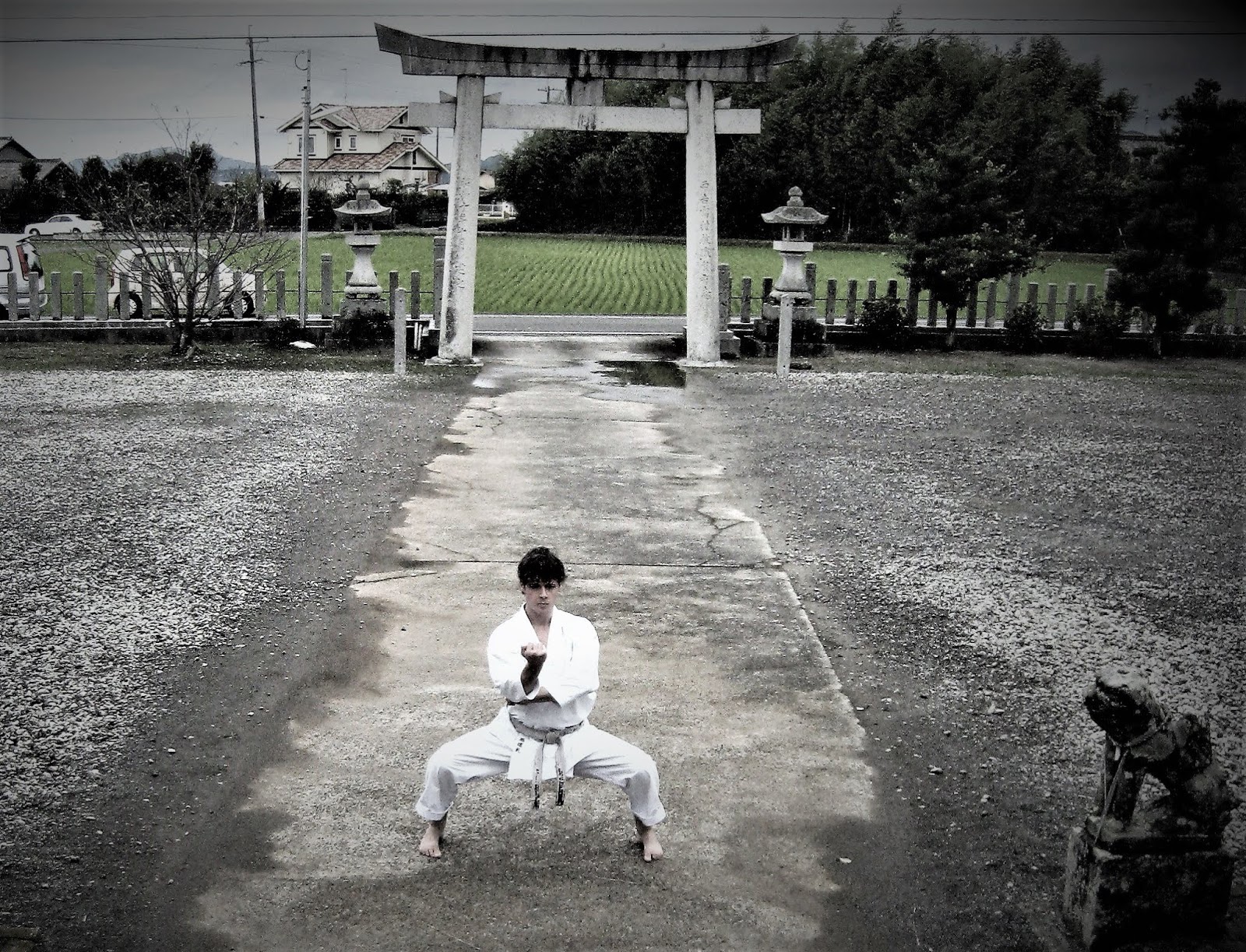
This site is based on my daily practice of Shōtōkan Karate-Dō here in Ōita City, Japan. More than anything else, unlike the majority of other karate websites, this page is primarily dedicated to Budō Karate training itself; that is, Karate-Dō as a vehicle for holistic development.
Punito Aisenpreis (Yondan) came for five days of private training in April. I was impressed to see that he has improved his core karate and further broken away from his sports karate movement.
A harmonious mix of Kihon, Kata and Kumite was covered including Kakuyoku Nidan and Rakuyo; Ido Kihon; and a generic coverage of proper Budo Kumite Training via the various forms of kumite. Overall, I feel that Punito's improvements reflect his efforts; furthermore, as a therapist and trainer he approaches his own karate practice in a holistic manner. With further physical understanding of Budo Karate, he will continue improving.
Lastly, rather than precisely detail about what was covered over those five days, here are a few images.
By request, here is a brief rundown on what I'm currently doing in my self training.
Kihon:
I’m
currently focused on the new Dan Examination Kihon. The focus of these
kihonwaza are not only for testing examinees but, actually to really increase
their skill level. This new approach and system is already causing positive
effects. Coming from an education background, I majored in education at the University of
Canterbury, I wanted the syllabus to primarily be a mechanism for martial arts
technical development and increased effectiveness: not just a set of
moves/combinations that one needs to pass tests. In sum, I want karateka to be
the best they can be, and the new kihon syllabus actively functions to do this (in the preparation for tests and throughout one's karate lifespan).
Kata:
I’m
currently going through all 65 of our official kata. Rather than exhaust you
with the details, yesterday was Junro Shodan (—I will possibly write more about this very soon), Bassai Dai, Gankaku, Chinte, and Raiko. Today was Junro Nidan, Hangetsu, Enpi, Bassai Sho and Nijushiho. My training focus, in all kata, is always
from my late Sensei’s advice; and accordingly, at present, mainly
‘technical/application—initiation’ is the top priority of my kata practice. Later in Halle, Deutschland this year, I
will unveil a higher level of karate from Sensei, and in 2020 and beyond, this
will expand further. Kata is at the soul of this process as it serves to
transmit critical martial arts knowledge from the past. That being said, kata is useless unless it directly enhances one's self-defence capacity.
Kumite:
Like
kata, I’m presently reviewing all the forms Kumite training. Decisively
understanding and properly all forms of Kumite training is imperative to
maximize training time. Today I worked on advanced Kihon ippon and Jiyu ippon
Kumite. These forms of training underpin the core 'basics' of maximum power
transfer—foundationally speaking. Kihon Ippon and Jiyu Ippon work together to achieve this target, therefore, are
essential elements of optimal karate training.
Away from this broad daytime practice, my current socho-geiko (morning training) is still, of course, ‘specializing’ (tokuiwaza, tokuigata etc...) as usual.
As promised, here is a video of 鶴翼初段 (Kakuyoku Shodan) kata performed slowly. This was filmed yesterday prior to my training. It is primarily for seminar attendees. I hope that this video helps you to review the key points covered and, consequently, results in your increased technical effectiveness.
Brief seminar video, as a very subtle reminder of key underlying key points I taught, during the Freital 2019 Seminar.
These points generically cover one of the dimensions imperative for street effective karate - irrespective of ryuha/kaiha; that is budo/bujutsu karate.
By the way, we'd like to hear feedback on the seminar!! Video comments are always very appreciated.
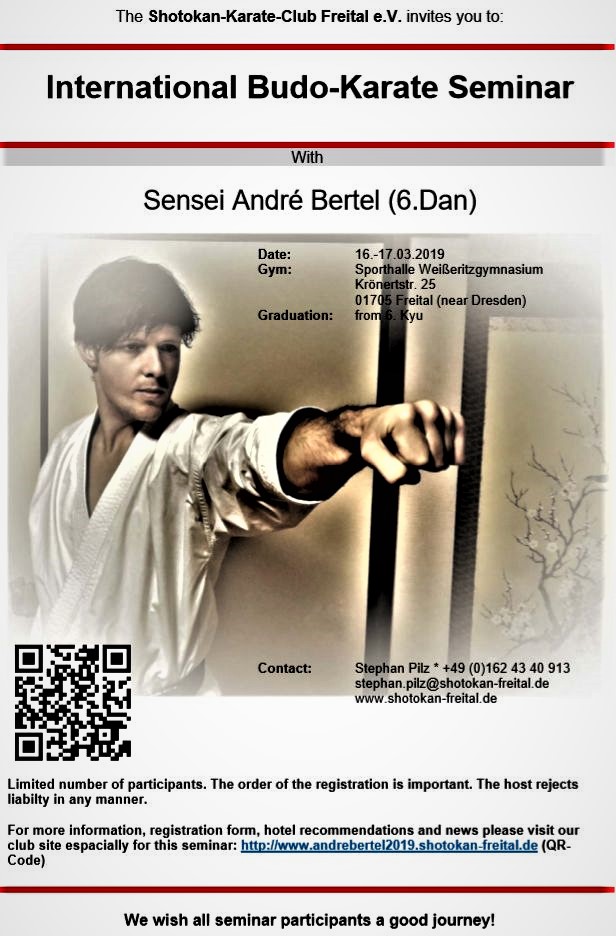
Here is the official report on the Freital Seminars—in
Deutsch—composed by Andy Nietzold Sensei, including the two official videos and numerous photographs.
Firstly, to the main organizer of the seminar and my host, Stephan Pilz Sensei (3rd Dan), also his lovely family, who took very good care of me.
Secondly, Andy Neitzold Sensei (2nd Dan), who also administrated the seminar; furthermore, translated, amongst other things.
Thirdly, Marco Herrmann Sensei (3rd Dan) who was the seminars MC).
Fourthly, the members and families of the Shotokan-Karateverein Freital e. V. club.
And fifthly, all of the karateka from across Europe whom attended.
A big "OSU" to you all from Oita City, Japan.
Andre
Official T Shirts from the 2019 Freital Seminar.
HOST DOJO PROFILE
Shotokan-Karateverein Freital e. V.
Founded
1984, current round about 90 members. Leading instructors Stephan Pilz Sandan,
Marco Herrmann Sandan. For those interesting in starting karate or finding a club in the Freital area here is their official website: www.shotokan-freital.de
Here is the fourth and final post on my recent seminars Karate Seminars in South Africa. Below the newpaper report are links to the first three parts. Osu, Andre
Finally here is some video footage from my
2019 South Africa International Seminar. Please note the video footage has been
cut in a way which allows the seminar participants to see key points
(hints/reminders), without revealing too much. Why? Because that knowledge is
for those who came and trained!
I must add that a couple of
important foundational points of Budo/BujutsuShotokan-style karate, are shown clearly;
nevertheless, again, without attending, these could still easily be taken out
of context and trained in a counterproductive manner. It elucidates the old
saying: 'Practice doesn't make perfect' but, rather, 'Perfect practise makes
perfect'.
Many people have asked me about commenting
on my videos. In sum, I really appreciate
comments as they confirm people's interest and, in turn, they really
encourage me to post new footage. Again, as stated above, the videos often reveal
things subtly (that is, only those who
have trained with me in person WILL UNDERSTAND). Moreover, as training
continues, deeper levels will be revealed to these karateka; thereby, resulting
in continuously increasing levels of technical skill and increased
effectiveness/application.
Lastly, I would again like to thank Gary GrapentinSensei and
Maureen deJagerSensei, and all
of the other instructors, and members, of USR (United ShotokanRyu). Indeed, I also extend this thanks to all
of the other wonderful people, who attended, from other karate groups. I have a
term 'Karate Family', which is what I believe all authentic traditional/budokarateka are.
For me personally, it was great not only
to teach karate outside Japan—which is always a great honour, but to also catch
up with old friends and forge new friendships as well. I am very positive that
this year’s seminar in South Africa will lead to an immense amount of technical
growth there – for those who practise what was covered.
In conclusion, I hope to see you all there
in South Africa again, in the near future, and/or here in Japan for training at
my dojo.
Kindest regards and all the very best from Oita. – Osu, André