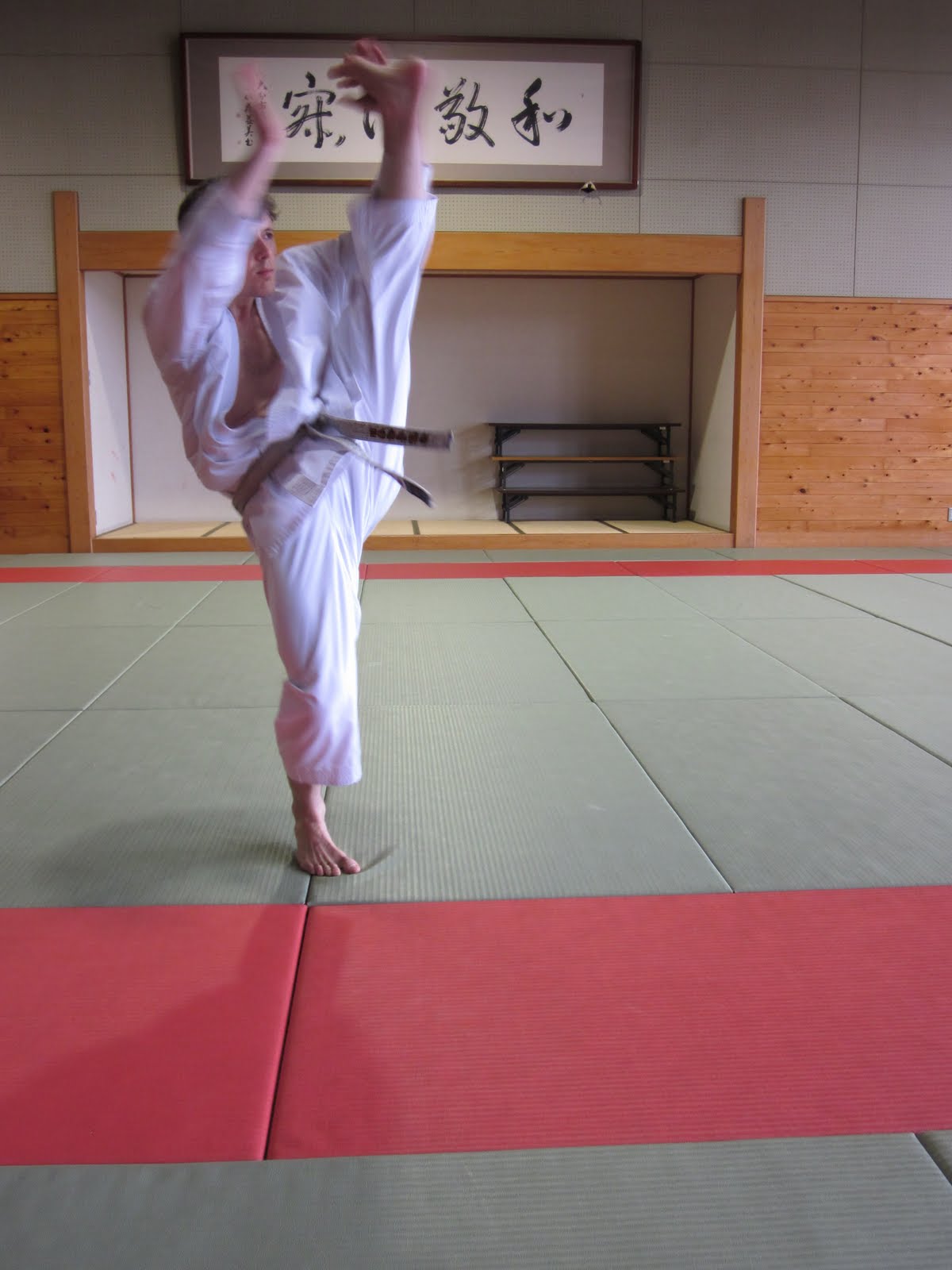
Thursday, 26 May 2011

Karate Maturitatem


The kata I'm now practicing extensively is Nijushiho, my late mentor Asai Tetsuhiko Sensei's Shotokan-ryu tokui-gata.

Below the pictures of my self-training today is a still of Asai Sensei at around 19 years old (circa 1954) from the old JKA- Japan Karate Association 8mm films. At this age he was apparently already assigned Nijushiho by Master Nakayama at Takushoku University. 52 years later, in 2006, he was still working on it! As I practice Nijushiho kata, a form which I've known for well over 20 years now, it is easy comprehend and openly say that I'm merely a beginner. This is reflected by my age, tenure, and most importantly my skill in my execution & application of this kata. Will I ever get a Nijushiho which comes close to Asai Sensei's? Most probably not, but I'll continue to try!


Whilst years of dedication are impressive, it is what one does with their time, which really matters. Asai Sensei not only studied karate for several decades, but clearly maximised his time to acutely perfect his craft.


Running a dojo is certainly not enough! Just as training for years and years, and training hard, is not enough. One must train correctly and be seriously challenged by other talented karateka daily. Otherwise time is wasted. The example of a mature kata, such as Nijushiho, & the benchmark of a karate master, such a Tetsuhiko Asai, supplements these prerequisites, providing a wonderful "elite example" to follow.


© André Bertel, Christchurch, New Zealand 2011.

Wednesday, 25 May 2011

KIHON IPPON KUMITE

Here are some basic notes on Kihon Ippon Kumite (Fundamental one-step sparring). I could write more, but thought I'd concentrate on issues which I find many karateka fail to do optimally and what Shuseki-Shihan Tetsuhiko Asai Sensei personally taught me. Intentionally I've not put photos of kihon ippon kumite here, but rather of kata. This is because Asai Sensei stressed that kihon ippon kumite is the first method of training where the more unique techniques, and variations of kata, can be applied. However before this practice can be useful the most raw form of kihon ippon kumite must be perfected. The notes here look at this most "basic" form and point towards the application of kata for actual self-defence training. To further simplify this article I've devided the article into two sections. (A) Notes for the ATTACKER; and (B) Notes for the DEFENDER. Osu, André Bertel.
_________


(A) Notes for the Attacker
1.
From shizentai (natural position) step back with the right leg into hidari zenkutsu-dachi (left front stance) with hidari gedan-barai (left lower level block). Simultaneously rotate the hips back into a proper `to the limit’ hanmi (half facing position). Announce “jodan” (indicating a prearranged ‘upper level’ attack). Note: when assuming hanmi naturally bend/contract the rear knee so that it is ‘under your hips’ and that the hips remain level.


2. Decisively attack with migi jodan oi-zuki (upper level chasing punch) advancing into migi zenkutsu-dachi (right front stance) thrusting and rotating the hips into shomen (the front facing/square on position). Note: Drive with the rear leg by thrusting the rear heel into the ground and making the leg straight (that is, “use your previously front leg which is deeply bent to propel your hips forward”).


A special point when attacking with oi-zuki is to perfectly coordinate the completion of the stance (i); punch (ii); hiki-te (iii); rotation and thrust of hips into shomen (iv); drive of the rear leg/supporting leg (v); and breath (vi) simultaneously. With experience alternatively practice the punch with the movement of the body and other variations for actual kumite (to autonomously perfect various applications of timing and body power).


Kiai sharply on the full extension of your techniques.


A final note I'd like to add about 'attacking' is that "without having correct distancing and targeting to really clobber your training partner you are mutually wasting time" . If you are doing Kihon ippon kumite with me and fail to block I will ALWAYS hit you. Why? Because I'm practicing my attacks. Please do the same, for yourself and your partner, as without an effective stimulus there is no need for a response. To summarise: THE ATTACKER IS THE MOST IMPORTANT PERSON. Please remember this!!!
B) Notes for the Defender
1. The defender waits in shizentai for the attack to come, then reacts `after it is launched’ even though it is prearranged (note: pre-emptive defence invalidates the drill). After the attack is on its way the defender drops their weight vertically whilst stepping back with the right leg into hidari zenkutsu-dachi. Concentrate more on dropping as opposed to stepping back so as to maintain an effective ma’ai (distance). Simultaneously twist the hips into a full hanmi – to the limit with hidari jodan age-uke (left upper level rising block). To counterattack thrust the rear leg straight rotating the hips back into shomen with migi gyaku-zuki (right reverse punch). Remember that that hips slightly precede the launch of the punch (so that the legs and waist are the main source of power). Remember: Traditional karate primarily utilises the kahanshin (lower body) as opposed to the johanshin (upper body).


The same applies for defences against chudan oi-zuki (middle level chasing punch), chudan mae-geri (middle level front snap kick), chudan yoko-kekomi (middle side thrust kick) and mawashi-geri (roundhouse kick). Note, the standard basic blocks against these techniques are as follows: 2. For chudan oi-zuki (defend with chudan soto-uke); 3. for chudan mae-geri (defend with gedan-barai); 4. for chudan yoko-kekomi (defend with chudan soto-uke); and 5. for mawashi-geri (defend with either chudan uchi-uke or jodan uchi-uke as appropriate).


• Kiai on all of your counterattacks.


LEFT & RIGHT!!!

ALWAYS PRACTICE BOTH RIGHT & LEFT ATTACKS FOR BALANCED TRAINING (BOTH ATTACKING & DEFENDING). – My `common sense’ advice in this regard is to practice one’s weaker side more... Whilst this is not rocket science, people usually fail to practice enough on their weaker side.


To conclude I hope that these notes assist you with your Kihon Ippon Kumite training! Obviously, I've just covered the very surface, but like everything, the initial points are what determine the effectiveness of the more advanced practice.


© André Bertel, Christchurch, New Zealand 2011.

Tuesday, 24 May 2011

Over 838,000 visitors to 'Andre Bertel's Karate-Do'

So far this blog has had over 800,000 visitors from all corners of the planet. Everyday I recieve kind messages from many people around the world. For example today alone, people from UK, Kenya, Iran, Russia, India, Norway, Greece, USA, Tahiti, Japan, Taiwan, China, Austria, France and Brazil have sent me letters.


Needless to say, it would be impossible to personally answer everyone, so I thought that I'd post a big thank you to all of the people who take time to contact me directly. Domo arigato gozaimasu - Thank you all very-very much!


PS - To maximise the resources on here you can check past articles from 2007, 2008, 2009, 2010 and earlier this year, and also access my youtube channel (http://www.youtube.com/user/andrebertel?feature=mhum - as a hint, be sure to scroll down the uploads and favourites, as there might be some things there that you haven't found before). And in regards to the videos, please make a comment! It is great to recieve these too, and sometimes they result in the production of new technical articles. Often questions which you may be asking will be already answered on here, and via use of the search engine you can access the information you're looking for.


Insofar as hosting me for Technical Seminars, please contact me directly at: andre.mizuho@hotmail.co.jp


Osu, André


© André Bertel, Christchurch, New Zealand 2011.

Friday, 20 May 2011

My current self-training regime

Here is my updated self-training schedule. If nothing else this can provide a base for you to construct your own daily routine. Especially in the case of instructors. An idea might be to use the search engine on this blog (you can check my previously posted regimes) and perhaps develop a superior schedule. Regardless, what matters is that one practices as much as possible, and does so via a systematic routine which produces results.


Kihon: The fundamentals for kihon ippon kumite and jiyu ippon kumite (attack, and defence/counterattack practiced seperately as kihon. Also special emphasis this month is on the relationship between Heian-shodan kata and Kihon ippon kumite, and how this transfers over to jiyu ippon kumite.


Kata: (a) Kihon-gata: Heian-shodan; (b) Sentei-gata: Bassai-dai; (c) Jokyu-gata: Nijushiho & Unsu. (d) Asai-ryu koten-gata: Kaminari-arashi with oyo. This month my oyo/bunkai-jutsu training is focused on Nijushiho kata.


Kumite: My kumite practice is twofold at present. Firstly: Kihon ippon kumite (Fundamental one-step sparring): Attacks, defences and counterattacks with/and against jodan oi-zuki, chudan oi-zuki, chudan mae-geri, chudan yoko-kekomi & chudan or jodan mawashi-geri. Emphasis is on basic form (stance, leg movments, use of hips, posture, precise form of technique, trajectory and zanshin), and exact ma'ai (distancing). And secondly: Jiyu ippon kumite (Freestyle one-step sparring) with specific focus on long-range attacking with full and proper application of koshi no kaiten, and harmonious tai no shinshuku.

© André Bertel. Kyushu, Japan 2011.

Thursday, 19 May 2011

A gap in my schedule

For those interested I am available to conduct seminars within the first three weeks of June. This opening in my schedule certainly does not need to be filled with travel and teaching courses, but this (when considering the disruptions we've had in 2011) is an extremely rare gap for me. It will be a case of first in first served, so if you are serious about hosting an Asai-ha Shotokan-ryu karatedo seminar or for personal training for you and your club members, please contact me in the next week or two.


My contact details are as follows:


TEL: +64 (21) 295-5600


© André Bertel. Christchurch, New Zealand (2011).

Wednesday, 18 May 2011

Hirokazu Kanazawa Kancho turns 80

Recently I was told that Hirokazu Kanazawa Kancho (10th Dan), who is the President, Founder and Chief Instructor of SHOTOKAN KARATE
INTERNATIONAL FEDERATION (S.K.I.F) celebrated his 80th Birthday.


We offer our deepest respect and congratulations to Kanazawa Kancho, & to our friends in the SKIF. Here are couple of classic pictures from 'Best Karate' of his exhibition match with my late teacher Asai Tetsuhiko Sensei. The bout was refereed by their mutual teacher, Masatoshi Nakayama Sensei.


© André Bertel. Christchurch, New Zealand (2011).

Mae-geri


Here are some notes on HOW TO DO THE BASIC SHOTOKAN KARATE MAE-GERI for total beginners. Keep in mind I've quickly written this up for my new karatedo students here in Christchurch in combination with my checking/correcting of their technique in class. Osu, André Bertel.


1. Assume gedan kakiwake-gamae in heisoku-dachi. The fists at used as `hip posture markers' diagonally at your sides (and should therefore remain set in position throughout your kick for self-analysis). Don't assume a free sparring type guard in this drill, but rather use it master the kick in isolation.


2. Raise the kicking legs knee high compressing your knee as tightly to hamstrings as possible. Imagine squeezing a lemon behind you knee. The ankle and toes are locked back towards your tibia anterior/shin as much as possible.


3. Snap the kick out to full extension and back identically to the previous position. The feeling should be that the hiki-ashi (withdrawal/pulling back of the leg/foot) is faster than the extension. Make sure to impact with the josokutei (the ball of the foot) - with the toes tightly pulled back. Keep the supporting leg heel down as much as possible and keep the hips "set". And imagine both of your legs turning into one long leg with energy travelling from the grounded foot right through to, and out of, the impacting foot. As a 'self-monitoring formula' keep the following still throughout your mae-geri: (A) the supporting foot/ankle & heel; (B) the fists/arms; & (C) the head.


4. Without delay rapidly return the kicking foot lightly to the floor into a precise heisoku-dachi.


SUPPLEMENTARY POINTS:


a. Many people question ""Why kick from a feet together position?" Answer: Simplification of trajectory (the straight line of the kicking leg is easy as the support leg can be easily used to monitor it. Utilize the heel of the kicking foot against the inside of the supporting leg just like `sliding the elbows' in punches). b. Mae-geri in Shotokan is typically a keage/keriage (snap kick literally `rising kick'). Always remember, in the most obvious terms, that the difference between the keage and kekomi (thrust kick) is whether the knee joint leads or follows the kicking limb. c. The concept of a rising kick can be confusing. Whilst the lower leg does rise the technique `goes in'. The impact is therefore extremely penetrating not merely a glancing upward action which is ineffective. d. Practice is completely useless without impact training. e. This most basic form of mae-geri practice (as described in text & photographically in this article) is ISOLATION TRAINING. It therefore remains useful throughout one's training in combination with the other core training methods (namely - 1. stationary mae-geri in zenkutsu-dachi; 2. oi geri - advancing in zenkutsu-dachi with mae-geri in ido-kihon practice by driving the support leg & thrusting the hips forward. This includes also 'transporting' the one's upper bodyweight into the target. 3. Renzokuwaza i.e. - rengeri etc).

_______


Final point: KNOWING HOW TO DO SOMETHING IS NOT MASTERING. Otherwise, once one could swing a golf club they would no longer need to practice. A rule of thumb which I learned visiting and living in Japan over the years was "less than 30 precise repetitions of a basic technique is time wasted." Hopefully this article, along with dojo-training, and some self-practice, will help you to master your mae-geri, and subsequently all of the other keriwaza (kicking techniques).


© André Bertel. Christchurch, New Zealand (2011).

Tuesday, 17 May 2011

Perfect practice makes perfect

Practice must be first and fore mostly based on perfecting the FOUNDATIONAL TECHNIQUES of Karate-Do. These `Kihon-waza' are like the foundation of a house with origins in the six basic kata, namely Heian-shodan to Tekki-shodan.
________


My mentor Tetsuhiko Asai Sensei (10th Dan) also gave us the five Junro kata which help us to further study the foundational techniques http://andrebertel.blogspot.com/2007/06/here-is-another-article-i-originally.htmloriginally.html. The standard Shotokan-ryu kihon-gata & Asai-ryu kihon-gata combined with Yakusoku-kumite if taught in the right way result in high level karate fundamentals.


Regardless of training, what matters is CORRECT PRACTICE & REPETITIONS OF CORRECT KARATE resulting in mastery of "the core basics". Many people say "there are no short cuts" but I prefer to say "do things right from the beginning and no time and effort is wasted". In karate this requires a good instructor, which is a rarity nowadays. I know of several people in existing Shotokan dojo here in Christchurch who are not satisfied by the low level of instruction that they are recieving. All of these individuals are welcome at my dojo TETSUBUKAN and the CPIT CITY DOJO run by Lyall Stone Sensei. However... They should be prepared to be corrected. Time wasting and passing on bad habits is not a part of the syllabus we teach.


© André Bertel. Christchurch, New Zealand (2011).

Monday, 16 May 2011

New Beginners Karate Classes in Christchurch


Back in New Zealand and the Christchurch Shotokan Karate Club is all go. This includes new adults/teenagers beginners classes (as pictured) which are being held at the CPIT Dojo on Tuesday's & Thursday's (6:00pm) and Monday's & Wednesday's at Shirley Boys High School Gym (7:30pm).


These classes are actually good for all grades as the training is very indepth focusing on the "CORE KIHON" (FUNDAMENTALS). For karate wanting to return to training, this month is a super time as these sessions will cover the nucleus of Asai-ha Shotokan Karate-do.


For more details please email me at: andre.mizuho@hotmail.co.jp


© André Bertel. Christchurch, New Zealand (2011).

Thursday, 12 May 2011

Karate EVOLUTION

The most influential instructors of the JKA (Japan Karate Association) Matsuno group, were as follows:


ASAI Shuseki Shihan, Yahara Fuku Shuseki-Shihan & YAMAGUCHI Shihan.


Also ABE SHIHAN & ISAKA SHIHAN.

Other instructors in Tokyo according to JKA Chief Instructor Asai Tetsuhiko Sensei were classed as “juniors”. Upon the loss of the Japan Supreme court case to the Nakahara group (Over the name of `JKA – Japan Karate Association’) in 1999, these instructors effectively split and formed their own organisations.

Chief Instructor Asai Tetsuhiko Sensei formed the JKS (& pre-empting that, his private “Asai karate” group IJKA); Yamaguchi Toru Sensei maintained his own dojo and developed a small group of followers; JKA Assistant Chief Instructor Yahara Mikio Sensei & Isaka formed the KWF; and Technical Director Abe Keigo Sensei formed the JSKA.

So why have I posted this? A political agenda. Of course not, nothing to be gained 12 years after our group lost the name JKA. My objective in posting this is just to provoke a quick thought on KARATE EVOLUTION… Who will you be with in 12 years? This further emphasises that all that matters is one’s training!

To conclude, a famous Japanese Sensei who I cannot name recently said to me “Mr. Andre, the reason you are still doing Asai Sensei’s karate is because you left”. OFTEN EVOLUTION IS UNPREDICTABLE but everything that survives improves.

© André Bertel. Christchurch, New Zealand (2011).

Tuesday, 10 May 2011

In transit at Changi Airport, Singapore

The trip back to Christchurch from Japan always means we transit at Changi Airport in Singapore.

_______


Waiting in transit gives me time to transfer my karate training notes to my laptop and produce some articles (to fill in the time). Anyway, here are just a couple of nice pictures Mizuho took at Changi of our aircraft, and one mid-flight from Fukuoka.


All the best, Andre.


© André Bertel (2011).

Monday, 9 May 2011

From Japan to Christchurch

After a month in Japan it is time to travel back to New Zealand. The training has been fantastic, and as always, I have a lot to share with the traditional karateka in Christchurch. Thanks to everyone for the kind messages since we've been away. - OSU! (Please note: To avoid confusion this post and some others have appeared late as I did not want to write them whilst in Japan through April and early May).

© André Bertel. Kyushu, Japan 2011.

Saturday, 7 May 2011

Karate master? Puppet? Good?

So you are GOOD AT KARATE? You are a `Karate Master'? Some people have said that I've made such claims, which is something I never have done. I once said "I am above shihan, I'm Gohan" but if you understand Japanese, you know this is an 'oyaji gag'.


A Master? No! I've been interviewed on TV in newspapers etc..., and all sorts of weird stuff has been written and said about me by reporters, including being labelled a `Master'. In saying that, everyday I try my best to perfect or `master' my karate.


A Puppet? Yes! A few times I was even been TOLD WHAT TO SAY. For example I was told once to say "kara-tee" instead of karate by a reporter, as what I was saying was "not English"... Need I say more... In the Asai Sensei interview on New Zealand National Television, almost everything I said was what Asai Sensei told me to say... If you understand the Japanese 'Senpai-kohai' relationship, you will understand this. In addition to this I've been completely misquoted several times in newspapers!


Good at Karate? That's my constant aim. My goal is to one day be 'good at karate'. In saying that I am not afraid to openly demonstrate my technique with all of its flaws. Slightly off topic... Some people have accused my uploading of karate pics & videos as being arrogant but thankfully most people appreciate them and find that they add integrity to my posts. Funnily enough the odd person that says such things you'll never see demonstrating anything online, and when you do...


I'd like to wrap up by saying that I try my best and have done so for a few decades. I don't claim to be `Good' or a `Master' in the martial arts. My experience, personal relationships with senior karateka (especially Asai Sensei), dan, competitive record, qualifications, times training in Japan, & even this blog are all a sideshow in comparison to what really matters. And WHAT REALLY MATTERS IS ONE'S OWN KARATEDO TECHNIQUE & EFFECTIVENESS. Let's talk with our skills through rigorous training and let the politicians continue acquiring their titles, ranks and authority through lame karate practice and lots of big mouthing.


© André Bertel. Kyushu, Japan 2011.

Friday, 6 May 2011

Korezo Karate-Do!

Karate-Do is 'The Way of the Empty Hand' implying that one must constantly empty themselves mentally to self-reflect. I believe that is an ongoing process, and as one develops, higher refinements are made. Many of the JKA (Japan Karate Association) instructors in their youth got into all sorts of trouble, but as they matured as people and karateka, they became better human beings. Asai Sensei told me " I used to love getting drunk and fighting"... I've heard the same thing from other masters also!!!

______


I used to enjoy drinking, the odd cigar and was happy to oblige trouble makers: Whilst I am by no means a 'karate master' as I've aged I've certainly mellowed down, especially in recent years. In saying that my determination to better my karate has remained fired up through daily keiko. When younger I had my share of scraps, and used to enjoy drinking and the odd cigar. Nowadays I rarely have any alcohol except at very special events, and never more than a glass or two. And I would never touch tabacco in any form. As far as fighting is concerned, before I didn't mind if someone had a go at me - I'd just deal with it as necessary, whereas now I'd be very disappointed if I had to resort to using my physical skills.


Asai Sensei at one seminar said "as you all grow older you will change, and if you don't you will stagnate as people". But he also said that "sometimes people need to experience certain things to get them out of their system".

_______


Regardless, the key is to keep 'mentally emptying' to optimally self-analyse. Applying this to training we can constantly improve, technically and as people... THIS IS KARATE-DO!
_______


© André Bertel. Kyushu, Japan 2011.

Thursday, 5 May 2011

Present from Higashihama Sensei & Mrs Higashihama


I'd like to deeply thank Higashihama Sensei & Mrs. Higashihama who last week gave me a very-very special gift.

_______


I was presented with a very high class male kimono, which I will certainly treasure for the rest of my life. Needless to say, Mizuho and I were blown away by this extremely kind gesture.

_______

Domo arigato gozaimasu!


© André Bertel. Kyushu, Japan 2011.

Wednesday, 4 May 2011

Karate the Japanese Way

Practice last week in Oita-shi was particularly focused on leg training. This was initiated each time by hillside run around the Shikido area. After this intense 10-20 minute "warm-up" lunges were performed numerous times to undeniably ensure that the legs were like jelly (and your mental focus was painfully on them).

_________

The rest of practice was kihon, kihon and more kihon, and attention was firstly on "using the legs to initiate power", then secondly, the hips and the abdomen. Kata and kumite was merely just an extension of this, which theoretically may seem normal, but rarely is outside of Nippon (in the most strict sense). Whether it's gyaku-zuki, driving backwards to defend in the first movement of Gankaku kata, leaping up for kesa-geri etc what matters most is legs, hips and hara (the hara also including kokyu/breathing).

________


The motto for the weeks training was "Don't learn by thinking". Rather "Make automatic by doing". This is Karate The Japanese Way.


© André Bertel. Kyushu, Japan 2011.