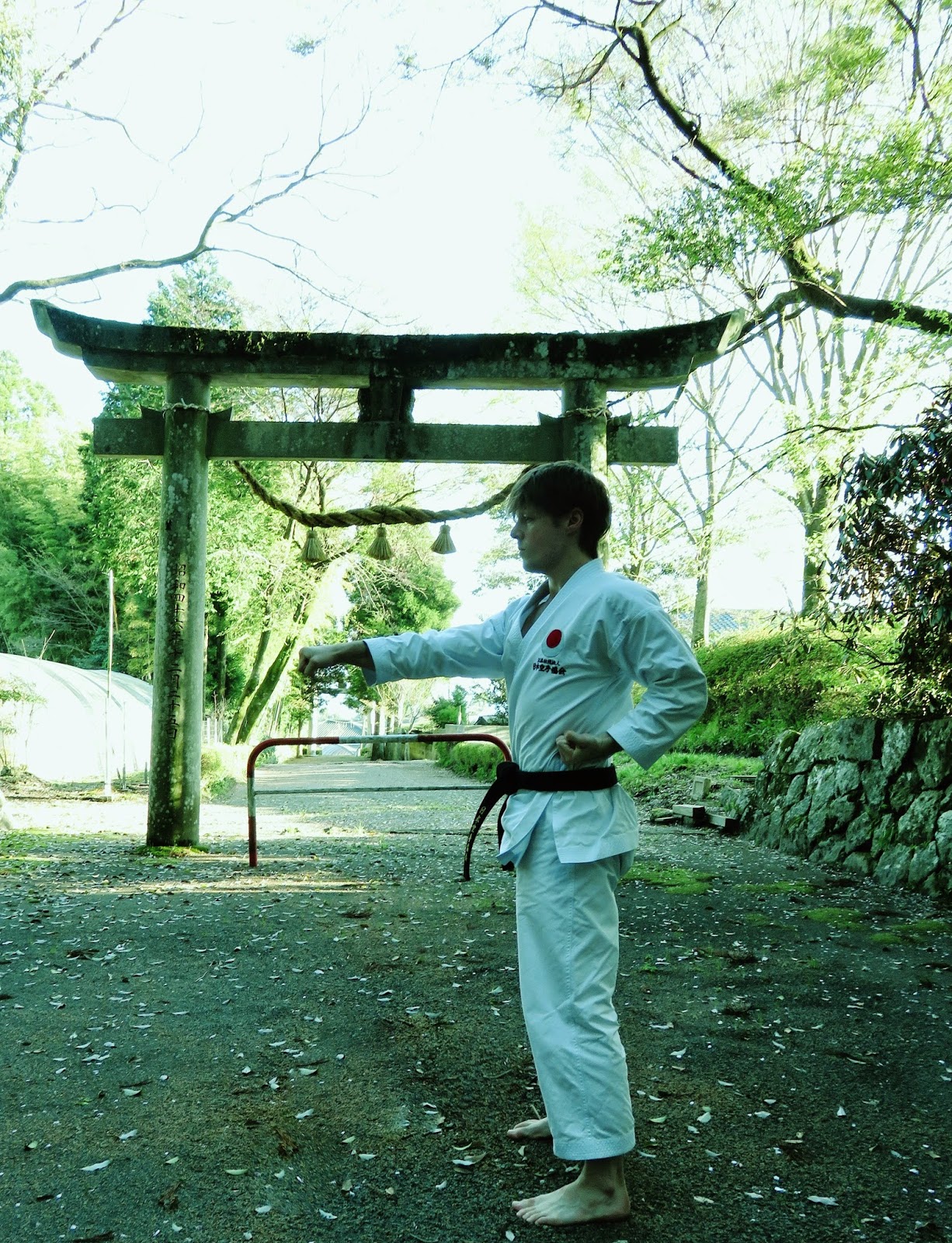
Monday, 26 May 2014

Unsu Kata: A generic outline


As you may well know from earlier posts, I recently switched back to Unsu (雲手) as my tokui-gata. This occurred for a variety of reasons, but the most predominant of these were: (a) advice from Nakamura Masamitsu Shihan; and (b) directly pertaining to the first point... that “…the techniques/applications of Unsu really suit my small frame: in a self-defence context”. Hence, today I thought I’d provide a broad outline of each technique in Unsu kata.

Whilst this, by no means, completely describes each of the movements featured in Unsu, it does clearly establish `what is completed in each count’ (and how each action in the kata is 'formally labelled' in Japanese, including the tachikata or stances).
All the very best from somewhere over the North Pacific, André.

A GENERIC OUTLINE OF UNSU KATA

REI: (Musubi dachi).

YOI: Ryoken taisoku namaeshita (Heisoku-dachi).

1.      Ryoteisho agomae kara ryoseiryuto ryokatayoko (Heisoku dachi).

2.      Ryokeito chudan haneageuke (Migi ashi mae neko ashi dachi).

3.      Migi gedan ippon nukite (Migi ashi mae neko ashi dachi).

4.      Hidari ashi mae neko ashi dachi.

5.      Hidari gedan ippon nukite (Hidari ashi mae neko ashi dachi).

6.      Migi ashi mae neko ashi dachi.

7.      Migi gedan ippon nukite (Migi ashi mae neko ashi dachi).

8.      Hidari tateshuto chudan uke (Hidari ashi mae fudo dachi).

9.      Migi chudan gyaku zuki (Hidari zenkutsu-dachi).

10.  Migi tateshuto chudan uke (Migi ashi mae fudo dachi).

11.  Hidari chudan gyaku zuki (Migi zenkutsu dachi).

12.  Hidari tateshuto chudan uke (Hidari ashi mae fudo dachi).

13.  Migi chudan gyaku zuki (Hidari zenkutsu-dachi).

14.  Migi tateshuto chudan uke (Migi ashi mae fudo dachi).

15.  Hidari chudan gyaku zuki (Migi zenkutsu dachi).

16.  Hidari chudan mawashi geri (Migi naname mae fuse).

17.  Migi chudan mawashi geri (Hidari naname mae fuse).

18.  Ryoseiryuto ryokata yoko (Kiba dachi).

19.  Hidari keito chudan kakeuke doji ni migi teisho koho gedanuke (Hidari zenkutsu dachi).

20.  Migi keito chudan kakeuke doji ni hidari teisho koho gedanuke (Migi zenkutsu dachi).

21.  Hidari haito jodan sotomawashi uchi (Migi zenkutsu dachi).

22.  Hidari jodan mae keage (Migi ashi dachi).

23.  Migi jodan soto uke (Migi ashi dachi).

24.  Saken chudan zuki (Migi zenkutsu dachi).

25.  Migi haito jodan sotomawashi uchi (Hidari zenkutsu dachi).

26.  Migi jodan mae keage (Hidari ashi dachi).

27.  Hidari jodan soto uke (Hidari ashi dachi).

28.  Uken chudan zuki (Hidari zenkutsu dachi).

29.  Ryoken taisoku namaeshita kamae (Heisoku-dachi).

30.  Migite jodan kensei doji ni hidarite gedan kamae.

31.  Uken gedan zuki (Migi zenkutsu dachi).

32.  Saken gedan ukezuki (Hidari zenkutsu dachi).

33.  Uken gedan ukezuki (Migi zenkutsu dachi).

34.  Hidari tateshuto chudan uke (Hidari ashi mae fudo dachi).

35.  Migi teisho hidari teisho uchi (Hidari zenkutsu dachi).

36.  Migi kakato gedan kekomi (Hidari ashi dachi). – KIAI

37.  Saken chudan zuki.

38.  Uken chudan zuki (Migi zenkutsu dachi).

39.  Migi sokumen migi gedan barai (Kiba dachi).

40.  Hidari haito hidari sokumen jodan yoko uke (Kiba dachi).

41.  Hidari shuto sokumen gedan barai (Kiba dachi)

42.  Migi haito hidari sokumen jodan yoko uke (Kiba dachi).

43.  Saken migi sokumen chudanzuki (Kiba dachi).

44.  Hidari tateshuto chudan uke (Hidari ashi mae fudo dachi) kara migi chudan mikazuki geri sasho ate (Hidari ashi dachi) soshite hidari kakato ushiro kekomi (Migi ashi zenkutsu—udetate).

45.  Hidari tekubi makiotoshi doji ni migi teisho migikatamae kara hidari teisho gedanzuki doji ni migi teisho jodanzuki (Hidari ashi mae ashi mae sanchin dachi).

46.  Migi tekubi makiotoshi doji ni hidari teisho hidarikatamae kara migi teisho gedanzuki doji ni hidari teisho jodanzuki (Migi ashi mae ashi mae sanchin dachi).

47.  Hidari jodan age uke (Hidari ashi mae fudo dachi).

48.  Migi chudan gyaku zuki (Hidari zenkutsu dachi). – KIAI

NAORE: Ryoken taisoku namaeshita (Heisoku-dachi).

REI: (Musubi dachi).
 © André Bertel. Aso-shi, Kumamoto. Japan (2014).

Saturday, 24 May 2014

Special Class in San Francisco California: JKA NORCAL

On Wednesday, May 21st, I taught a class exclusively for the members of JKA Northern California (http://www.jkanorcal.org/) in San Francisco. The class eventuated through the correspondence of Khim Torres Sensei (JKA 5th Dan), who is the current JKA-AF (Japan Karate Association American Federation/日本空手協会アメリカ連盟) silver medallist in both kata and kumite. Firstly I will begin by giving a profile of Khim Sensei; secondly, I’ll provide details about JKA Norcal for perspective members; and thirdly, outline my class, and wrap up with some conclusive remarks. Before I begin, I’d like to offer special thanks to JKA Norcal club administrator, Christina Foo Sensei (JKA 5th Dan), for her assistance.
Khim Torres Sensei (JKA 5th Dan)


Instructor Profile: “Khim Torres Sensei (Godan) is leading the effort to promote and inspire Shotokan karate in the San Francisco Bay Area. He is chief instructor of JKA Northern California (JKA NorCal) – a non-profit dojo, part of JKA American Federation (JKA/AF) under the guidance of Takayuki Mikami Sensei. Khim is a JKA qualified instructor (B), judge (B) and examiner (C). He comes from a 3-generation karate family – trained at the tender age of four with his father Ruperto Torres Sensei (JKA Philippines, Luzon Director) and now instructs his sons Rosh and Yuki. Khim has a degree in Psychology and worked as a Health, Music and Physical Education teacher before migrating to the US in 2002 as a full-time karate instructor. In 2009, Khim with a few fellow karate-kas started the non-profit dojo operating out of Prime Time Athletic Club in Burlingame, California. JKA NorCal began by providing instruction for the health club’s kids/beginner adult karate program. JKA NorCal augments the program with additional advanced classes that provide a curriculum to train 6 days a week for JKA members. JKA NorCal is active competing and training in local and international karate events. An accomplished and experienced competitor himself, Khim has been on the Philippines team and now is a core member of the US National team since 2006. He will be competing at the upcoming 2014 Funakoshi Gichin World Championships in Tokyo…”
 
 My class at JKA Northern California…
While I won’t go into specific details, essentially I taught the core principles needed to maximise human power via kihon, partner drills, and exercises; in particular the four foundational `technical themes’ of budo karate: (1) chushin and shisei (the centreline and posture); (2) koshi no kaiten (the rotation of the hips—“horizontal power”); (3) tai no shinshuku (the contraction and expansion of the body—“vertical power”); (4) Junansei (softness—for “snap”); and (5) the coordination of all of these for maximum effect. While it was a session based on strengthening`the foundations of Shotokan-ryu karatedo’, I really hope that all of the attendees still gained something from it. Overall, my aim—rather than doing ‘something elaborate`—was to impart introductory points (and taiso/exercises), which result in the long-term technical development (and of course, `base strength’/`explosiveness’).

 
I only wish I had more time to work on some more interesting things and that I wasn’t so unwell, coughing and trying to get my breath… The inherent dangers of air travel! Nonetheless, who knows what the future holds? Whether in Japan, the United States or elsewhere, I look forward to meeting Khim Sensei, Christina Sensei and my new friends at the JKA Northern California again.

 
Looking for a karate club in the San Francisco Bay Area? For anyone wishing to begin or practice karate in the San Francisco Bay Area, I highly recommend that they go to JKA Northern California. Besides accessing Khim Sensei’s training, and having a great bunch of people to train with, the club is fully affiliated to the Japan Karate Association. For all contact details and information, please go to their website: http://www.jkanorcal.org/
Card from the JKA Northern California Dojo.
I’d like to wrap up by reiterating that the chief instructor of JKA Northern California, Khim Torres Sensei, is not only a world class karate technician, but an excellent karate teacher, and wonderful person. On the whole, I was very happy to see that authentic traditional Japanese karate-do—through Khim Sensei’s dojo—will have a bright future in San Francisco Bay area. Osu, André.
 
© André Bertel. Aso-shi, Kumamoto. Japan (2014).

Wednesday, 7 May 2014

Dealing with differences

A major issue, that seems to always disturb karateka (practitioners of karate-do), is `the differences between the teachings of prominent instructors’. `Instructor A’ might say a technique “must be done this way”; yet, `Instructor B’ will emphatically claim that “Instructor A’s way is totally incorrect”. People always ask me, “What should I do when this happens?” So I thought I’d share my approach to this “problem” with you today.
My solution is very simple… Firstly, when you train in someone else’s class, or a seminar, do your techniques `their way’ during the session (this is my personal rule)… After the class, note the variations. Whether you like these variations or not, test them out (technically and in application i.e. in oyo-kumite, jiyu-kumite, on the makiwara, etcetera). Last, but not least, record them in a `training diary’ of some sort. In this way, positive or negative, you will still benefit from the experience via a different perspective/understanding.
Secondly, don’t get frustrated when `a different way of doing things confuses you’ or severely `tests your physical coordination’. Rather, embrace the challenge, and try to adapt to the variations as quickly as possible (during the class/as you learn them). Certainly, such occasions present an opportunity to test your ‘physical adaptability’ and `smarts’ in general. Despite that, I am not necessarily meaning that you `take on’ these variations…
 
 Conclusive comments: A word of advice… Be careful what you graft into your karate-do, especially when it comes to your kihon; moreover, physically question and test everything you learn. Most of all “Learn by doing”: as opposed to thinking too much. With diligent practice of traditional Japanese Budo Karate, personal inquisition, and the right tuition, the answers will come.
© André Bertel. Aso-shi. Kumamoto-ken, Japan (2014).

Thursday, 1 May 2014

A return to Unsu Kata

Demonstrating Unsu kata in front of my instructor, Nakamura Masamitsu Shihan.
 
  I have finally decided to exchange Nijushiho kata with Unsu (雲手) in my free-kata practice. While the time concentrating on Nijushiho was certainly productive, I found that I couldn’t maximise my karate-do with it. As I’ve said, over and over again, I find Nijushiho to be an extreme challenge for my body-type, and personal attributes. Again, as stated earlier, this is why I took it on (in addition to its highly effective oyo/applications).
 
 
So why a change back to Unsu? I suddenly felt the need to `athletically push myself’ a little more. Also, an amalgamation of coaching tips from Nakamura Shihan helped me to reconsider Unsu; in particular, his points on HOKOTENKAN (changes of direction). Another motivation, like Nijushiho, are the combative applications in this kata. They really suit me well due to my small frame. I weigh a mere 73kg (160lbs) and am only 174cm tall.

Lots of work: In a sense, returning to Unsu has put me back to square one… However, the essence of it all, as always, is kihon (the foundational techniques of karate-do).  

Imbalanced focus on the jump—an introspective into `budo karate kihon’: One thing I always laugh at is how a lot of people single-mindedly focus on the jump in Unsu. Yes, it is important, but a good Unsu—like all other “well executed kata”—has excellent kihon. Give an Olympic gymnast the Unsu jump and they will have a sky high one, with perfect form, after one fleeting glance. Ironically, they won’t be able to do movement 47 and 48 (jodan age-uke kara chudan gyaku-zuki) so easily… Yes, they will need years (even though we as karateka learn these as white belts). Once again, this brings back the point the point of ‘budo verses sports’ or ‘mere aesthetics verses practical application’. Karate-do is not physically about `doing moves’, it is about being able to turn the body into an effective weapon of self-defence: this takes intensive training.
Taken as a whole, the shift back to Unsu has really refreshed my karate-do training. I look forward to testing it out, under the pressure of competition, in late May (at the JKA Kyushu Senior Championship). While that is far too soon—to get my Unsu to the level I want it to be at—it will hopefully help in this process.
© André Bertel. Aso-shi, Kumamoto, Japan (2014).

Saturday, 26 April 2014

From Switzerland to Japan

Christa after a lesson at my private dojo.
 Our good friend Christa Lehman from Switzerland came to Aso-shi for training and to catch up. Christa has been to Japan many times to seriously study karate-do and kobudo; furthermore, she has also come to Japan for private training with me in the past. I think her example really shows a person who is not only committed to their training, but is also willing to put themselves on the line; that is, “learn by being a challenger”.

Christa has trained with me at my full time dojo in New Zealand around 10 years ago, also when I lived in Oita-ken in 2008 (click here: http://andrebertel.blogspot.jp/2008/07/christa-visits-japan.html), and at some of the international seminars I’ve taught (twice in New Zealand; twice in Northern Germany; and once in England).

In 2005 she competed in the New Zealand Karate-Do Championships as a member of my dojo (the Christchurch Traditional Karate Team). At that tournament she placed in the women’s individual individual kumite. In 2011, she won a world kobudo championship title in Okinawa. Away from karate, Christa even attended Mizuho and my wedding in 2006!
What is so great about Christa, besides being a great person, is that she doesn’t practice budo for competition; rather, she is seeking the tradition of Japanese martial arts and simply focuses on “improving herself through culminated practice”. Moreover, she is willing to go out of her way to access top-level traditional training. This, to me, sums up the essence of karate-do training and budo in general.

Training: Our training focused on the contrast between linear and circular techniques at an extreme, and `winding up’ (essentially `tai no shinshuku’) without any unnecessary action(s). This also included basic stepping in both zenkutsu-dachi and kokutsu-dachi; however, I primarily had Christa focus on choku-zuki, gyaku-zuki and shuto-uke. We then moved on to Unsu kata, which I broken down into very small sections: to further practice the aforementioned focal points. We also practiced important oyo (applications) from Unsu, Enpi and Gankaku.
It was great seeing Christa’s movement really improve via the moderation of her koshi no kaiten (hip rotation) and cutting superfluous extra hand/arm movements out of her kata. The result was a much more strong, balanced, and `Japanese style’ kata. In particular, her improvement in the final sequence of Enpi was nice to see. By and large, kata performed in this way generates optimal movement for goshin-jutsu (self-defence). This vividly reflects the maximum that kihon, kata and kumite are one: the “trinity of karate-do”.

Christa’s also trained with Nakamura Shihan and Nakamura Sensei in Kumamoto City. I’d like to end by saying that it was an honour for me that Christa came to visit and train here in Aso-shi. Domo arigato gozaimashita Christa. Safe travels!!! Osu, André.
Training at JKA Kumamoto. Nakamura Sensei on the far right (standing). A great person and his class is always fantastic!

© André Bertel. Aso-shi, Kumamoto. Japan (2014).

Tuesday, 15 April 2014

Back to white belt

Tekki Shodan Kata.
Here’s my latest daily self-training routine. I hope it finds you well. Osu, André Bertel.

KIHON
(A)  Stationary practice: 1. Chudan choku-zuki (shizentai or kiba-dachi); 2. Chudan gyaku-zuki (stationary punching in both hidari and migi zenkutsu-dachi); and 3. Chudan mae-geri (stationary kicking following the format of gyaku-zuki practice or from heisoku-dachi).

(B)   Ido-kihon: 1. Kizami-zuki (jiyu-dachi) kara sanbon ren-zuki; 2. Jodan age-uke kara chudan soto-uke soshite chudan gyaku-zuki (blocking with the same arm); 3. Chudan uchi-uke (kokutsu-dachi) kara kizami-zuki soshite chudan gyaku-zuki; 4. Chudan shuto-uke (kokutsu-dachi) kara nukite; 5. Chudan shuto-uke (kokutsu-dachi) kara kizami mae-geri soshite nukite; 6. Mae-geri kara yoko kekomi, mawashi-geri soshite chudan gyaku-zuki; 7. Chudan mae-geri kara yoko-kekomi soshite chudan gyaku-zuki (kicking with the same leg); and 8. Yoko-keage ashi o kaete yoko-kekomi (kiba-dachi).

·         Repetitions: At present I am working with considerably lower repetitions in my kihon practice. Typically, this includes ‘one warm-up set of 10 slow repetitions’ followed by `30 explosive repetitions’.
Chudan choku-zuki.
KATA

Moving on from Nijushiho: After several months of focusing on Nijushiho, and extracting numerous technical gems, I have finally decided to move on to another jiyu-gata (free-choice kata). As I have said before, this formal exercise has been “extremely challenging” for me (and, consequently, very hard to maximise my strengths). This, in turn, has forced me to face my many weaknesses and better understand ‘my bodily limitations’. In sum, I believe my time focusing on Nijushiho has been very valuable and will undoubtedly contribute towards my next phase of development
My kata training updated: Probably, needless to say, the shitei-gata (Heian and Tekki Shodan) and sentei-gata (Bassai Dai, Kanku Dai, Enpi and Jion) remain as the foundation of my kata practice. The new jiyu-gata I am focusing on are Bassai Sho and Unsu.

·         Repetitions: A minimum of three for each kata; however, depending on the session, I sometimes only work on two or three kata from this list and do them many times.
 
Tekki Nidan... A occasional "treat" is good!
KUMITE

My focus at present is back on Gohon Kumite (Five-step sparring), Kihon Ippon Kumite (Fundamental one-step sparring) and Jiyu Ippon Kumite (Free one-step sparring). In particular, I’m concentrating on: (a) shisei (posture) in attack, defence and counterattack; (b) kokyu (breathing); and (c)  tachikata (stance)—namely, “more subtle transitional actions”. Technique-wise all of these points are primarily relating to jodan and chudan jun-zuki (oi-zuki), jodan and chudan gyaku-zuki, chudan mae-geri, chudan yoko-kekomi, chudan mawashi-geri, jodan age-uke, chudan soto-uke, gedan-barai, shizentai (hachinoji-dachi) and zenkutsu-dachi (shomen/zenmi and hanmi).
On the whole, this really is the beginning of a new phase of training for me. As always, and as it always should be, it’s back to white belt.

© André Bertel. Aso-shi, Kumamoto. Japan (2014).

Friday, 11 April 2014

"Holistic Control"

Tobi mae-geri
 As I have always said, quantity is never a substitute for quality when it comes to technical karate-do practice; in particular, and most obviously, in kihon-geiko. However, quantity does count when top quality form is maintained. Now, here’s the problem…  If you are anything like me, maintaining high quality form is very difficult when high repetitions are executed—especially when exhaustion sets in. Moreover, “the injury issue” also becomes a significant concern i.e. – overuse strains, pressure on the joints, etcetera.

The golden question: So, how can high repetitions be `trained safely’ so that “good form is reinforced” and made second nature (intensely grooved into the subconscious)? The answer to this question can be found in one’s common-sense. Essentially, technical practices must be varied and ideally done according to one’s daily condition.  Now this does not necessarily mean that one does fewer repetitions on one day and more on the next—although, of course, it certainly might. Instead, it comprehensively means that one “controls the intensity of their training” on any given day—according to their physical (and/or mental/emotional state). I’d like to add here that controlling intensity is possible, however, duration is usually not—when you are participating in someone else’s class.
The bigger picture: This returns us to the title of this post `holistic control’ which, unfortunately, our common-sense sometimes blotches out: irrespective of how long we have trained. Accordingly, this meltdown can occur due to numerous factors; nonetheless, the most common include `competition with others’; excitement (i.e. – a charged up/spirited class where one gets `carried away’); a tough day at the office; insufficient junbi-taiso (preparatory exercises/warm-up); rushing ‘too far beyond one’s ability physical ability’; and `raising the bar too high’ etc.... 

Migi chudan choku-zuki.
Having, and more importantly maintaining, holistic control means that “we are really in touch with ourselves when we practice karate-do”. Returning to the specific issue of maintaining `high repetitions of quality techniques’, one (for example) could consciously attempt to reduce their power and increase their lightness of movement. Such focal strategies, based on concerted/conscientious self-control, can contribute towards developing the psychological regulatory skills needed to further refine one’s karate-do (i.e. - when participating in a spirited class of high reps and great intensity, “…if a karateka can `selectively block’ out certain environmental influences/stimuli, they can move according to their own condition”. In this way, they can potentially conserve energy whilst keeping up with the class and, in doing so, and maintain precise form). It is worth noting here that this skill can be significantly accelerated under the JKA rules of kata in the elimination rounds (where participants perform the shitei-gata and sentei-gata `side-by-side’). Doing well, following this traditional format, requires that the karateka present their kata “without being influenced by the person performing the same kata next to them”. In particular, this especially correlates to the waza no kankyu (rhythm of techniques), which again directly links to psychological control.

 
 On the whole, holistic control is essentially another way of explaining `SHIN GI TAI’; that is, the `Body—Mind—Spirit/Emotional’ connection. Each influences the other and, in doing so, impacts (to varying degrees) on our training. In turn, training influences our mind and spirit/emotions; again however, the level of positive influence is determined by our own conscious effort.

Making a full circle, I truly believe that people “…by proactively seeking holistic control…” can avoid a lot of imprudent injuries, increase their technical performance, acquire greater physical strength/endurance, become mentally sharper, and even gain more satisfaction from their training.
Lastly, putting this into practice… Next time you are in a class and your technique starts to wane (due to high reps, fatigue, taking a big hit, or any other factors), attempt to `better use’ your mental control to guide your body. If you conscientiously do this, your physical training will further transcend its bodily benefits. Taken as a whole, I hope this post underscores that “…in many ways, holistic control is what largely transforms karate into `Karate-Do’”.
© André Bertel. Aso-shi, Kumamoto. Japan (2014).

Monday, 7 April 2014

The 2014 JKA Kumamoto Prefecture Championships

The JKA Kumamoto Prefecture Championships
Jodan mawashi-geri.
I really enjoyed the weekend, competing in the JKA (Japan Karate Association) Kumamoto Prefecture Karate-Do Championships. It was the first tournament I have entered in for nearly a decade, so I was very-very `rusty’. The last time I competed in men’s individual kata and kumite was in 2005 (and team kata 2006). I really have to say it was so much fun after not competing for so long; moreover, for those of you have who have entered traditional karate-do tournaments, there is nothing like competing here in Japan.
Chudan mawashi-geri to the back.
Another keriwaza... Having fun...
Above and beyond my own involvement in the competition, I was really happy to see the up-and-coming youngsters on their road to this year’s JKA All Japan Championships; also, to be able to encourage them at ringside. To see what Nakamura Shihan and Nakamura Sensei are doing with them is nothing less than awesome. The level of these young kids is outstanding. Undoubtedly, this is due to the high level training they are receiving on a daily basis. By observing this training and being regularly used to assist, I am learning so much—from an instructional perspective.

How I went... Insofar as my events went, it was a bonus for me to attain second place in the men’s individual kata. While I got the highest scores, two of the seven judges scored me extremely low. While one of the low scores was dropped, the second low score caused me to fall into the silver medal position. Based on my own performance, I think the low scores were very fair as they reflected current execution of Nijushiho: much more work to do!

In the men’s individual kumite, I lost in the first round. My opponent beat me fairly—as I wasn’t really there. To all of those who have fought me in the past, it was a typical case of my `first round jinx’… I either get defeated in the first round or `warm-up’ get to the finals… That being said, I would not have won this time, irrespective of any subsequent rounds—as my heart wasn’t in the match. I didn’t even warm-up before the match and just enjoyed it.... I played around... Accordingly, this was reflected by my use of kaiten uraken in the bout (as pictured below). Anyway, the instructor who eliminated me fought the eventual champion.  Unfortunately though, he was disqualified for excessive contact with a very nice jodan gyaku-zuki. It was just bad luck that he didn’t win through to the next round. I certainly would have given him an ippon and given his opponent keikoku (a cautioning) for muboubi (failing to rationally guard himself).

Kaiten uraken (spinning back fist)...


 Clearly, due to the excellent training of Nakamura Shihan, and Nakamura Sensei, the dojo won numerous medals at the championships. Two of the juniors won titles in both their kata and kumite events, which was irrefutably an exceptional result. More importantly, the competitors all demonstrated excellent karate-do spirit and traditional budo karate technique. Lastly, I would again like thank Nakamura Shihan and Nakamura Sensei for their excellent training; furthermore, my other team mates from the JKA Central Kumamoto Dojo. Oss, André 

© André Bertel. Aso-shi, Kumamoto. Japan (2014).
Nakamura Shihan and me after the conclusion of the 2014 JKA Kumamoto Prefecture Championships. Nakamura Shihan was one year junior at Taku Dai under my late teacher Asai Tetsuhiko Shihan... Continuing a tradition!