Saturday, 24 January 2015

Being in the moment

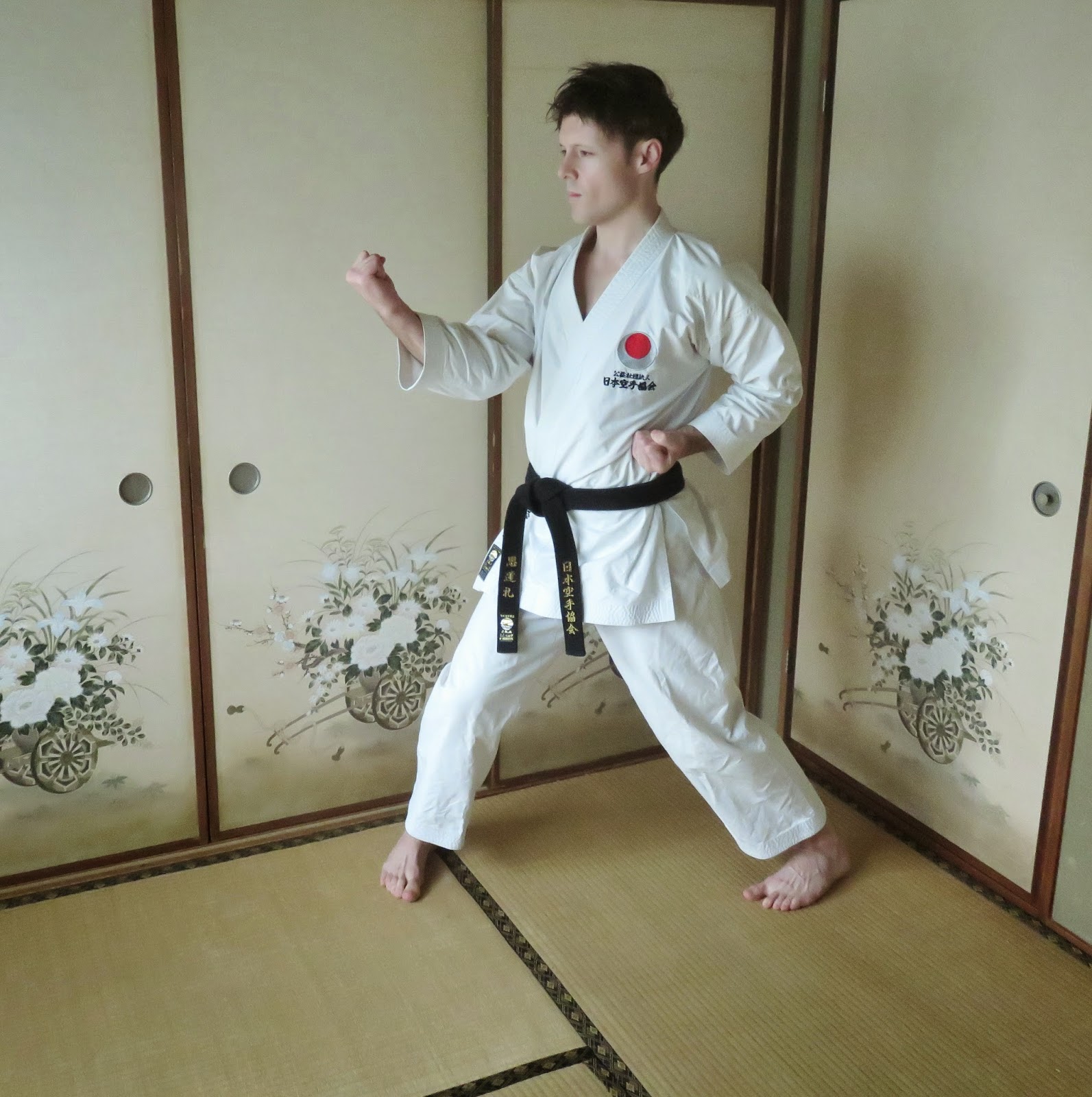
Hidari chudan jun-zuki.
Outlined below is my latest training regime, which I began upon returning from our recent trip to New Zealand. Essentially, the focus--in kihon, kata and kumite--is simplicity and `connectedness'; namely, Shin-Gi-Tai. Paradoxically, my ido-kihon and kata practice is relatively advanced: but I believe this better serves the aforementioned objectives. Before I launch into my practice outline, I thought to leave you with a quote from Funakoshi Gichin Sensei, which pertains to my current focus: "Kantan na momo yoku kachi o seisu" ("The balance between victory and defeat often hangs on simple matters").

KIHON

Stationary kihon: 1. Migi gyaku-zuki (hidari zenkutsu-dachi); 2. Hidari gyaku-zuki (migi zenkutsu-dachi); 3. Mae-geri (heisoku-dachi); 4. Migi mae-geri kara yoko-kekomi soshite ushiro-geri (hidari zenkutsu-dachi); and 5. Hidari mae-geri kara yoko-kekomi soshite ushiro-geri (migi zenkutsu-dachi).

Ido-kihon: 6. Kizami-zuki kara sanbon ren-zuki; 7. Jodan age-uke kara chudan soto-uke soshite chudan gyaku-zuki; 8. Ipp sagatte jodan age-uke kara mawashi-geri, uraken soshite chudan jun-zuki; 9. Chudan uchi-uke (kokutsu-dachi) kara kizami-zuki soshite chudan gyaku-zuki; 10.  Ippo sagatte gedan-barai kara chudan jun-zuki soshite chudan jun-zuki; 11.  Chudan shuto-uke (kokutsu-dachi) kizami mae-geri soshite shihon nukite; 12.  Mae-geri kara yoko kekomi, mawashi-geri soshite chudan gyaku-zuki; 13.  Mae-geri kara yoko-kekomi soshite chudan gyaku-zuki; 14.  Yoko-keage ashi o kaete yoko-kekomi (kiba-dachi); and 15.  Oi komi gyaku-zuki (jiyu-dachi).

* Reps: I am presently doing less reps than usual. Stationary kihon only 30 of each (+ one set of 10 slowly as a `junbi-undo'). My ido-kihon is five repetitions up and down the dojo once slowly, then repeat twice with maximum snap. When I make any errors, or fail to be satisfied by my execution of any aspect, I perform an additional set (or sets if need be).


KATA
a.      Nijushiho
b.      Gojushiho Dai
c.       Random selection from the six shitei-gata (Heian 1-5 and Tekki-shodan).

* Reps: My kata training is where the hard work is at the moment. This is partially why repetitions of kihon are presently lower than normal. Looking at the last few practices and I've been averaging eight to twelve Gojushiho-dai, the same with Nijushiho, and randomly going through the shitei-gata twice each. Needless to say, upon finishing kata, I have jelly-legs: especially my left leg (all of you Gojushihodai fanatics out there will know what I mean)...


KUMITE

Yakusoku kumite: I. `Gohon kumite’ (jodan , chudan); II. `Kihon ippon kumite’ (jodan, chudan, mae-geri and yoko-kekomi); and 'Jiyu ippon kumite' (jodan, chudan, mae-geri, yoko-kekomi and mawashi-geri).

 
* Reps: My present kumite practice is more technical than full-on; again, this relates to the physical pressure from my current kata training... Consequently, I am only twice going through Gohon, Kihon Ippon and Jiyu Ippon Kumite; however, both times with maximum speed/explosiveness. All counters are either chudan or jodan gyaku-zuki. When I self-train, I am doing this as kihon, and when with a training partner, both kihon then as `kumite' in the standard form. Again, this is very simple practice, yet VERY challenging as it is `pure'.
 
To conclude, my present training gives me nowhere to hide the numerous weaknesses in my karate; hence, I hope to use it to mitigate these and continue to improve throughout 2015. Irrespective of this, my focus remains on the journey by `being in the moment'. Best wishes from Kumamoto-ken, Japan. Osu, André.
 
© André Bertel. Aso-shi, Kumamoto. Japan (2015). 

Monday, 19 January 2015

New Zealand Seminar Video: January 2015

This video is a mere technical reference for the karateka who attended! Osu, André.

I'd like to also give a very special thanks to my friend Hanshi Renzie Hanham (8th Dan) for making this seminar possible. For more information on Seido Karate Christchurch please visit their website: www.seidoshibu.co.nz.

Lastly, here's a link to an interview I did with Hanshi three years ago: http://andrebertel.blogspot.jp/2012/01/interview-hanshi-renzie-hanham-8th-dan.html
 
© André Bertel. Aso-shi, Kumamoto-Japan (2015).

Friday, 19 December 2014

CHRISTCHURCH, NEW ZEALAND KARATE SEMINAR: January 2015


On January 10th and 11th I’ll be coaching a weekend of Karate-Do seminars in Christchurch, New Zealand. This will be a one off event before I return to Japan. As most people are away (on holiday) at this time, and the sudden notification, it is expected that not so many karateka will attend; nevertheless, this will result in the attendees getting much more personal tuition than usual.

The venue has yet to be decided; however, the schedule will be as follows:

Session one: Saturday 1pm - 3pm

Session Two: Saturday 4pm- 6pm

Session Three: Sunday 9am - 11am

Session Four: Sunday 12pm – 2pm

If you wish reserve a place, please email me directly at: andrebertelono@gmail.com. Already karateka from around New Zealand, and from Australia, have confirmed their attendance. For those attending, see you in New Zealand. Osu, André.

© André Bertel. Aso-shi, Kumamoto. Japan (2014).

Thursday, 18 December 2014

Trainee from Sydney, Australia: Leo Pintos

Leo at Kokuzou Jinja.
Leo Pintos, from Sydney Australia, came to Japan to train at my private dojo last week. Leo has attended several of my karate-do seminars (in New Zealand and Australia) so it was great to see him here in Kumamoto Prefecture. I will not specifically detail the training he received—as that is for him—and for whom he chooses to share this knowledge with; however, I will provide a brief outline, and a few photographs, from his training with me here in Japan.


Day one: After some sightseeing at Aso Jinja (Shrine) the first two hour session began. This covered the subtle points of traditional Japanese kihon that are most commonly misunderstood; in particular, "...the aspects that are essential for budo karate, which essentially work towards the objective of ichigeki-hissatsu (the ability to down an adversary with a single blow)". Again, without going into detail, this primarily focused on foot positioning, use of the legs and hips: essentially, the kahanshin. This training was then seamlessly applied to Enpi kata, Gohon kumite and Kihon ippon kumite. Overall, the proper connection of the '3 K's', which leads to karate being highly effective (for self-defence in the real world), was decisively practiced.
Traditional application of movement one of Enpi.

Traditional application of movement two of Enpi.
 Day two: I took Leo for sightseeing at Kumamoto-Jo (Kumamoto Castle) and Musashi Koen (the park that hosts the grave of Japan's legendary swordsman, Musashi Miyamoto). I have to say that I had a great time hanging out with Leo… Super bloke! Following this, we went for a few hours of training at the JKA (Japan Karate Association) Kumamoto Chuo Shibu under Nakamura Shihan and Akiyoshi Sensei. This session really reinforced the previous day's training as it covered Jiyu Kumite Kihon; Gohon Kumite, Jiyu Ippon Kumite, and several rounds of Jiyu Kumite; and Kata (free-choice). Leo and I performed Enpi based on the previous days practice. Unambiguously, he did really well and everyone at the dojo took a shine to him immediately.

Kime with haito uchi.
Day three: On day three the real meanings, and foci, of Gohon Kumite, Kihon Ippon, Jiyu Ippon Kumite were stressed. The session ended with a controlled Budo Jiyu Kumite drill (which must not be `sparring’ but, rather, “reinforce full commitment of the body every time one attacks”). After this training, which I should say was at the new Aso-Budojo (i.e. - not my `refrigerated dojo), a nomikai (drinking party) was well deserved!

Kime with jodan zuki to the throat.
Day four: Leo’s final day of training recapitulated everything on a deeper level. We also covered the oyo (applications) of Enpi, which come from the origins of Wanshu in Okinawa. This was done
via the first level of Oyo Kumite. Again, this is for  Leo, as he took the plunge and came to Japan with Budo Spirit; that is, he talked with his karate and put himself on the line.
To conclude, I really respect Leo as a karateka and also as a person. Mizuho and I are honoured to know him. Domo arigato gozaimashita Leo San, you are always welcome at my dojo here in Japan. Furthermore,  Nakamura Shihan, Akiyoshi Sensei, and all the members of JKA Kumamoto Chuo hope to see you again! You have made many friends in Japan. Osu, André.

© André Bertel. Aso-shi, Kumamoto. Japan (2014).
Jodan mawashi-geri


Hidari seiken jodan-zuki to the throat.

Jodan mawashi-geri.
Leo: movement one of Kanku-Dai Kata.
Movement one of Enpi at Kokuzou Jinja (Aso-shi, Kumamoto, Japan). Even though you can't see it, it was lightly snowing.
Leo after training at the JKA (Japan Karate Association) Kumamoto Chuo Branch.

Sunday, 23 November 2014

Correct elbow positions in ukewaza

Migi zenkutsu-dachi with migi chudan uchi uke.
The position of one’s elbows when utilizing ukewaza (reception techniques) must be fully understood, and correctly applied, whether using ukewaza for defence, attack or both simultaneously.

A good way to learn this is to learn this is from the top down: especially in a freestyle context such as jiyu-kumite or via self-defence scenario training. Have your partner attack you, and attack relentlessly (without concern of your counter offensive manoeuvre; that is, their safety); accordingly, restrict your actions to only ukewaza.

At first concentrate on (using) your hands: This is typical amongst beginners and is very difficult if the opponent is relatively strong, and aggressive. Secondly, concentrate on (using) your elbows to move your hands. This, in comparison, you will find is much more easy and, understatedly, far more effective. Of course this also equally applies to ashi-uke (leg blocks) i.e. - focusing on the knees instead of the feet. I'd like to elucidate here that I am not disregarding the imperative use of the hips, the criticality of body shifting/footwork, and so forth. Rather, this is an isolation exercise for better understanding the elbows (in the overall context of karate-do waza).

Returning to the "basic" ukewaza, which we train in a formalized context (kihon, kata and yakusoku-kumite), we quickly gain an appreciation of our elbows. From here, let's consider the five most 'standard ukewaza' of Shotokan-Ryu as established by Funakoshi Gichin Shuseki-Shihan, at  the foundation of the JKA (Japan Karate Association), namely jodan age uke, chudan soto uke, chudan uchi uke, gedan barai and chudan shuto uke.
 

  (1)  Jodan age uke: wrist one fist width from the forehead and forearm diagonal.

(2)  Chudan soto uke: elbow one fist width from the body and bent 90 degrees.

(3)   Chudan uchi uke: elbow one fist width from the body and bent 90 degrees.

(4)  Gedan barai: wrist one fist width above the knee and elbow one fist width from the body.
 
(5)  Chudan shuto uke: elbow one fist width from the body and bent 90 degrees.
Hidari kokutsu-dachi with migi shuto chudan uke.
In all cases, with the exception of shuto uke (where the sword hand is applied), the blocking surface is one's tekubi (wrist) and, 'fundamentally speaking', all of them target the opponents respective wrists and ankles; furthermore, the power of all ukewaza primarily derives from your centre; most notably, the hips. In particular, this comes from koshi no kaiten, which like all `technical categories' in karate-do can be applied via jun-kaiten, gyaku-kaiten, or a combination of the two (often referenced as 'hip vibration'). However, koshi no kaiten cannot be so easily summarised as "..there are also various degrees of rotation and appropriate usage, which differs `case-by-case'". Additionally, it involves using the seika tanden and numerous other parts of the body (and a vast array of aspects, which establish `mastery'). Needless to say, we could go on and on but, for the sake of this article, I'd like to return to the issue of one's elbows.

So where do the elbows, in the context of the `core ukewaza’, fit in relation to one's overall effectiveness? Well, besides the point mentioned above in the freestyle context (essentially controlling what the hands/wrists “do”), the distance of the elbows in relation to the torso determine leverage. In simple terms, as the blocking elbow gets further away from the body the basic ukewaza become weak. Ironically, if it comes closer to the body (than a fist width) they lose functionality/applicability.

If this point is fully expressed one can create a huge amount of power if the waist is fully applied, via the rear leg, and the shoulders relaxed (all the other aspects such as shime simply add to these points). In this way, the feeling is to attack with both your wrist and elbow as single unit. Suddenly age uke becomes a rising elbow strike; soto uke - a roundhouse elbow strike; uchi uke - a side elbow strike; and both gedan barai and shuto uke become downward elbow strikes. Again, this goes beyond various forms of enpi-uchi...

Another aspect I'd like to mention here is 'over blocking'; that is, executing ukewaza beyond the body or head. A "classic error" is chudan soto uke in, say, Gohon kumite (Five step sparring) where the defender superfluously moves. All of my students will laugh here, because you all know what I'm about to say and what I do when this happens... When someone over blocks, in Gohon kumite (or in any of the forms of Ippon kumite), I immediately punch jodan. For me, when this occurs, they have given me a huge gap of time that I can't resist capitalizing on and—much more importantly—it gives me the opportunity to give my students a `foundational lesson’... I then ask them, "…were you imagining you were also defending someone next to you?" To me this is the benefit of yakusoku-kumite because in any form of 'freestyle' "...superfluous `over-action’ is what will get one hurt in serious dojo kumite or in a match (or killed in the likes of a carjacking, home invasion and the like)".  If such key fundamental points are not second nature in one's technique, even in a basic pre-arranged context—in the somewhat `safety of the dojo’—they certainly won't be able to be applied in an unpredictable circumstance (of a serious match or in a real fight). In sum, it is obvious that "if one continues to practice in this way they are literally reinforcing very-very bad habits". But here's the good news, if you do your ukewaza correctly (adhering to proper kihon and kata) you will not over block; moreover, you will learn to use and adapt to combative variations subconsciously, which is the beauty of strictly practicing budo. I can say this with confidence from my experience in the security industry, on the door, private protection jobs, and in other occupational contexts of my former life.

Some of you reading this may be questioning the 'the elbow one fist from the body' rule mentioned in this article (in relation to chudan ukewaza); furthermore, you may be questioning the issue of techniques such as tate shuto chudan uke. To answer these questions: Firstly, yes it is true that around twenty years ago chudan uke were changed to 1.5 fist widths from the body by Sugiura Motokuni Shuseki-Shihan (i.e. – in the `Karate-Do Kata’ textbooks; however, this has recently been amended to one fist width. This is a minor difference, and 'application-wise' insignificant, but I believe is better, based on further simplification. Simplicity is what I learned to appreciate when I had to use my karate in the real world. Secondly, in the case of some ukewaza, such as tate shuto, the energy applied is different; for example, swinging the uke in an arc. This idea is consistent with muchiken-waza such as kesa shuto uchi, sotomawashi haito uchi and, indeed, various keriwaza.

Migi ashi mae hangetsu dachi with migi chudan uchi-uke.
 A critical error with basic chudan uke: one typical error that is seen by sports kata exponents is making their chudan uke too high. For example, numerous kata 'champions' perform their ryo keito chudan haneageuke (movement two of Unsu kata) incorrectly. Such 'changes' in the techniques of karate, merely for aesthetics or to make performance more easy, is clearly due to a total lack of understanding, faking power, or—in most cases—both. Essentially what they do is turn karate kata into an odd dance form. The same can be seen by their exchanging yoko keage for yoko kekomi, excessive pauses, and performing other superfluous actions. Worse than the athletes doing this are those who copy them around the world! And yes, there are legions of them. It’s what I guess can be termed ‘karate fads’ and unambiguously have no relationship with actual karate—the martial art. In saying that, this helps to identify genuine from the artificial karate.

A key indicator of correctness: "The top of the fist, or finger tips of shuto, when executing the core chudan ukewaza is in-line with the top of the shoulder (with VERY SLIGHT VARIATIONS depending on ones arm length etc.)". Keeping this in mind, with `the one fist width from the body rule', and the elbow bent at right angle: and the correct form becomes immediately apparent. This is the most effective and physiologically/biomechanically strongest position for the core chudan ukewaza... "If you have a look around you will see many sports kata `world champions' who do this incorrectly. Indeed, this is one of the numerous ways of easily separating budo karate (real martial arts karate) from fake karate, which is merely for show". While this may sound like I am repeating myself, I am, on purpose...

Last, but not least, by adhering to the correct form (and principles) of the core ukewaza one can maximize their ukewaza in un-prearranged context: whether the karateka wishes to block/cover/parry, strike, lock or apply a joint lock/dislocation. In traditional budo karate, irrespective of style, "kihon, kata and kumite are one; moreover, this is not merely an abstract idea". Hence, the techniques of real karate always reflect optimal functionality in a freestyle context. The key is to know the 'how's' and 'why's', which are often misunderstood in the greater karate world. Of course, this transcends the positions of one's elbows; nonetheless, "...such points collectively come together and literally establish authentic karate technique, which is grounded on the tradition of optimum functionality".
Kiba dachi with hidari sokumen gedan-uke.
All the very best from Kumamoto-ken, Japan. Osu, André
© André Bertel. Aso-shi, Kumamoto. Japan (2014).

Friday, 14 November 2014

Italian trainee from Canada: Pietro Giordan

Pietro and I, at dinner, after his final private lesson earlier this evening. 
Pietro Giordan, an Italian 2nd Dan (who is a university professor based in Toronto, Canada), has been training at my private dojo for the last couple of days. He flew all the way here to Kumamoto for some ‘one-on-one training’.

Pietro at my dojo in Aso-shi.
The private lessons I have taught Pietro have focused on the ‘core kihon’ of Karate-Do and the aspects that underpin on-going high-level development; namely, correct koshi no kaiten (the rotation of the hips), tai no shinshuku (the contraction and expansion of the body), and junansei (softness). These three points added to “the correct position at the `pre-point’, `initiation’, `delivery’, and `completion’ (of techniques)” was covered.


Some key points of Enpi for Pietro. Movement one: MIGI ASHI ORISHIKI HIDARI HIZA TATE. MIGI ZENWAN GEDAN BARAI. HIDARI ZENWAN SUIGETSU MAE KAMAE.
Movement 14 of Enpi kata: SASHO HIDARI NANAME MAE UE (KIBA DACHI).
Movement 34 of Enpi kata: MIGI TEISHO CHUDAN OSHIAGE UKE. HIDARI TEISHO CHUDAN OSHIAGE UKE (MIGI ZENKUTSU DACHI).
A particular aspect that was looked at in great depth was unsoku (leg movements) and correctly applying/”sliding” linear techniques along the chushin (centreline). From there it was possible to look at the more unorthodox techniques that I practice and teach; accordingly, this, in turn, clarified that “…in order to perform these techniques, kata, and applications (from outside of standard Shotokan) one must have solid Shotokan”. Ultimately, this culminated in the various forms of sparring ranging from Gohon kumite to Jiyu kumite (focusing their specific purposes from a `Karate in Japan’ perspective). Needless to say, special coverage of tenshin (rotational techniques) and snapping techniques (including muchiken-waza) were also addressed.It is worth mentioning that the private training included the rationale behind a number of the more common drills/exercises that I teach on international courses (and, indeed, when practice/teach in my private dojo on a daily basis). Those who have attended my classes (or seminars here in Japan and/or around the world) well know that ‘these rationales imperative to understand: so that the exercises/drills are not merely a novelty’. The key point here is that “…everything one does—in their physical training—should decisively work towards the development of effective martial arts karate”. Accordingly, it cannot be stressed enough that “in Traditional Japanese Karate-Do, the physical aim of techniques is always to achieve a single finishing blow (Ichigeki-hissatsu)”.

Lastly, a couple of formal exercises were covered, Enpi and a non-syllabus kata; however, these are for Pietro, so I won’t say anything further. I look forward to seeing his kihon, kata and kumite in the future.
Overall, I wish Pietro the very best and hope that the last couple of days of training here at my dojo will help his long-term karate development. As I say to everyone who comes to me for private training, “consume what you find useful and spit out the rest”. All I hope is that Pietro has at least gained one point that will help progress his Karate-Do and that he thoroughly enjoyed the classes. It was a pleasure to meet you Pietro! Please have a safe and enjoyable trip back to Canada. I look forward to hearing your report about training here in Japan. Osu, André.
Movement 36 of Enpi: HIDARI KAITEN TOBI. HIDARI KOKUTSU DACHI, MIGI SHUTO CHUDAN UKE.
© André Bertel. Aso-shi, Kumamoto. Japan (2014).

Monday, 20 October 2014

HAIEN: Down and out with severe pneumonia

A photo of my training in the early days of this website.
One of my policies, when I write articles on this blog, is “…when I don’t train I don’t write nor post”. My mentality (and not at all a criticism of others) is that “When I don’t train, I have no `right to write’ about karate”. Furthermore, I also believe doing so takes away the kokoro that comes out of this site, which has made it so popular around the world. Unambiguously, in many ways, I suppose this is utter nonsense; nevertheless, I do intrinsically and wholeheartedly believe that when it comes to Karate-Do, training takes precedence over every other aspect. Thinking and writing have their place, but can never replace the hard yards on the dojo floor. I’ve talked about this much before—in past posts—but here I am posting today; indeed and understatedly, without training for the first time in many years.

Anyway, today, I was diagnosed with serious pneumonia (39.6 Degree Celsius fever) and told that I must either be admitted to hospital, or go home and strictly stay inbed. I decided to come home, as I’m not contagious (safe for our new-born baby Mia, and Mizuho).

That being said, the doctor told me firmly “NO WORK, NO KARATE BERTEL SAN: FOR AT LEAST FIVE DAYS!” So, here I am, hypocritically breaking my own rules… Perhaps ironically, I have plenty to do here, study Japanese (desperately need to do more of that), read books, you name it,... Yet, it is really is strange not to teach nor train karate daily… And today is only my first day!!! Oh my…

You might think I’m implying I can’t relax, but that is not true either… Give me a cold beverage and good company; a walk in nature; or, especially at present, time with my wife and daughter, and I am more than relaxed.

So what am I writing about??? Basically, ROUTINES. I couldn’t work out my consistency with karate for so many years. I was really asking myself, and of course being asked by friends and family, “HOW DO YOU KEEP GOING?” I am not bragging when I say this—and you will see why—after I explain routines more specifically.

It is not my personal determination or mind-power that keeps me going. I can’t credit those attributes to myself, insofar as my daily karate training goes; instead, it is that karate training is in `my daily routine’—irrespective of how busy I get in life.

If there is not enough time for karate, I make the time. If that means getting up a lot earlier to self-train etc., that’s exactly what I have to do.

I never jeopardise other areas of my life for karate, especially family. Instead, like water, karate training flows into the gaps of my life and fills them idealistically. Perhaps there is some level of  determination involved; but, more importantly, I have a power which transcends my personal weaknesses (especially that inherent lazy streak, which we all have).

Ewwieeee, so André has a power…  Well, no! As mentioned above, it is primarily routine. Let’s compare daily karate training to the simple action of brushing our teeth.  We don’t stop brushing our teeth two-three times per day because of any factor (at least I hope that no one who reads this does…). Rather we brush on a daily basis to avoid cavities, look as nice as possible, and not `submit the world around us to extremely bad breathe’. What I am trying to say is that karate is simply a routine to me, more so than my effort: otherwise `lazy bones' would certainly win!

MY SECRET—KARATE IS CONTROLLED BY MY ROUTINE: If I am having a great day, and all is super, fine, and yes, even dandy—I still train. If I am feeling tired, glum, frustrated, or anything else—yes, I still train. What I’m trying to say here (and have indeed stated numerous times in the past) is that “Training is not controlled by my emotions: nor love or periodic dislike for karate—which has occurred consistently over the years; instead, it is a part of me. This makes keeping up training `NO EFFORT’ because it is simply what you do. It is primarily cerebral as opposed to emotionally driven. The bonus, not the main point, is what karate does for my body and mind (irrespective of my day). Needless to say, these points make us happy.
 
A special message for those who competed at the 13th Funakoshi Gichin Cup World Karate Championships. Firstly, congratulations!!! Secondly, the fire is burning hot now, but naturally it will cool. This is a wonderful window of opportunity to routinize your karate, so that your training moves forward consistently from now. The excitement may waver for a little while, but again, don't let this influence/lessen your training. A special thanks to Pinto Karate Dojo: http://pintokaratedojo.com/ for streaming the World Karate-Do Championships live. Also apologies to Lutie van den Berg Sensei and Naka Tatsuya Sensei for being unable to meet with you tomorrow night due to my illness. Of course, I am very disappointed about this.
 
I’ll wrap now… I hope this little article offers you something. At the very least, if you are a karateka, keep going to the dojo; and, make karate-do your routine: irrespective of how many days a week you can get to the dojo (and especially irrespective of your emotions, which are all too often hindrances to peoples life achievements and, overall, their joy).  If you do this, you will gain the most from your training and will routinely continue; moreover, should you choose to do so, you may well continue benefiting Karate-Do until your old age.

Kindest regards from my Japanese futon, André
© André Bertel. Aso-shi, Kumamoto. Japan (2014).

Wednesday, 8 October 2014

Updated training regime: a return to the sentei-gata

Warming up: my private dynamic stretching routine.
At present I am reviewing the sentei-gata: Bassai Dai, Kanku-Dai, Enpi and Jion. Needless to say, this is a big step from the five Heian and Tekki Shodan, however, I am now tackling `the big four’ in light of them. In addition to these kata I am working on Gohon kumite (Five step sparring); Kihon ippon kumite (Fundamental one-step sparring); and once again going through the JKA syllabus kihon. In my own training this is currently focused on the 9th, 8th and 7th Kyu exams.

Balancing this, at the Kumamoto Chuo Dojo one of my seniors (Mr. Katayama who is in his 70s) is going for his JKA Sandan soon; consequently, kihon practice with Nakamura Shihan has naturally been focused on the Sandan curriculum.  For those of you who don’t know this includes: (1) Kizami-zuki+ sanbon ren-zuki; (2) Jodan age-uke + same arm chudan soto-uke + gyaku-zuki; (3) Chudan uchi-uke in kokutsu-dachi + kizami-zuki + gyaku-zuki; (4) Shuto-uke + kizami mae-geri + nukite; (5) Stepping back with jodan age-uke + advancing with mawashi-geri + uraken yoko-uchi + chudan jun-zuki; (6) Mae-geri + yoko-kekomi + mawashi-geri + gyaku-zuki; and (7) Mae-geri + yoko-kekomi + ushiro-geri kicking frontward, sideward and rearward: before returning the kicking foot to the floor (with both right and left legs). Perhaps a little off topic, but it really impresses me how we can find several of these renzokuwaza (combination techniques) in the 1960s JKA textbook, `Dynamic Karate’. Other groups do this as well, but the JKA have some very special points which pertain to the origins of these waza.
Kanku-dai kata.

That being said, it is very interesting how everything comes back to the core fundamentals—the core foundational principles, irrespective of complex renzokuwaza, kata, kumite, self-defence or impact work. When this is a physical reality—all aspects of training unite—and shingitai can be optimally worked towards. Contrasting my previous months kata training, of the six shitei-gata, with the more advanced sentei-gata; furthermore, my current `basic’ kihon work (in my self-training) with the `advanced training’ (under Nakamura Shihan and Akiyoshi Sensei); and the aforementioned point can be vividly seen.
Presently I'm focusing on deai in jiyu-kumite as depicted here in Germany.
It is from this reference point that the lines between basic and advanced become blurred and often undertake a sort of ‘polar reverse’ if you will. In my case, this has constantly occurred over the last three decades in karate-do and will certainly continue to do so. Such learnings are what make karate so challenging and, at the same time, so enjoyable. Osu, André.

© André Bertel, Aso-shi, Kumamoto. Japan (2014). 
 

Wednesday, 1 October 2014

Hirota's Latest Karate Uniform: The `TAKUMI'

A while back I bought the `Takumi’ (Craftsman), which is the latest dogi (karate uniform) from Hirota. I can honestly say that it is the best dogi I have ever worn in my karate career—actually the best by far! Until now, their `Pinak kata’ was, in my opinion, the best karate suit on the market.
___________

Probably the most accurate way to explain the Takumi is that it’s half-way between the `Pinak Kata’ and ‘Pinak Kumite’. It has paper thin material which moves with the body yet it is firm. This means it gets the best of both types of Pinak… Not to mention, it dries rapidly.
___________

Comfort and how a dogi hangs/”sits” on the body are probably the most important points when it comes to karate uniforms, and the Takumi is unparalleled in both of these aspects. Accordingly, I rate this new suit 11/10… `11’ because I can’t see Hirota, or any other companies, ever outdoing it. Of course, I’d like to see them prove me wrong, but I really can’t see this happening. Essentially, this dogi is certain to become “the standard” for all experts (and world level competitors alike).

With all these points in mind, make sure you get the perfect size for you!!! And, as always, I strongly recommend going through Kuroobiya to ensure this: because they are the best in Japan at achieving an optimally fitting dogi. Hamid and his team at Kuroobiya will ensure you get the right size (which is critical, as the Takumi is a fully tailored uniform and thus requires real specifics to get it right).
Hirota's measurement chart... Looks easy, but requires a thorough knowledge of the product: in relation to your own
specific wants and needs.
Here is a link to the Kuroobiya homepage—it is a one of the few karate websites I have bookmarked: http://www.kuroobiya.com.
 
 Taken as a whole, I can’t overemphasise the excellence of Hirota’s Takumi: this new dogi has lifted the bar to an unprecedented height.
© André Bertel. Aso-shi, Kumamoto. Japan (2014).