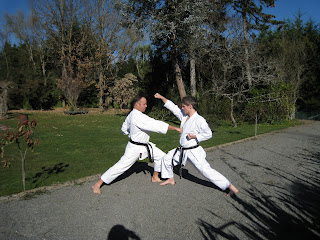
This site is based on my daily practice of Shōtōkan Karate-Dō here in Ōita City, Japan. More than anything else, unlike the majority of other karate websites, this page is primarily dedicated to Budō Karate training itself; that is, Karate-Dō as a vehicle for holistic development.
Monday, 10 August 2009
Karate with Tony Petronelli Sensei
Sunday, 9 August 2009
TV Interview
However, even with a nasty migraine headache and a very sore muscles (probably from jet lag) the ex
© André Bertel, Japan (2009).
Friday, 7 August 2009
Private lesson for Lyall Stone Sensei
Monday, 3 August 2009
Trip to New Zealand
Before wrapping up I'd like to thank the following two instructors, Lyall Stone Sensei, and Tony Petronelli Sensei for hosting us in New Zealand. I'd also like to thank the members of the SKNZ (Shotokan Karate New Zealand) honbu dojo based at CPIT in Christchurch.
Osu!
Sunday, 2 August 2009
Asai Sensei's Kata
In memory of my karate teacher, Asai Tetsuhiko (who passed away on August 15th, 2006), I wrote an article concerning the many kata he created. The article has been published on The Shotokan Way.It is my hope that Asai Sensei’s legacy will be stringently kept alive, and technically not distorted, for the future generations of karateka. Here is a direct link to the article: http://www.theshotokanway.com/theasaikaratekata.html
Monday, 20 July 2009
Anata no karate ryuha wa dore desu ka?
_______
Amusingly enough, one of the biggest questions 'outside of Japan' amongst karateka, is exactly that... "What style do you practice?" Ironically, here in Nippon, whilst politics obviously still exist, there is just karate-do, competition and traditional. The biggest divisions are not style, but rather the manners/main objectives of training.
So when someone says they practice Uechi-ryu, Wado-ryu, Shorin-ryu, Seido, Goju-ryu, Shito-ryu, Shukokai, Kyokushinkai, Ryuei-ryu, Shotokan etc.., it really doesn't say much. The real issue is how they practice, and what they sincerely practice for. Do they train for full-contact fighting, sports karate, or for application in the real world. One may argue that they train for a combination of these, however, this is impossible, if a reliable level expertise is desired in any of these fields.
© André Bertel, Japan (2009).
Sunday, 19 July 2009
Asai Wheelchair Karate
__________
Is wheelchair karate only for the disabled? Sensei devised these kata and fighting applications not only for people who are disabled and the elderly, but also for people who are inj
ured and/or unwell. However, lesser known is the fact that he also developed kurumaisu karate for able bodied people. He even created special training routines in which people practicing on wheelchairs and standing, could simultaneously follow together (often with people being seated on wheelchairs and standing alternately throughout the session). For example whilst the karateka in wheelchairs turned their chairs diagonally with jodan age-uke followed by uraken tatemawashi uchi, the standing karateka would pivot into kiba-dachi with the same techniques. Sensei proudly stated “Kurumaisu karate has been my biggest contribution to broader society, especially in regards to social inclusion. My dream is to see it in the paralympics.”
Wheelchair karate competitions: A good point to mention here, is the fact that both able-bodied and disabled, are permitted to enter wheelchair karate competitions (they are not divided into separate categories). Asai Sensei’s explanation of this was “We do not regard kurumaisu karate as an inferior method of martial arts training. In many ways it is more difficult than standing karate as one must have superior junansei (softness) and shoulder snap if they are to be effective. Male and female, handicapped and not handicapped, everyone competes together, everyone is included.”__________

The technical benefits of Asai Wheelchair Karate (The perfection of upper body joint snap): Asai Sensei explained that kurumaisu karate is for all karateka because it more effectively trains upper body snap. He stated “You have to master snapping the shoulders, elbows, and wrists, and using the waist and backbone without the drive of the legs. This requires softness. It is therefore isolation training.” He also emphasized his philosophy of seated, standing and jumping karate. “You must be able to do effective karate whilst seated and in an unstable position, and because a wheelchair rolls around, it is such a position.”
__________

Monday, 13 July 2009
No excuses, just train!
________
My stationary kihon at the moment comprises of a vast array of different foundational techn
B. Ido-Kihon
________
________
My present focus is on practical/street effective goshin-jutsu (self-defense) techniques. The source of these waza are the kihon, and kata, that I’m currently refining.
OSU!
Thursday, 9 July 2009
Usa Jingu
Usa Jingu: The Usa shrine is one of the most famous in Japan, and has long been the recipient of Imperial patronage. In actual fact, in all of Japan, it is considered second only to Ise Jingu. Interestingly enough, for believers, it is the home of Emperior Ojin,
________
A little history: The shrine was founded in Kyushu during the Nara period. Ancient records place the foundation of Usa jingū in the Wado era (708-714). It is today the center from which over 40,000 branch shrines have grown. Usa's Hachiman shrine first appears in the chronicles of Imperial history during the reign of Empress Shotoku. The empress allegedly had an affair with a Buddhist monk named Dokyo. An oracle was said to have proclaimed that the monk should be made emperor; and the Kami (God) Hachiman at Usa Shrine was consulted for verification. However, the empress died before anything further could develop...
________
Japan, especially if you find yourself here, in beautful Kyushu. Best wishes from Oita, Japan.
Monday, 6 July 2009
Totemo Isogashii
I'd like to take this brief chance to thank all of my readers from around the world. I sincerely hope that my blog continues to assist you, where ever you may be. Over the last couple of years I've received so many wonderful emails from people of every ethnicity. All who mutually love the art of traditional Japanese Karatedo. Such letters always put a big smile on my face. Karate never ceases to amaze me, in regards the development of strong international bonds, regardless of cultural differences.
__________
My kindest regards to you all from Nakatsu City, Oita, Japan.