Saturday, 22 February 2014

JKA GODAN DIPLOMA

The box the diploma came in.
Last night, after training, Nakamura Masamitsu Shihan formally presented me with my JKA (Japan Karate Association) Godan shojou. I have to say, it was a great honour for me to receive this qualification from Nakamura Shihan. Osu, André   
  
© André Bertel, Aso-shi, Kumamoto. Japan (2014).
My JKA Godan (5th Dan) Diploma.

Sunday, 16 February 2014

Pedagogical differences: A brief case study of gyaku-zuki

The 'traditional' (foundational) gyaku-zuki.
  In jiyu kumite we “break the foundational rules” of kihon and kata by coming up on the toes (as opposed to keeping the feet flat). Just like a sprinter doesn’t run on their heels, being on one’s heels in a free-fighting match (or self-defence) is like turning oneself into a `sitting duck’: it is both defensively and offensively cumbersome. flat)e their body, but is eel from


So why do we train to keep the feet flat in kihon and kata? Let’s briefly look at the `traditional (foundational) gyaku-zuki’ and the `free-style version’ where the heel is raised. Please note the three photographs, the first being the `basic’/`traditional’ gyaku-zuki; the second being the freestyle gyaku-zuki—with a classical full hiki-te (pull back of the opposite hand); and the third, a simultaneous hidari gyaku-zuki with te-nagashi-uke (sweeping block)—commonly seen in jiyu-kumite matches.
The `freestyle' hidari gyaku-zuki (with nagashi-uke).

Criticism of the heel drive: Some Western karateka criticise the traditional Japanese idea of driving from the heel. And while their arguments are valid, they show a misunderstanding of the Japanese way: as they are steeped in `tunnel vision pragmatism’. I assure you that the Japanese are very aware that keeping the foot flat is not appropriate in the freestyle context. The fact of the matter is that the Japanese have shown time and time again that practicing “driving from the heel—in the foundational waza—results in better freestyle techniques”. Why? Firstly, because the foundational techniques and kata are highly restrictive; hence, when the restrictions are removed, one can move far bettere restrictive. hat the Japanesetion that they haven'  towards tr. Secondly, by keeping the heel down, one is more stable when hitting a target with full power (and the heel naturally raises without conscious effort). In this case, only practicing with the `heel raise' results in reduced balance/shock absorbance. 

Needless to say, one must not only practice the traditional/foundational versions of techniques, e.g. – the basic gyaku-zuki, but also the freestyle versions (jiyu kumite no kihon). What I am trying to say here is that "everything is about balance". Traditional and freestyle... Not one or the other...

The gapping pedagogical void: What I have consistently found, over the years of being here in Japan, is that there is often a huge void between the pedagogical approaches of Japanese and Western karateka/instructors. This is not good or bad, but I personally believe that having an open mind, and not jumping to uninformed conclusions, is the best way (especially when taking into account the language and cultural barriers, which sometimes result in technical misunderstandings). Taken as a whole, optimal development in Karate-Do will always be a balance of the foundational kihon, kata, and yakusoku kumite; and, of course, the `unrestricted' zone of jiyu-kumite training. All the very best from snowy Nippon, André.

The `freestyle' migi chudan gyaku-zuki (with hiki-te)
© André Bertel. Aso-shi, Kumamoto. Japan (2014).

Saturday, 15 February 2014

The projection of energy: tachikata and unsoku


Sokumen jodan uchi-uke doji ni sokumen gedan-barai.
Something I rediscovered recently, but on a more in-depth level, was `directing power’ when moving in the various tachikata (stances); that is, how the weight is projected in techniques.

In particular, this relates to the width and length of stances in direct relation to techniques: for example, movements 38-41 of Jion. In all four of these movements if the zenkutsu-dachi (front stance) is even slightly too wide one’s energy will partially go to the side (as opposed to being fully projected forward). This is easier to feel, and correct, in the two jun-zuki but can subtly go under the radar, and is more challenging, when turning with the two uchi-uke. Quite simply, this is because the “sideward energy” applied in the uchi-uke (going from inside-outward); furthermore, the use of hanmi (the half-facing position) and zenmi/shomen (the front-on/squared position) respectively.

While all of this is plain, and very easy to understand in text, it requires diligent practice. Why? Because one must physically/subconsciously understand, and maximise, how their stances and movements optimise the various techniques of karate-do (especially in correlation with unsoku/leg movements). This starts from the straight line (choku-zuki, mae-geri etc) and runs a full course to the full-circle (kaiten-waza/ tenshin); subsequently, the added impetus/possibilities/combinations of raising and lowering the body are added to the equation.
Taken as a whole, as Nakayama Shuseki-Shihan stated, karate-do masters all of the possible bodily movements for potential offense and defence. Subsequently, effective application of technique can easily come from this baseline approach in training. Last but not least, knowing is not enough in Karate-Do. Only by having “…the ability to express knowledge within one’s physical technique” is knowledge useful for the karateka. Osu, André.

A snow covered view of Aso-San from my apartment. The volcanic steam, rising out of the crater, is hidden by clouds.
© André Bertel. Aso-shi, Kumamoto-ken, Japan (2014).

Friday, 14 February 2014

Kangeiko opportunity

Concluding my training outside my private dojo, the Asobudojo, in Ichinomiya, Aso-shi: 100 seiken choku-zuki
A crazy level of snow has fallen here in Aso shi… Even Aso-jin are surprised by it! Yesterday, my commute home from my private dojo took close to two hours, which is normally a 10 minute drive. This morning Mizuho’s car and my car were both buried in snow.
At the dojo, after training in the dojo for two hours, I decided to get outside and do some “kangeiko style” training: 100 choku-zuki; 100 migi and hidari gyaku-zuki; 100 migi and hidari mae-geri; and a run to the dojo caretaker to return the key. Needless to say, the dojo caretaker was shocked when she saw me running (to her office in my dogi) in the snow. She said in Nihongo, “you are very Japanese”, which can best be translated “…you are a crazy gaijin”. Actually she is such a lovely old lady and was very concerned I might get sick from the cold. Often I have received snacks, genki drinks, and visits during my self-training.
Anyway, it was a case of frozeeturn the keyfor two hours. two hours.o I decided to get outside and do some kangeiko style trainnign, sore muscles, but an excellent session!

Heian-yondan kata before getting out into the snow.
Unable to travel to Kumamoto today and study under Nakamura Masamitsu Shihan, due to the dangerous road conditions, I will need to turn our spare bedroom into a mini dojo; however, I will use the time to review some points in my kihon.
Osu, André.
© André Bertel. Aso-shi, Kumamoto-ken, Japan (2014).

Wednesday, 12 February 2014

New karate-dogi and obi

 Last week I got a new Hirota dogi (uniform) and obi (belt) at long last. For anyone looking to get the ideal dogi and obi, especially karateka outside of Japan, I thoroughly recommend Hamid at `KUROOBI YA’… Please click on the following link for more information: http://andrebertel.blogspot.jp/2013/01/getting-best-karate-uniform-belt.html. All the best, osu. 

© André Bertel. Aso-shi, Kumamoto. Japan (2014).

Friday, 7 February 2014

The three important variations of the Shotokan `front stance'

There are three important variations of the front stance that need to be fully understood. I would like to briefly describe these today. But before I do, I’d like to highlight their technical significance. Firstly, by not utilising these stances one cannot correctly follow the line of the enbusen (performance line) in their execution of kata. This is a discipline in kata, which should be strictly adhered to: especially amongst those who practice traditional JKA Shotokan (needless to say, this is worthy of a separate article). Secondly, these variations pave the way for effective application via their flexible use—combatively speaking; that is, stances must be used in different ways to maximise one’s effectiveness/goshin-jutsu (self-defence) skills. For example, the migi chudan uchi-uke kara migi chudan mae-geri (movements 16 and 17) in Heian-Nidan Kata, a full zenkutsu-dachi is less effective than hidari ashi zenkutsu. Accordingly, this is because gyaku-hanmi can be more fully applied in ashi-zenkutsu; moreover, a speedier counter-kick can be delivered from this position. Such points must become instinctive and conscientiously expressed, which in turn elucidates the value of “proper kata training” (within the context of a martial arts/self-defence training programme). OK, so here are the three fundamental variations of zenkutsu-dachi:

1.      Hidari zenkutsu-dachi and migi zenkutsu-dachi: This is the standard ‘front stance’. As a basic rule, the width is approximately that of one’s hips and the length is approximately two hip widths.

2.      Hidari ashi-zenkutsu and migi ashi-zenkutu: This stance is generally shorter and narrower than zenkutsu-dachi. For example, movements 16 and 19 in Heian Nidan Kata etcetera.

 3.      Hidari hiza-kutsu and migi hiza-kutsu: This where techniques are delivered to a different direction from the front stance position, for example the first half of movement 11 in Heian Yondan Kata.

Conclusion—“The big picture”: Kihon and kata are for kumite, for actual self-defence; therefore, all of one’s techniques must be fully understood/physically expressed in their most basic form. Variations express deviations/unpredictability in actual physical conflict. In this regard, things change according to one’s opponent(s), environment, type of attack, etcetera (but not so much that the fundamentals/core principles aren’t fully applied). Overall, the three variations of zenkutsu-dachi, described in this article, subtly accentuate this point. I wish you the very best in your training. Osu, André.

 © André Bertel. Aso-shi, Kumamoto-ken. Japan, 2014.

Saturday, 1 February 2014

New self-training regime

In two days time Mizuho and I've been back in Japan for six months! How time fly's...  Anyway, Here is my new training self-regime, which I began very recently (in my recovery from influenza). I suspect this self-training schedule will be used for a while, especially in regards to the sentei-gata.
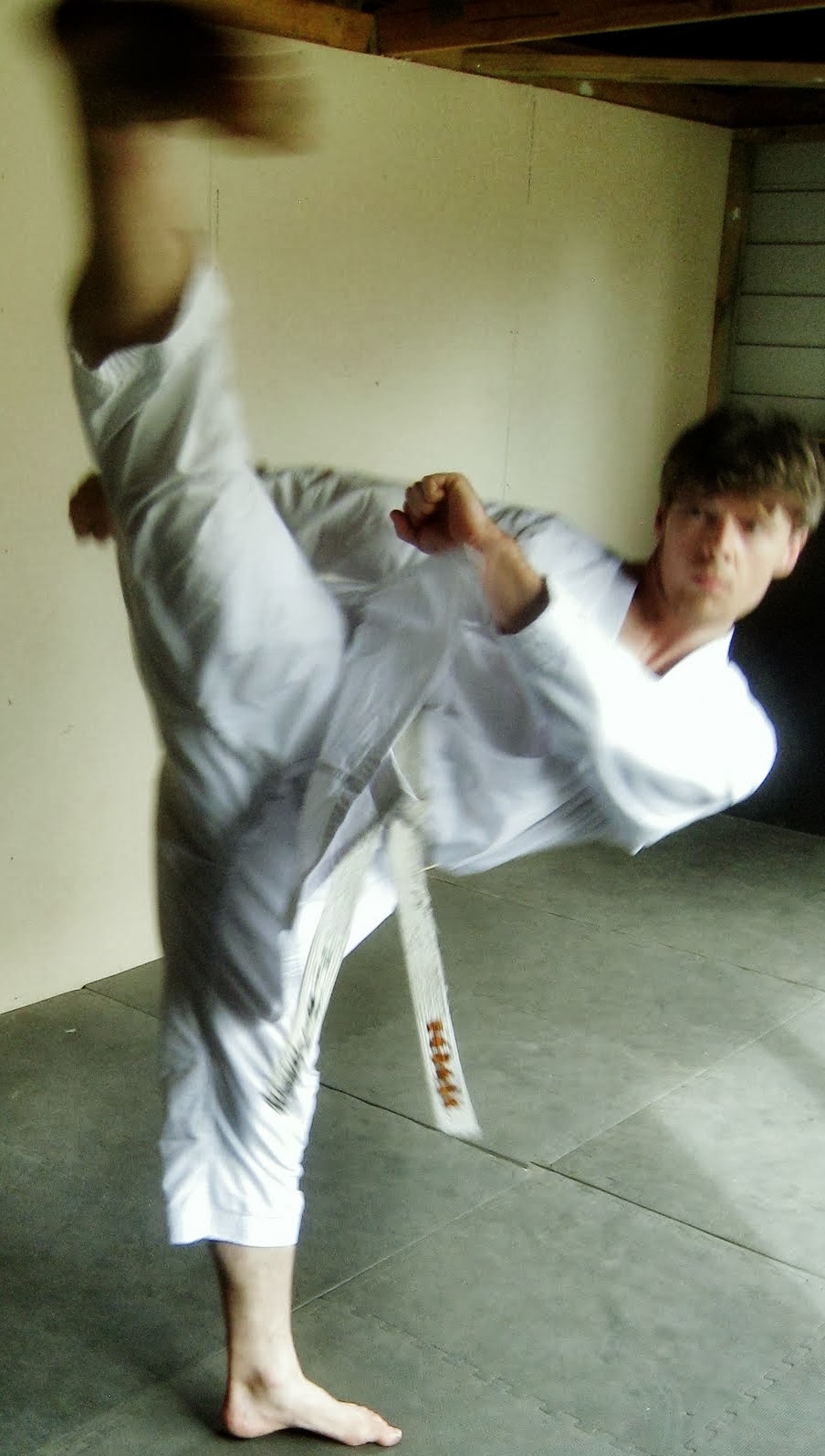
Kihon: (a) Kata specific kihon/sections; and (b) special focus on `two handed blocks’ (i.e. – chudan and jodan morote-uke; chudan uchi-uke doji ni gedan-barai; chudan and jodan juji-uke including the open hand variation; chudan kakiwake-uke; jodan uchi-uke doji ni gedan-barai etcetera).   
Kata: As alluded to above, at present the majority of my kata practice has been dedicated to the four sentei-gata: Bassai dai (披塞大), Jion (慈恩), Enpi (燕飛) and Kanku dai (観空大); and an unspecified/random mix of jiyu-gata. In regards to jiyu-gata, my interests remain focused on Nijushiho (二十四步) and also Bassai sho (披塞小); nevertheless, Kanku sho (観空小) and Unsu (雲手) have also been slipping in and out of my practice sessions.

Kumite:  Uchikomi and image training: (1) focusing on various forms of gyaku-zuki (employing sen no no, go no sen etc); (2) tai sabaki with a variety of techniques; and (3) deai-waza. In all cases, seeking `ippon technique’.
Overall, my repetitions (and intensity) of techniques, and kata, have been highly variable. This is directly attributable to the recovery process from the flu. On a positive note, this has allowed me to be more introspective and will, hopefully, allow me to `further mitigate' my many weaknesses.

Irrespective of all my shortcomings in karate-do, my goal is to simply keep moving forward and developing my spirit. I wish everyone who reads this the very best and good health. Oss, André.

© André Bertel. Aso-shi, Kumamoto-ken. Japan, 2014.

Wednesday, 29 January 2014

We can always adapt karate-do training according to our condition

Last week I was diagnosed with influenza.

Anyway, to keep my body moving (and practicing a little) whilst unwell and resting at home, I used the chance to go through small sections of kata. For example, movements 1-3 of Bassai Dai; various sections of Kanku Dai—especially the last quarter; gedan barai kara age-zuki in Empi; and the gedan-barai doji ni jodan uchi-uke (followed by both kagi-zuki and sokumen jodan morote-uke) in Jion.

Clearly, nothing can replace actual training sessions; nevertheless, this still gave me some aspects to work on whilst sick. My point is that, if we are determined enough, we can always adapt karate-do for our condition.

Finally, I’m back to the norm this week. However, in light of the aforementioned comment, I will be taking it easy: to allow my body ‘the chance’ to fully heal and, more importantly, to avoid a relapse. Kindest regards, from Kumamoto-ken, André.
© André Bertel. Aso-shi, Kumamoto, Japan (2014).

Sunday, 12 January 2014

MAAI

Maai (meeting distance), in traditional Karate-Do, is where you get yourself into a position where you can optimally impact on your opponent with the respective technique you’re employing; but also, (with this point in mind “as your priority”) a position which enables you to do this whilst making it “…most difficult for your opponent to attack you”.


Maai: from long to close range: At first, and throughout one’s training, the base of this practice is the long-range oi-waza; however, (with this as an ‘optimal position’ and ‘point of reference’) “…one must move on to also practice delivering effective close range blows”. I am not so much talking about close range techniques (i.e. empi-uchi, atama-uchi, hiza-geri etcetera); but rather, I am referring to any technique from a tight distance.

Maai for hangeki-waza: In countering one must automatically respond with the right technique instantly, depending on the maai. Kihon ippon kumite (Fundamental one-step sparring) and Jiyu ippon kumite (Free one-step sparring) form the base of this practice. For example, in close, immediately counter with mawashi-zuki, mae empi-uchi, ura-zuki. Middle distance, launch the seiken gyaku-zuki, teisho or nukite; further back, plant a kick. Of course, there are numerous methods of ashi-hakobi/unsoku which can allow one to deliver a great range of ‘first-seemingly inappropriate techniques’ (i.e. – switching legs in midrange to land a kizami-geri, keri-nuke or tobi konde empi-uchi); however, irrespective of this, for the most part—keep things simple and razor sharp. This is the beauty of traditional Shotokan-ryu.

The potential to achieve ichigeki-hissatsu: Every technique one throws in training must be effective, not just a visually fast and sharp move. Techniques must maximize the chances (that if you did not control your blow) it would seriously maim your training partner. For this reason, achieving ichigeki-hissatsu must be foremost in one’s mind—whilst adhering to the principles that underpin sun-dome.

Conclusion: Always remember that karate is not about practicing non-contact techniques: “…karate-waza are full contact techniques (with the maai distance to cause serious damage), which are controlled when practiced against a partner”. Osu, André.

© André Bertel. Aso-shi, Kumamoto, Japan (2014).

Sunday, 5 January 2014

Hip Alignment

Irrespective of the label on the photo, this was actually taken in Shonai, my father-in-law's hometown,  in 2006.
Alignment of the hips is very important as it allows your body to maximize movements; that is, optimal speed, power and mobility can be achieved. This is because, just like walking, `being aligned' is natural. Correspondingly, alignment also influences the optimization of one’s kokyu (breathing), but I will not address this aspect today.
Kaminari-arashi (circa 2003).


Intro: Many of the techniques of karate-do, especially the extended positions, really test our hip alignment. In every country, a major problem amongst karateka is that…"people change their posture and contor
t their bodies unnaturally when lowering/extending into stances”. Unsurprisingly, besides the lessening of technical prowess, being unnaturally twisted is unhealthy and, in the long term, has the potential to damage one’s body (especially under the forces that are exerted in martial arts training).

 Tips on checking your hip alignment: Of course, you can SELF-CHECK AND CORRECT the alignment of your hips easily using any karate-waza; nevertheless, to save you some time, here are the initial techniques I personally recommend using:
 
(A) By executing and self-checking 1. seiken choku-zuki in hachinoji-dachi; 2. the Tekki kata (kiba-dachi posing some interesting challenges with lateral techniques); and 3. kicking mae-geri in heisoku-dachi. In all three cases, keep "simple, square and perfectly balanced".  Think of your hips as identical twins!
 

Nijushiho in Nakatsu (2007). At the time, Nijushiho was `out of the question'...
(B) Following all of any of these three do the same in zenkutsu-dachi (keeping the previous points in mind). I recommend using the following three techniques for rapid progression: 1. stationary chudan gyaku-zuki (or kizami-zuki kara gyaku-zuki); 2. stationary mae-geri; and lastly 3. advancing with jun-zuki (oi-zuki) or sambon ren-zuki. The techniques from zenkutsu-dachi pose much more difficult challenges, especially the stationary mae-geri; however, this also leads to the removal of superfluous actions—thereby, also mitigating telegraphed actions in one's waza.  

Conclusion: Shotokan-ryu karate-do brings everything back to the most basic/natural/simple position. It is from this position where `the rules can be broken’… I think a major problem is that many Westerners approach karate without getting the simplest things 100% correct, such as hip alignment, and therefore fail to maximize their overall development. This in turn leads to ingrained habits which are difficult to rectify. I hope this post helps you to check and, if need be, correct your hip alignment.

I'd like to end by simple saying I have emphasised over the years: "Hanmi and gyaku-hanmi exist for zenmi/shomen." All the very best in your training! Osu, André.

© André Bertel. Aso-shi, Kumamoto. Japan (2014).