 |
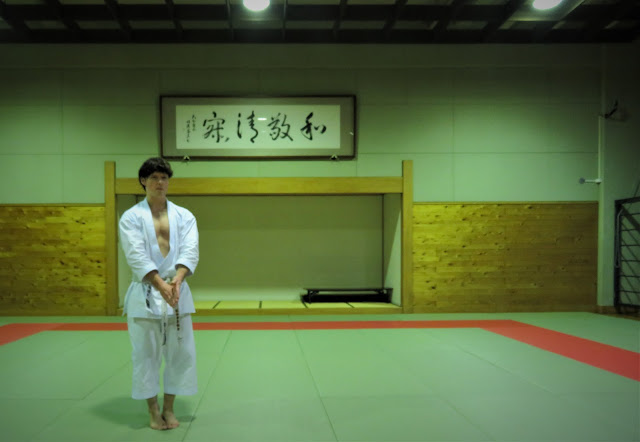
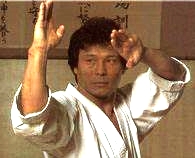
| Yahara Mikio Sensei, Heian Yondan Kata. |
Introduction and commentary:
The forth Heian kata is the longest in the series with 27
movements. The kiai are on movements 13 and 25 (uraken tatemawashi uchi and
hiza-tsuchi respectively). This kata and the fifth and final Heian kata
summarize the first three ‘base forms’, moreover, contain more variations of
self defense responses. These applications deal with varying circumstances and
are more sophisticated; thus, require higher skill levels to utilize.
That being said, as Funakoshi Gichin Sensei emphasized: “…
with mastery of the five Heian kata one can have confidence in their ability to
defend themselves”; furthermore, “…the name 平安
in Mandarin literally translates as ‘safety’, which specifically elucidates
this fact”.
An outstanding feature of Heian Yondan is an extensive amount
of keriwaza. There are six leg attacks including three jodan mae-geri keage,
two yoko-geri keage, and hiza-tsuchi.
While the kicks are practiced higher in training that is
primarily for ‘solo form training’. With a training partner these waza are low kicks
and are done in relation to where the opponent is to you. Yoko keage is the
product of improved karate; that is, improved karate for practical
self-defense. Rather than turning the hips to kick the opponents testicles—who
is at your side—instead ‘keage’/‘kick up’ from directly where you are. This
requires less ‘fine motor skills’ as sokuto is used, which requires less
accuracy for impact and also produces what I call a ‘bulk action’.
Another stand out point is the large use of double arm
techniques. Think about this for a moment. In total there are the two opening
actions followed by juji-uke then chudan morote uke. And it doesn’t stop there!
Finally, ryoken koshi gamae—movement five—concludes the double arm actions, but
not for long. After the simultaneous uraken and yoko keage enpi is impacted
onto to an open hand. Then of course is double arm open handed actions which
conclude with sword hand attack and simultaneous jodan kamae.
Not long after this in movement 14 and 17 Chudan kakiwake
uke is utilized, then the second to fourth advancement with chudan morote uke,
in kokutsu dachi, are executed. Last but not least, on the 25th count, there is
a cover and double handed head pull to impact with hiza-tsuchi.
Overall, we can readily see lessons from Kanku Dai in this
form but, indeed also other kata such as ‘reverse engineering’ from Jion.
Notice the absence of Kiba-dachi after its extensive use in Heian Sandan? That's not a coincidence and is dictated by jiku/seichusen training.
A key technical aspect in Heian Yondan is te-ashi onaji,
which is most notably challenged in the first two movements. Originally, these
two waza were performed rapidly; however, Funakoshi Sensei increased its
technical difficulty to more precisely be able to utilize in application.
Here are the 14 different waza featured in Heian Yondan:
1) Haiwan
sokumen jodan yoko-uke doji ni zenwan hitai mae yoko-gamae (Kokutsu-dachi).
2) Ryoken
gedan juji-uke (Zenkutsu-dachi).
3) Chudan
morote-uke (Kokutsu-dachi).
4) Ryoken
koshi-gamae (Migi/Hidari ashi dachi).
5) Sokuto
yoko-geri keage doji ni uraken jodan yokomawashi uchi (Migi/Hidari ashi dachi).
6) Mae-enpi
(Hidari zenkutsu-dachi).
7) Shuto
gedan-barai kara jodan-uke doji ni shuto jodan sotomawashi uchi (Hiza kutsu).
8) Jodan
mae-geri keage.
9) Te
osae-uke kara uraken jodan tatemawashi uchi (Kosa-dachi).
10) Ryoken
chudan kakiwake-uke (Kokutsu-dachi).
11) Chudan
oi-zuki (Zenkutsu-dachi).
12) Chudan
gyaku-zuki (Zenkutsu-dachi).
13) Ryoken
hiza ryogawa doji ni hiza-tsuchi (Hidari ashi dachi).
14) Chudan
shuto-uke (Kokutsu-dachi).
HEIAN YONDAN OVERVIEW
REI (Musubi-dachi).
YOI: Ryoken daitai mae (Hachiji-dachi).
1. Hidari haiwan hidari sokumen jodan yoko-uke doji ni migi
zenwan hitai mae yoko-gamae (Migi kokutsu-dachi).
2. Migi haiwan migi sokumen jodan yoko-uke doji ni hidari
zenwan hitai mae yoko-gamae (Hidari kokutsu-dachi).
3. Ryoken gedan juji-uke (Hidari zenkutsu-dachi).
4. Migi chudan morote-uke (Hidari kokutsu-dachi).
5. Ryoken migi koshi-gamae (Migi ashi dachi).
6. Hidari sokuto yoko-geri keage doji ni hidari uraken jodan
yokomawashi uchi (Migi ashi dachi).
7. Sasho ni migi mae-enpi (Hidari zenkutsu-dachi).
8. Ryoken hidari koshi-gamae (Hidari ashi dachi,
Okuribashi).
9. Migi sokuto yoko-geri keage doji ni migi uraken jodan
yokomawashi uchi (Hidari ashi dachi).
10. Usho ni hidari mae-enpi (Migi zenkutsu-dachi).
11. Hidari shuto sasho gedan-barai kara sasho jodan-uke doji
ni migi shuto jodan sotomawashi uchi (Hidari hiza kutsu).
12. Migi jodan mae-geri keage.
13. Sasho osae-uke kara migi uraken jodan tatemawashi uchi
(Migi ashi mae kosa-dachi)—KIAI!
14. Ryoken chudan kakiwake-uke (Migi kokutsu-dachi).
15. Migi jodan mae-geri keage.
16. Uken chudan oi-zuki (Migi zenkutsu-dachi).
17. Saken chudan gyaku-zuki
(Migi zenkutsu-dachi).
18. Ryoken chudan kakiwake-uke (Hidari kokutsu-dachi).
19. Migi jodan mae-geri keage.
20. Saken chudan oi-zuki (Hidari zenkutsu-dachi).
21. Uken chudan gyaku-zuki
(Hidari zenkutsu-dachi).
22. Hidari chudan morote-uke (Migi kokutsu-dachi).
23. Migi chudan morote-uke (Hidari kokutsu-dachi).
24. Hidari chudan morote-uke (Migi kokutsu-dachi).
25. Ryoken migi hiza ryogawa doji ni migi hiza-tsuchi
(Hidari ashi dachi)—KIAI!
26. Hidari chudan shuto-uke (Migi kokutsu-dachi).
27. Migi chudan shuto-uke (Hidari kokutsu-dachi).
Naore: Ryoken daitai mae (Hachiji-dachi).
Rei (Musubi-dachi).
To conclude I'd like to stress, yet again, that the Heian series were not designed for school children. However, they were used to introduce karate (into the Okinawa elementary school system) due to them being condensed variations of the classical forms, which were much less suited. Therefore, while they are not long kata, the applicative content they have is no less dangerous than their predecessors. This is why Master Funakoshi said what he did and should be closely noted. OSU!
© André Bertel. Oita City, Japan (2022).