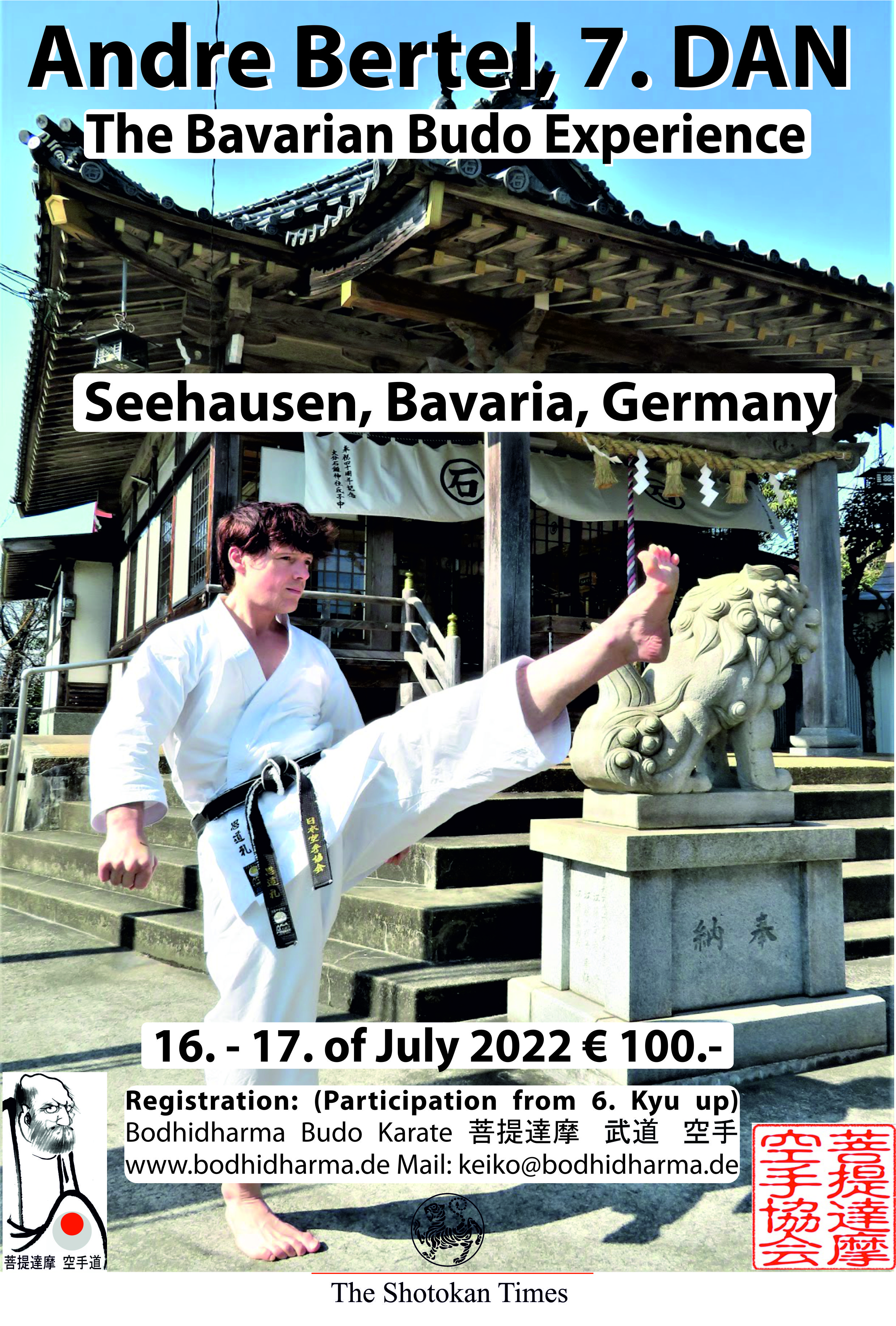
Greetings from Japan. The seminar in Seehausen, Bavaria, is all go!
To reserve a place you should contact the organizer, Mr. Punito, via the email at the bottom of the poster.
See you in Deutschland, OSU.
 |
I often get asked, where’s the SEARCH Function? Well, it’s always here, but if you are using a mobile phone it’s not visible unless you change to what's called the 'VIEW WEB VERSION'.
To do this scroll down on your phone to the near bottom of
the page until you find the red bar which says ‘Home’ in white (you can see this by checking the bottom of the next photo).
Immediately, under this is ‘View web version’.
Click on
this, and you will find the SEARCH function at the very top left corner of the
page.
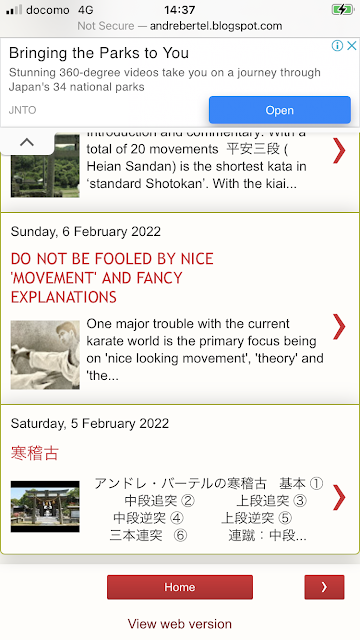 |
| Click on the 'View web version' immediately above. |
It’s that simple and from there you can easily comb through 15 years of articles here on the site.
Emails: Still, if you have any questions you are welcome to email me
at: andrebertelono@gmail.com I tend to receive a large amount of emails each
day, so I can’t physically answer them all. It would literally be impossible.
That being said, when ‘a specific theme becomes requested enough’, I will
usually answer via an article. An example of this is the recent Heian articles.
Of course, when possible or deemed necessary, I also answer
people and groups back personally: via email.
Overall, I hope that this post allows you to better navigate
the site. I’d also like to thank the thousands of Budo Karateka, here in Japan
and around the world, who have supported and followed this site. There are lots
of great things to come and many projects in the works.
 |
© André Bertel. Oita City, Japan (2022).
 |
| Said by seniors to be Nakayama Sensei's closest follower, Abe Keigo Sensei. |

Introduction and commentary:
With 23 movements 平安五段 (Heian Godan) completes this series of kata and, like Yondan, is a summary of the fundamentals found in Nidan, Shodan and Sandan; moreover, an extension of these to deal with alternative situations in unarmed self-defense. Accordingly, it features flinch responses/striking; responses upon connection to the opponent(s); gatame-waza (locks); and nagewaza (throwing techniques).
An important lesson from this formal exercise is to avoid
blurring techniques; that is, when renzokuwaza are used (and there are many in this short kata) you make each action
fully with kime.
Movements one to six feature an application principle on
both sides and can be used according to the position of the opponent. The wind
up and weight drop with uchi-uke dropping into kokutsu-dachi must be maximized.
Likewise the snatch and tsuki followed by tai-sabaki and zenwan mizu nagare no
gamae, which functions as an ude-gatame (arm lock).
Once again, remnants of yondan are found in movement seven
by the use of an advancing kokutsu-dachi and the execution of chudan
morote-uke. This is occurs again one more later in the kata (movement 20), albeit in a different stance (migi ashi zenkutsu), which is a telltale.
Movements eight to twelve involves ryoken gedan juji-uke
follow by ryosho jodan juji-uke, ryosho juji chudan osae-uke, follow rapidly by
nobashi-zuki (uke-zuki/hiji suri-zuki) flowing immediately into chudan oi-zuki.
This sequence also involves locking and impacting. Be sure that ryosho juji
chudan osae-uke drops directly downward as opposed to being brought closer to
your body.
On movement 13 which is migi sokumen gedan-barai there are
two ways. One with and one without fumikomi. I personally still do the ‘Best
Karate’ version with the stamp, which is consistent with movement 26 of Bassai
Dai; however, both ways are equally effective. In this case, I advise everyone
to experiment with the best version for themselves when applying this waza in
Oyo Kumite and the other essential forms of 'kata based goshin-jutsu practice'.
Movements 14 to 16 involves trapping the opponent then
impacting with mikazuki-geri then pulling them into an enpi. Kick chudan in
solo Kate training but, in application, make a big slap to the opponents inside
thigh or groin to fold them in half; thereby, chudan becomes jodan with your
elbow. This is a very powerful and reliable sequence which very little fine motor skills and accuracy. Just focus "...on a relaxed and snapping swing of the leg and sharp and soft shoulder to deeply plant the tip of your elbow".
Movements 17 to 19 conclude with the first high jump in the
Shotokan Kata, however, this is literally throwing oneself when practicing Godan as a solo routine. These three
movements are, in fact, the set up and execution of 背負い投げ (Seoi-nage).
Once again chudan morote-uke is applied again here in movement 20 (as mentioned above) but this
time in the straight lined zenkutsu. By this stage the karateka must be well
versed "that as this waza (within Heian), is always in isolation"; hence, it is always a
simultaneous defense and attack.
To conclude movements 21 to 23 apply a take down and,
alternatively arm lock and neck wrench on both sides. This also trains "hip work
and transitions from zenkutsu to kokutsu-dachi in harmony with the shuto gedan
uchikomi and classical Shotokan ‘manji’ formations" (which was a vast technical improvement on the Okinawan version, which was allegedly masterminded by Master Funakoshi and/or his son).
Here are the 17 different waza featured in Heian Godan:
1. Chudan
uchi-uke(Kokutsu-dachi).
2. Chudan
gyaku-zuki (Kokutsu-dachi).
3. Zenwan
mizu nagare no gamae (Heisoku-dachi).
4. Migi
chudan morote-uke (Kokutsu-dachi).
5. Ryoken
gedan juji-uke (Kokutsu-dachi).
6. Ryosho
jodan juji-uke (Zenkutsu-dachi).
7. Ryosho
juji chudan osae-uke (Zenkutsu-dachi).
8. Chudan
oi-zuki (Zenkutsu-dachi).
9. Sokumen
gedan-barai (Kiba-dachi).
10. Tekubi
sokumen chudan kake-uke (Kiba-dachi).
11. Chudan
mikazuki-geri (Ichi ashi dachi).
12. Mae-enpi
(Kiba-dachi).
13. Sokumen
chudan morote-uke (Kosa-dachi).
14. Uho
tsuki-age (Renoji-dachi).
15. Tobi-komi
kara ryoken gedan juji-uke (Kosa-dachi).
16. Chudan
morote-uke (Zenkutsu).
17. Jodan
nagashi-uke doji ni shuto gedan uchikomi kara sokumen jodan uchi-uke doji ni
sokumen gedan-uke (Zenkutsu kara kokutsu-dachi soshite heisoku-dachi).
From the many tegumi-waza (grappling techniques) in the
‘basic’ Heian we can see and learn “… a complete system of self-defense. This, as
opposed to ‘impacting/striking arts’, and ‘grappling arts’, being separated/compartmentalized”. Indeed, before competition Karatedo (and, of course,
competition Judo, as well) budo was bujutsu. Hence, for the traditional karateka: "...in unarmed self-defense, striking and grappling are absolutely inseparable entities".
Once karate practitioners, get through to practicing Heian Godan and have sufficient physicality in all five Heian kata, it is
important that they are well into flow drills dealing with realistic
self-defense scenarios; moreover, this training cannot be merely an occasional novelty but,
rather, included in daily practice. Allow me to quote Asai Tetsuhiko Sensei
here: “Kata can teach you how to fight, but not by merely doing
them”. What he meant was "just doing the moves is not enough. With that in mind, I’ll now move on to a generic overview of Heian Godan.
HEIAN
GODAN OVERVIEW
REI (Musubi-dachi).
YOI: Ryoken daitai mae (Hachiji-dachi).
1. Hidari
sokumen hidari chudan uchi-uke (Migi kokutsu-dachi).
2. Uken
chudan gyaku-zuki (Migi kokutsu-dachi).
3. Hidari
zenwan mizu nagare no gamae (Heisoku-dachi).
4. Migi
chudan uchi-uke (Hidari kokutsu-dachi).
5. Saken
chudan gyaku-zuki (Hidari kokutsu-dachi).
6. Migi
zenwan mizu nagare no gamae (Heisoku-dachi).
7. Migi
chudan morote-uke (Hidari kokutsu-dachi).
8. Ryoken
gedan juji-uke (Hidari zenkutsu-dachi).
9. Ryosho
jodan juji-uke (Hidari zenkutsu-dachi).
10. Ryosho
juji chudan osae-uke (Hidari zenkutsu-dachi).
11. Saken
chudan nobashi-zuki (Hidari zenkutsu-dachi).
12. Uken
chudan oi-zuki (Migi zenkutsu-dachi)—KIAI!
13. Migi
sokumen migi gedan-barai (Kiba-dachi).
14. Hidari
tekubi hidari sokumen chudan kake-uke (Kiba-dachi).
15. Sasho ni
migi chudan mikazuki-geri (Hidari ashi dachi).
16. Sasho ni
migi mae-enpi (Kiba-dachi).
17. Migi
sokumen chudan morote-uke (Migi ashi mae kosa-dachi).
18. Uken uho
tsukiage (Hidari ashi mae renoji-dachi).
19. Tobi-komi
kara ryoken gedan juji-uke (Migi ashi mae kosa-dachi)—KIAI!
20. Migi
chudan morote-uke (Migi ashi zenkutsu).
21. Sasho
jodan nagashi-uke doji ni migi shuto gedan-uchikomi (Hidari ashi zenkutsu) kara
migi sokumen jodan uchi-uke doji ni hidari sokumen gedan-uke (Migi
kokutsu-dachi).
22. Jotai-sonomama
(Heisoku-dachi).
23. Usho jodan
nagashi-uke doji ni hidari shuto gedan-uchikomi (Migi ashi zenkutsu) kara
hidari sokumen jodan uchi-uke doji ni migi sokumen gedan-uke (Hidari
kokutsu-dachi).
NAORE: Ryoken daitai mae (Hachiji-dachi).
REI (Musubi-dachi).
In fact, it’s not an overstatement to say that 'Osaka Sensei
almost references Heian for everything else in karate' which, again, elucidates
their criticality for us Shotokan practitioners. While not 'mind boggling spectacular' like Osaka Sensei (in
external performance of his kata) I also enjoyed Abe Keigo Sensei’s teaching style. Moreover, it is said by many of my seniors that "...Abe Sensei’s
Karate was closest to Nakayama Sensei":
at least ‘teaching-wise’. Needless to say, anyone who can break things down into
simple parts, and make it accessible for everyone, is an expert teacher. I admire that he could teach kihon and kata that way, even though his fame came from being a ferocious kumite man. His waza of choice were uchiwaza and keriwaza, both of which were feared. In addition to his bushi lineage, he really had Samurai spirit. Accordingly, in light of this, I can’t help but think of Abe Sensei’s exceptional budo teaching
skill in addition to his background and karate specialties.
It’s interesting to consider that with the Heian combined,
the total number of official movements is 117, which is significantly longer
than any other kata (standard Shotokan or Koten-gata). Maybe this point is
trivia, but for me, unless only focusing on one Heian, I tend to do them all in
succession followed by the oyo (applications). In this way, the consistent themes and
progressive extensions of these can be practiced in a systematic manner. Needless to say, before this approach can be done, one must have good knowledge
of the 基本技
(Kihonwaza) in all five. This highlights a very important point: “One can know
all the applications, but without sufficient physicality (as alluded to above in this article), this also will have
no meaning.” Consequently, balance in training is utterly imperative.
With this mind, whilst the meaning of the characters 平安 in Chinese (Mandarin) means ‘SAFETY’—referring to self defense mastery so one is 'safe'; whereas, the Japanese reading of the kanji is interpreted as ‘PEACEFUL’. It is important for me to say here that the Japanese reading is also essential for complete knowledge. This relevance is related to having ‘a calm mind’ and a ‘relaxed body’ in order to optimally use it in self-defense. Taken as a whole, this indeed gives “…a complete understanding of the name PINAN/HEIAN” and, more usefully for one’s daily training, “what the core physical objectives of these five kata are”. It also shows the intellectual genius of the formulator of these kata: Itosu Anko Sensei. 押忍 ― André


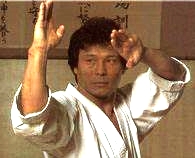 |
| Yahara Mikio Sensei, Heian Yondan Kata. |
Introduction and commentary:
That being said, as Funakoshi Gichin Sensei emphasized: “…
with mastery of the five Heian kata one can have confidence in their ability to
defend themselves”; furthermore, “…the name 平安
in Mandarin literally translates as ‘safety’, which specifically elucidates
this fact”.
An outstanding feature of Heian Yondan is an extensive amount
of keriwaza. There are six leg attacks including three jodan mae-geri keage,
two yoko-geri keage, and hiza-tsuchi.
While the kicks are practiced higher in training that is
primarily for ‘solo form training’. With a training partner these waza are low kicks
and are done in relation to where the opponent is to you. Yoko keage is the
product of improved karate; that is, improved karate for practical
self-defense. Rather than turning the hips to kick the opponents testicles—who
is at your side—instead ‘keage’/‘kick up’ from directly where you are. This
requires less ‘fine motor skills’ as sokuto is used, which requires less
accuracy for impact and also produces what I call a ‘bulk action’.
Another stand out point is the large use of double arm
techniques. Think about this for a moment. In total there are the two opening
actions followed by juji-uke then chudan morote uke. And it doesn’t stop there!
Finally, ryoken koshi gamae—movement five—concludes the double arm actions, but
not for long. After the simultaneous uraken and yoko keage enpi is impacted
onto to an open hand. Then of course is double arm open handed actions which
conclude with sword hand attack and simultaneous jodan kamae.
Not long after this in movement 14 and 17 Chudan kakiwake
uke is utilized, then the second to fourth advancement with chudan morote uke,
in kokutsu dachi, are executed. Last but not least, on the 25th count, there is
a cover and double handed head pull to impact with hiza-tsuchi.
Overall, we can readily see lessons from Kanku Dai in this
form but, indeed also other kata such as ‘reverse engineering’ from Jion.
Notice the absence of Kiba-dachi after its extensive use in Heian Sandan? That's not a coincidence and is dictated by jiku/seichusen training.
A key technical aspect in Heian Yondan is te-ashi onaji,
which is most notably challenged in the first two movements. Originally, these
two waza were performed rapidly; however, Funakoshi Sensei increased its
technical difficulty to more precisely be able to utilize in application.
Here are the 14 different waza featured in Heian Yondan:
1) Haiwan sokumen jodan yoko-uke doji ni zenwan hitai mae yoko-gamae (Kokutsu-dachi).
2) Ryoken
gedan juji-uke (Zenkutsu-dachi).
3) Chudan
morote-uke (Kokutsu-dachi).
4) Ryoken
koshi-gamae (Migi/Hidari ashi dachi).
5) Sokuto
yoko-geri keage doji ni uraken jodan yokomawashi uchi (Migi/Hidari ashi dachi).
6) Mae-enpi
(Hidari zenkutsu-dachi).
7) Shuto
gedan-barai kara jodan-uke doji ni shuto jodan sotomawashi uchi (Hiza kutsu).
8) Jodan
mae-geri keage.
9) Te
osae-uke kara uraken jodan tatemawashi uchi (Kosa-dachi).
10) Ryoken
chudan kakiwake-uke (Kokutsu-dachi).
11) Chudan
oi-zuki (Zenkutsu-dachi).
12) Chudan
gyaku-zuki (Zenkutsu-dachi).
13) Ryoken
hiza ryogawa doji ni hiza-tsuchi (Hidari ashi dachi).
14) Chudan
shuto-uke (Kokutsu-dachi).
REI (Musubi-dachi).
YOI: Ryoken daitai mae (Hachiji-dachi).
1. Hidari haiwan hidari sokumen jodan yoko-uke doji ni migi
zenwan hitai mae yoko-gamae (Migi kokutsu-dachi).
2. Migi haiwan migi sokumen jodan yoko-uke doji ni hidari
zenwan hitai mae yoko-gamae (Hidari kokutsu-dachi).
3. Ryoken gedan juji-uke (Hidari zenkutsu-dachi).
4. Migi chudan morote-uke (Hidari kokutsu-dachi).
5. Ryoken migi koshi-gamae (Migi ashi dachi).
6. Hidari sokuto yoko-geri keage doji ni hidari uraken jodan
yokomawashi uchi (Migi ashi dachi).
7. Sasho ni migi mae-enpi (Hidari zenkutsu-dachi).
8. Ryoken hidari koshi-gamae (Hidari ashi dachi,
Okuribashi).
9. Migi sokuto yoko-geri keage doji ni migi uraken jodan
yokomawashi uchi (Hidari ashi dachi).
10. Usho ni hidari mae-enpi (Migi zenkutsu-dachi).
11. Hidari shuto sasho gedan-barai kara sasho jodan-uke doji
ni migi shuto jodan sotomawashi uchi (Hidari hiza kutsu).
12. Migi jodan mae-geri keage.
13. Sasho osae-uke kara migi uraken jodan tatemawashi uchi
(Migi ashi mae kosa-dachi)—KIAI!
14. Ryoken chudan kakiwake-uke (Migi kokutsu-dachi).
15. Migi jodan mae-geri keage.
16. Uken chudan oi-zuki (Migi zenkutsu-dachi).
17. Saken chudan gyaku-zuki
(Migi zenkutsu-dachi).
18. Ryoken chudan kakiwake-uke (Hidari kokutsu-dachi).
19. Migi jodan mae-geri keage.
20. Saken chudan oi-zuki (Hidari zenkutsu-dachi).
21. Uken chudan gyaku-zuki
(Hidari zenkutsu-dachi).
22. Hidari chudan morote-uke (Migi kokutsu-dachi).
23. Migi chudan morote-uke (Hidari kokutsu-dachi).
24. Hidari chudan morote-uke (Migi kokutsu-dachi).
25. Ryoken migi hiza ryogawa doji ni migi hiza-tsuchi
(Hidari ashi dachi)—KIAI!
26. Hidari chudan shuto-uke (Migi kokutsu-dachi).
27. Migi chudan shuto-uke (Hidari kokutsu-dachi).
Naore: Ryoken daitai mae (Hachiji-dachi).
Rei (Musubi-dachi).
To conclude I'd like to stress, yet again, that the Heian series were not designed for school children. However, they were used to introduce karate (into the Okinawa elementary school system) due to them being condensed variations of the classical forms, which were much less suited. Therefore, while they are not long kata, the applicative content they have is no less dangerous than their predecessors. This is why Master Funakoshi said what he did and should be closely noted. OSU!

© André Bertel. Oita City, Japan (2022).

Here's some images from my training today, which was a light one (as I’ve pushed myself particularly hard this week). I only did kata and had breaks between each. Also, I only spent just over an hour and 45 minutes in the dojo. Usually my daily self-training sessions are two hours in duration.
 |
| Movement 22 of Unsu Kata. |
The kata I practiced were especially 平安初段 (Heian
Shodan) and 平安四段(Heian
Yondan),but also briefly on Heian Nidan, Sandan and Godan, 壮鎮 (Sochin), 雲手 (Unsu),
五十四歩小 (Gojushiho
Sho) and 雷光 (Raiko).
 |
| Movement 25 of Heian Yondan. |
Overall, it was both a fun and technical session. I personally believe that it is imperative to intermittently train with less intensity as it allows one to focus on different areas of skill development; furthermore, allows the body to stretch, rest and recover. What’s more, it can a be psychologically motivating, which results in more doing those extra sessions in the week even though one is feeling tired.

Osu and greetings from central Oita City, Japan.
アンドレ
© Andre Bertel. Oita City, Japan (2020).

カキエ (Kakie) is an important practice method for developing sensitivity to one’s opponent. Commonly referred to as ‘Pushing hands’ or ‘Sticky hands’ it is predominantly found in the Chinese arts, such as Tai Chi and the various forms of White Crane Fist; accordingly, it naturally entered into the Tode/Karate of Okinawa. It is well known that Kakie became integral part of the classical Okinawan wrestling: 手組 (TEGUMI) / 無刀 (MUTO).
It is actually said that, the refined punching, kicking and striking techniques entered karate later; nevertheless, based on humans fighting throughout history, percussive blows were certainly there: but possibly not so refined. Irrespective, of what came first, and what degree of sophistication everything evolved, one thing is clear: punches, striking and kicking were always mixed with grappling and, indeed, vice-versa. Kata irrefutably verifies this fact.

I need to clarify here that I’m not referring to the ‘bunkai’ (‘analysis’) that was largely put together after the Second World War but, rather, the pre-WW2/pre-competition bunkai: the OYO (which were/are practical ‘applications’)
What makes this basic understanding so important, is that it allows one to really understand and practice karate as a complete defensive art. That is, real fighting/self-defense has never been compartmentalized. Compartmentalization, by nature, has come from having rules; thus namely, from adaptations for ‘sports competition’. The purpose of this being: (a) to make the respective matches more entertaining for spectators; (b) safety; and (c) a combination of both of these.
Of course, on Okinawa, many styles still practice kakie and tegumi. Ironically, the Okinawan styles also benefit from the dynamic elements of ‘mainland Japanese karate’ when the emphasis is on budo/bujutsu (that is, to achieve ichigeki-hissatsu). These dynamic refinements—when not watered down into sports karate—demonstrate a positive evolution of the art. In sum, in regards to this: neither the karate of Okinawa nor that of mainland Japan are superior—that being said, “…there are, certainly superior ways to practice if the aim is to develop reliable karate for self-defense”.

For those in Shotokan wishing to
decompartmentalize their karate and return it to the complete form, Kakie is
certainly a good starting point; furthermore, a useful element of training
irrespective of skill level and experience. Much like ‘Jiyu Ippon Kumite
bridges to Jiyu Kumite’, Kakie connects us to the grappling techniques (and
links this to striking). Osu, André
© André Bertel. Oita City, Japan (2020).


