Saturday, 5 June 2021

巻落し受け (Makiotoshi-uke)

While there are some stylistic differences the two handed ‘windmill’ like reception is found in most ryuha/kaiha. In Shotokan, it is known as 巻落し受け (Makiotoshi-uke); however, in most styles it is termed 回し受け (Mawashi-uke). So today, I thought I’d write about the difference between these two labels; moreover, some other aspects pertaining to this technique of karate. Before I delve in, I’d like to warn you—the reader—that I’m writing rather quickly and freely today; consequently, this article may turn out to be less structured than usual. OK, so that said and done, let’s begin!


1.0        The difference between the terms:

Basically 回し (Mawashi) describes the movement, round/turning (commonly termed roundhouse) or turning 受け (reception) i.e. mawashi-geri, mawashi-zuki etcetera. Whereas, (Maki) means wrapping and 落し translates as falling. Accordingly, 巻落し受け (Makiotoshi-uke) means ‘wrapping falling reception’, which ‘more than describes the physical action/motion’ additionally ‘describes its application in relation to an actual opponent/attacker’. In this regard, think ‘makiwara’ (rolled straw) or ‘temaki-zushi’ (hand rolled sushi).


1.1        Its practice in the ‘standard Shotokan kata’:   

In Shotokan ‘the larger scale versions’ only appears three times in the standard 26 kata: the full version twice in 雲手(Unsu- movements 45 and 46 respectively. And once in 二十四歩 (Nijushiho) movement 34. The two in Unsu, as said before, are full-scale; whereas, the final movement of Nijushiho is a roughly halved. However, the smaller versions such as ‘Shuhai tekubi osae-uke appear in 十手 (Jitte) movement one (reference: Osaka Yoshiharu Sensei); and earlier in Nijushiho – ‘movement 16’ (which Asai Sensei termed ‘‘Tekubi kake-uke’). Certainly, these waza are effective, however, not as versatile as a full scale makiotoshi-uke (as these waza are also contained within it).  


1.2        The ‘Makiotoshi-uke’ kata of Shotokan-Ryu:   

When we consider that the full version of 巻落し受け (Makiotoshi-uke) is featured eight times in 百八歩 (Hyakuhappo/Hyakuhachihoour version of Suparinpei/Pechurin) and, in fact, nine times ‘in application’ (if we include movement 35 (‘Tekubi kake-uke) immediately after the final makiotoshi uke and teisho awase-zuki).


This aspect in isolation readily clarifies the technical value of this kata; however, more important, in my opinion, is the vast use of 三戦立ち (Sanchin-dachi) and generating power from this position, which is also largely neglected within standard Shotokan training. While these are merely two points of this kata, and there are indeed many others, we can again see the importance of this kata. It is well worth noting here that it is said that Hyakuhappo entered Shotokan through Nakayama Masatoshi Sensei and his close friendship with Yamaguchi Gogen Sensei.

It is also worth noting here that Some Wado Ryu groups also have their version of Suparinpei which also allegedly “…entered their style via their founder, Hironori Otsuka Sensei’s relationship with Yamaguchi Sensei”. 


1.3        Makiotoshi-uke is a highly effective 古典技 (Classical technique):

Makiotoshi-uke is a highly effective waza in self-defense as it is easy and natural to apply. This is because it utilizes natural energy via the use of the circular action of the waza; furthermore, it makes the most of both gravity (by ‘dropping’) and disruptive angles (by ‘rolling’/’wrapping’). Added to this requires very minimal fine motor skills to apply, which is of course optimal for reliability when facing a sudden assault. That being said, it is not a waza for karate ‘competition kumite’ (except in the use a kamae and/or kenseiwaza); therefore, much of mainstream Shotokan merely practices it in the performance of Nijushiho and Unsu. This is a real shame as makiotoshi-uke is the basis for many defense and follow up counterattacks—as said before—for actual self-defense.


1.4        The ‘other kata‘ with makiotoshi-uke and critical partner drills

In addition to these kata, and 百八歩, I personally teach makiotoshi-uke in 古典型 such as 明鏡二段 (Meikyo Nidan), 掌手大 (Shote Dai), 安三 (Ansan) and many others. More importantly, we practice applying it in close range kumite/self-defense drills (Goshin-jutsu/Oyo-Kumite).


If one’s aim is merely ‘fist kendo’ and ‘to score points’, perhaps this waza is only for those wishing to look nice in the performance of their kata; nevertheless, if one is interested in karate as bujutsu, makiotoshi-uke is highly versatile technique (which can defend, impact, lock, take down, throw and choke an opponent). In sum, makiotoshi-uke is a waza that reflects pre-WW2 karate, which was not a sport but, rather, a complete system of self-defense. I will conclude on that note today.

押忍! André

© André Bertel. Oita City, Japan (2021).

Tuesday, 1 June 2021

Initial Summer Training Regime

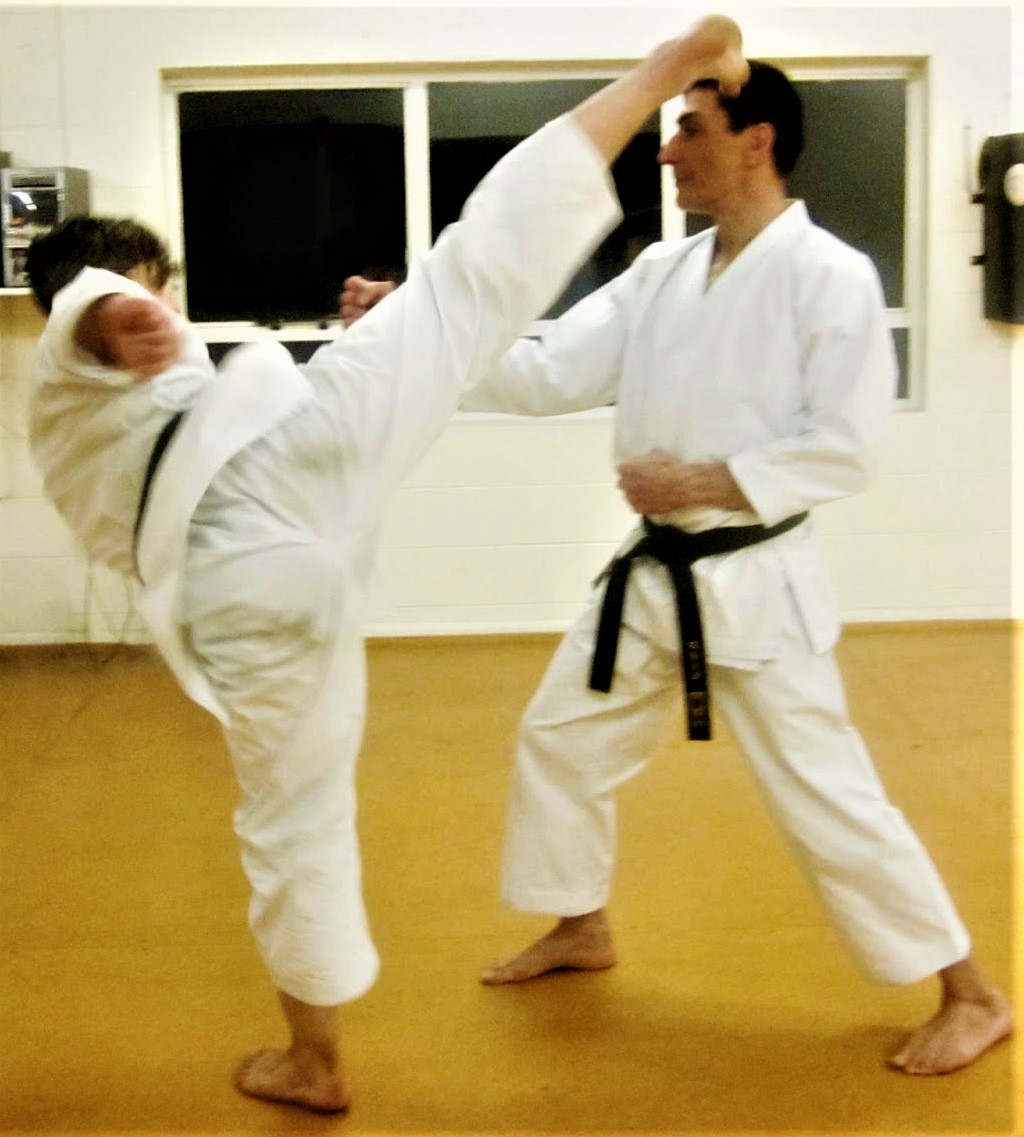
Jodan mawashi-geri on one of my senior students, Lyall Stone (4th Dan).

Here’s my updated self-training regime for Natsu (Summer). I am particularly ‘genki’ as Summer is by far my favorite season here in Kyushu! The dojo I now rent has automated and state-of-the-art air conditioning; consequently, when I want to ‘turn up the heat’, I simply do my training outdoors at a local Jinja (Shrine) or Tera (Temple). Nothing has changed!


Today for my regime, I’ve also included reps to give some indicator of workout intensity. This entire routine, including rests, is completed in just under three hours each day. As always, I am keeping a training log with progression and analysis. So here we go!


基本(KIHON)


Sonoba Kihon

1.     Chudan choku-zuki (Hachinoji-dachi)

2.     Chudan mae-geri keage (Heisoku-dachi).

3.     Hidari kizami-zuki kara migi chudan gyaku-zuki (Hidari zenkutsu-dachi).

4.     Migi kizami-zuki kara hidari chudan gyaku-zuki (Migi zenkutsu-dachi).

5.     Migi chudan mae-geri keage (Hidari zenkutsu-dachi).

6.     Hidari chudan mae-geri keage (Migi zenkutsu-dachi).


·        10 slow ‘warm up reps’ followed by a minimum of 30 reps with speed.


Ido Kihon

7.     Sanbon ren-zuki (Fudo-dachi/Zenkutsu-dachi/Fudo-dachi).

8.     Mae-geri keage kara oi-zuki.

9.     Mawashi-geri kara gyaku-zuki.

10.Ushiro-geri kekomi kara uraken yokomawashi uchi soshite gyaku-zuki.

11.Yoko-geri keage ashi o kaete yoko-geri kekomi (Kiba-dachi).

12.Jodan age-uke kara mae-geri keage soshite gyaku-zuki.

13.Chudan soto-uke kara yori-ashi yoko enpi-uchi (Kiba-dachi), uraken yokomawashi uchi soshite gyaku-zuki.

14.Chudan shuto-uke (Kokutsu-dachi) kara kizami mae-geri soshite tateshihon nukite.

15.Gedan-barai kara chudan uchi-uke (Nekoashi-dachi), maete ura-zuki soshite gyaku-zuki.


·        10 reps—five in each direction with speed (with the exception of yokokeage/kekomi: three repetitions in each direction). At present I am focusing more on keriwaza in my kihon; therefore, when kicks are trained with or without arm techniques I tend to 40-100 reps on average.


組手(KUMITE)

五本組手 (Gohon Kihon)

1.     Attack: Jodan (Jodan oi-zuki). Defense: Jodan age-uke: Hangeki—Free choice.


2.     Attack: Chudan (Chudan oi-zuki). Defense: Chudan soto-uke: Hangeki—Free choice.


3.     Attack: Maegeri (Chudan mae-geri keage). Defense: Gedan-barai: Hangeki—Free choice.


4.     Attack: Jodan (Jodan oi-zuki). Defense: A different jodan no ukewaza each time: Hangeki—Free choice.


5.     Attack: Jodan (Chudan oi-zuki). Defense: A different chudan no ukewaza each time: Hangeki—Free choice.


6.     Attack: Maegeri (Chudan mae-geri keage). A different mae-geri no ukewaza each time: Hangeki—Free choice.


·        One rep of each complete drill—attack and defensive aspects—once, followed by a minimum of three times fully with speed. Ideally with training partners but, of course, this can also be done as solo practice. I find that a mix of both is optimal as Gohon Kumite is in fact ‘partner kihon moreso than 'kumite for fighting’. Some may contest this point, however, this view is based on pragmatism and the training of seniors such as Asai Tetsuhiko Sensei, Nakamura Masamitsu Sensei, Osaka Yoshiharu Sensei and indeed others.


(KATA)


平安初段 (Heian Shodan).

鉄騎三段 (Tekki Sandan).

燕飛 (Enpi).

慈恩 (Jion).

五十四歩小 (Gojushiho Sho).

古典型 (Koten-gata): A random kata from Asai Sensei based on my daily aims and/or shortcomings; for example, today I worked on 安三 (Ansan), which is a kata practiced in some other styles, but we have a different and completed version from Tomari-Te. 


·        Five reps per kata. One slowly, followed by four with regular speed northward, eastward, southward, and finally westward. 


 I’ll wrap up on that note! Best wishes in your training and good health.

 Osu!


©André Bertel. Oita City, Japan (2021).

Friday, 21 May 2021

EMBRACE THE CHALLENGE AND FORGET THE EGO!


I have received many requests to post videos on two particular Shotokan-Ryu Kata:


慈韻 JIIN (SHOKYO)

百八歩   HYAKUHAPPO (HYAKUHACHIHO, SUPARINPEI)


Today, in my self-training, in the kata portion of my practice I focused on these two kata, which are both very-difficult for me. I will do my best to refine them more and share them in the future. But unlike other kata, I’m not ready with these two yet.


I also find 王冠(Wankan) very difficult; however, I ‘took the plunge’ and posted that in the past. I have no regrets about that, but I need to expand my skill within its waza (technique) and oyo (applications).


My point in this post is just a simple message, but an important one! If we are talking about karate as BUDO / BUJUTSU, it is impossible to PERFECT ALL OF THE KATA. ‘Looking nice’ for competition is—of course—possible (with unlimited kata, if the individual is athletically talented and determined); however, this is ‘performance karate’ not ‘effective fighting karate’.


To conclude, I was taught many different kata; however, this teaching was not for me, it was for my students/trainees.


Don’t feel disappointed when you can’t do a particular kata well, nor use it in kumite. Instead, be happy that you have discovered that is no good for you. Moreover, that might change in the future as you change! This is one of the beauties of Karate-Do as a lifetime art.


EMBRACE THE CHALLENGE AND FORGET THE EGO!


Greetings from Oita City, Japan.

André


  © André Bertel. Oita City, Japan (2021).
Wednesday, 19 May 2021

Minimum tenure and age between advancement in DAN (as established by Nakayama Masatoshi Sensei)

段位習得に関する期間


空手道を2年以上練習した者、かつ1級の証書を保持している者が初段審査を受ける事ができる。


初段取得後1年間の練習を経て2段の審査を受ける事ができる。


2段取得後2年間の練習を経て3段の審査を受ける事ができる。


3段取得後3年間の練習を経て4段の審査を受ける事ができる。


4段取得後4年間の練習を経て5段の審査を受ける事ができる。


5段取得後5年間の練習を経て6段の審査を受ける事ができる。


6段取得後6年間の練習を経て、かつ満41歳以上の者が7段の審査を受ける事ができる。


7段取得後7年間の練習を経て、かつ満50歳以上の者が8段の審査を受ける事ができる。


8段取得後8年間の練習を経て、かつ満60歳以上の者が9段の審査を受ける事ができる。


  四段以上は、松涛流全26形全てを習得している事


© André Bertel. Oita City, Japan (2021).