Monday, 25 November 2013

New self-training regime

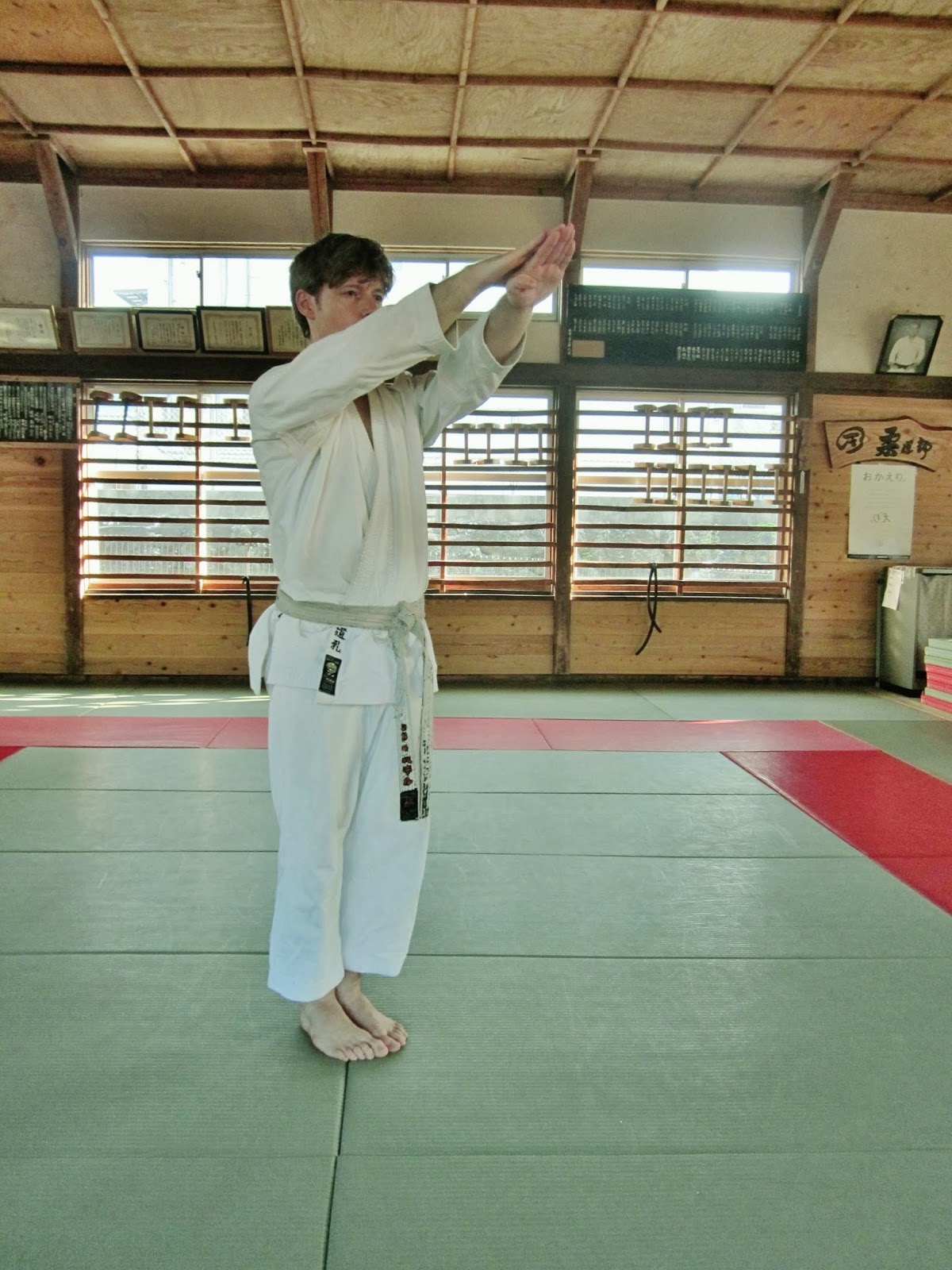
I have finally updated my self-training regime, post JKA (Japan Karate Association) dan shinsa, to address my newfound weaknesses—and move forward. In brief, here is a blueprint of my schedule. I hope that it finds you well.

Kata: I am currently  training the following kata: (a) The six shitei-gata (Heian Shodan, Heian Nidan, Heian Sandan, Heian Yondan, Heian Godan and Tekki Shodan); (b) The four sentei-gata (Bassai-dai, Kanku-dai, Empi and Jion); and (c) Two jiyu-gata—Nijushiho and one other randomly self-selected kata each day (based on my intentions/feeling/goals).

Kihon: Essentially my kihon is based on my current kata regime; hence, I outlined my kata training first. For example, the timing of the hands/arms with body shifting, the reservation of the pivot foot etcetera. Presently, this is the bulk of my kihon training; however, I have been topping this off by going through the Japan Karate Association kihon exams… A sort of mock test to push myself to the limit.

Kumite: (i) The bunkai (analysis) of Nijushiho kata, especially pertaining oyo (applications); and (ii)  Uchikomi/Jiyu Kumite training.

Overall, I have some major targets in 2014, which I am now aiming for. Regardless of whether they materialise or not, my aim is to use them to continue pushing forward. All the very best,  André Bertel.
© André Bertel. Aso-shi, Kumamoto, Japan (2013).

Saturday, 2 November 2013

終わりなき旅 (ENDLESS JOURNEY)


Contrastingly over the years, I have seen numerous people leave karate because they couldn’t win at competition level, or were champions who were finally defeated and their spirit was broken; likewise, I have seen many people quit because they couldn’t pass a particular kyu or dan test. These people, in my opinion, missed the point of karate-do: the battle with them-selves was lost—as their focus was on “end points” rather than the journey—which I believe defines Karate-Do. My question is “How can one focus on destinations when practicing karate when, in reality, destinations/achievements are just moments in the wider scheme of time? Especially when considering the blatantly obvious point that time keeps moving”… Also, without being pessimistic, what is success/achievement? Notwithstanding, this can’t help one to think of the words of the Greek philosophers… Parmenides immediately comes to mind... In sum, the underlying principle of `DO’ in budo, and other traditional Japanese art forms, is that of “a journey: as opposed to a destination”.
Grading examinations and tournaments: So what about entering competitions, taking kyu and dan exams, qualification tests etcetera? Perhaps one should just train? …There is nothing wrong with tournaments, examinations and the like… Of course, they are wonderful goals! It is great to train towards a gold medal in a competition, or the next rank. In my opinion it is essential to experience these things. Not experiencing competition, and attempting examinations, is nearly as bad as quitting altogether… Why? Because the same things that make people quit karate are the same things that stop them from participating in such events.

EGO & FEAR: Not trying to enter tournaments, or trying for the next rank is often connected with ego and/or fear of failure. Again, this elucidates too much internalised focus on the destination as opposed to the bigger picture. People think “how I will look if so and so beats me in the kumite?” or they are too scared to walk out in front of examiners—to have their technique scrutinised. Being free from our ego turns us into LIBERATED HUMAN BEINGS; moreover, it strengthens us by pushing us “to face and overcome our inherent fears”. This is where competition and kyu/dan examinations really benefit us. But like all things these points should not be taken to the extreme: ideological balance is pivotal.
My personal kotowaza is to “LOSE MAGNIFICENTLY”. Don’t merely seek to win or pass, seek to improve your execution of karate and personal development in general. Seek to perform the best you can, because your best is your best... Don’t worry about `the best of others’, simply appreciate them and focus on what you have to do to improve. My aim in kumite is to always seek an ippon, I always fully commit with my attack and try to express my kihon. When this results in my defeat, so be it. My only loss is when I don’t commit, irrespective of winning or losing a match. By never seeking a wazari one can do their very best, then, if the wazari is achieved, it still has meaning. This is merely an example of losing magnificently, and of course it transcends the realms of shobu ippon.
In conclusion, always focus on the here and now in your karate-do training, and plan for the future. When you are successful in your endeavours, great… Well done… But don’t immerse yourself in glory. It’s time to move on… If you fail, ascertain why, and train hard to correct these flaws. Even if you never reach the goals you have set yourself, I assure you that, by following this way, you WILL maximise yourself. More than this, your karate training will then also function as a tangible resource to strengthen your spirit, self-confidence, courage, determination and self-efficacy. Remember, “The journey is what matters, not the destinations (plural)”. Overall, the destinations along the path are merely tools that contribute towards the greater whole: this, to me, is Karate-Do.
© André Bertel. Aso-shi, Kumamoto. Japan (2013).


Saturday, 19 October 2013

KARATE DO: A POWERFUL MECHANISM FOR DEVELOPING RESIILIENCE


I am now reviewing the five Heian kata with special focus on fine points of fundamental technique (kihonwaza) and, in particular, the removal of superfluous actions. For example, wind ups for ukewaza such as morote-uke, seiken juji-uke etcetera; and completion of techniques within the correct range of action, such as kihon tsukiwaza (namely, jun-zuki and gyaku-zuki). This approach is also being taken in my kihon training and includes a tighter control over nukite and gyaku-zuki following keriwaza (i.e. – shuto-uke kara kizami mae-geri soshite nukite, mae-geri kara yoko-kekomi, mawashi-geri soshite gyaku-zuki and so forth).

Yet again, repeating the maxim I constantly stress on this site, “kihon is everything”. Accordingly, this is because it offers the ultimate challenge, as via its complete and utter `rawness’. Kihon, the fundamental kata, and yaksuoku-kumite show us how little we “really know”: and “know” in karate (and all other physical disciplines for that matter) is determined by what we have “programmed into our bodies”. Where do YOU come unstuck in this regard…? There are certainly plenty of places in my case: especially when I am fatigued during a taxing class. Needless to say, this is the ultimate challenge of karate—it gives us the necessary taste of `humble flavoured pie’; moreover, it elucidates how physical training can benefit us mentally and spiritually.

My understanding is that many people eventually quit training because of this point—the feeling of never getting the fundamental techniques to the level that they have in their minds/aspirations. This is definitely the wrong reason to quit and it misses what karate-do is… Karate-do is not a destination of perfection; rather, it is a road towards it—a road towards an `unattainable yet motivational goal’. Striving to get the most basic techniques right is a lesson that never ends, and I am very thankful for this point.

Pushing through this challenge is a POWERFUL MECHANISM FOR DEVELOPING RESIILIENCE: that is, the ability to bounce back in life. Resilience is a quality that everyone should have and need to maximise their lives. We shouldn’t be vain and think that we want to be the best—this is a dangerous trap, which leads to self-defeat… Instead, just think that we want to better ourselves and humbly strive towards this goal. By following this `way’ one will become the best they can be.

All the best from Nippon, André.
© André Bertel. Aso-shi, Kumamoto. Japan (2013).

Thursday, 10 October 2013

Power from within


Harnessing “power from within” in karate-do requires that the limbs are not the centre of one’s energy. This means that power (energy) is sourced from the seika tanden, the hara, the hips; that is, the centre of one’s body in accordance with natural kokyu (breathing), which facilitates higher awareness (and immensely increased physical effectiveness). Of course, as mentioned, kokyu is also at the centre: and kokyu centres the mind helping to control emotions such as anger and fear.
________
 
This is probably one of the reasons why `chudan waza’ are so predominant (in the kihon and kata of karate-do): because they facilitate `power centralisation’ and an innate understanding of the chushin (centre line)—in the most comprehensive way. Moreover, this benefits the daily lives of traditional karate-do practitioners as it can result in greater concentration and a more peaceful life.
 
Returning to the training of waza (techniques) in karate-do, common sense quickly reveals that `jodan waza’ i.e. – jodan age-uke, jodan gyaku-zuki etcetera add additional challenges (in particular, higher level shoulder joint control) and; because of that, they increase the number of `critical focus points’ whilst practicing. Irrespective of one’s thoughts on these matters, centralisation of power and concentration on the chushin are utterly imperative.  
Most obviously this point elucidates the need for the limbs to not `leave from the body’ but, rather, “come from and are transported by the body”.  Examples of this are tight and high chambering of keriwaza, not letting the elbows of `blocking arms’ keep the fundamental rule of being  `one’ to `one and a half’ fist widths from the head/torso, and so on…
Always remember, the traditional karate-do technique is never born from the limbs: just as "the pen is mightier than the sword". Kindest regards from Aso-San, André.


© André Bertel. Aso-shi, Kumamoto. Japan (2013). 


Sunday, 6 October 2013

Over 1,200,000 visitors


I didn't notice that this blog has now had over 1,200,000 visitors! I would like to thank everyone who has supported the site since I started it in 2007.
It is a great honour. Thank you all very much! After 32 years of practicing karate-do I still dream of one day having good karate. While I may never attain this goal, seeing step-by-step improvement through daily practice has still been rewarding.

More than technique, my hope is to continue to develop my character through Karate-Do Keiko and, in doing so, contribute more to society as a whole. I think this is the essence of true Karate-Do. 

Kindest regards and thanks, André Bertel.
© André Bertel. Aso-shi, Kumamoto, Japan (2013).

Sunday, 29 September 2013

二十四歩

Today I enjoyed training in central Oita-shi. Following my current training regime the main focus was on Nijushiho (二十四歩)kata, three of the grading syllabus ido-kihonwaza and various timing in kumite (with tsukiwaza). Interestingly, here is an article from Japan (2011) at the same dojo and ironically about Nijushiho!!! Certainly a case of Deja Vu (you can click here to read the article: http://andrebertel.blogspot.jp/2011/04/japan-kata-training-nijushiho.html). Anyway, for the time being I will leave you with some stills from todays socho-geiko (morning training).
 
Kindest regards and all the very best from Nippon, André


© André Bertel. Aso-shi, Kumamoto. Japan (2013).

Saturday, 28 September 2013

Breakthrough

Whilst for the most part maintaining my current self-training routine, I have slightly altered my approach to kihon, and amended my kata practice. Kumite training has remained completely unchanged…With these points in mind, as opposed to describing the routine in full again, I will only write about the amended aspects of my routine. Moreover, below, I will explain why this has occurred…


Kihon routine changes/amendments: Typically I am now working two or three of the prescribed kihon techniques (please refer to my previous training if you wish to see what these waza are). For example, (1) `Kizami-zuki kara sanbon ren-zuki’; (2) `Shuto-uke kara kizami mae-geri soshite nukite’; and (3) `Mae-geri kara yoko-kekomi, mawashi-geri soshite gyaku-zuki’. I am practicing these renzokuwaza many-many times over. In sum,  I am hoping to reap benefits from this training methodology that will lift my overall gains.
Nijushiho Kata: Kata-wise I have made significant changes as I’ve adopted Nijushiho supplemented by two other kata for variety (one other jiyu-gata and one from the 10 shitei-gata/sentei-gata: i..e  - Nijushiho,+ Kanku-sho & Heian Yondan). Like my kihon, I am working on Nijushiho with high repetitions; however, in contrast, the additional two kata I am only doing a couple of times each. Why Nijushiho? Well, fundamentally because it tests one’s transitions to the maximum.
To conclude, I’ve just had a major technical breakthrough, which prompted the above amendments to my self-training regime. I won’t go into this here, except to say that a long-term vision has been achieved, and now I must seek a higher plateau. In this way, I hope to one day have `OK karate’, perhaps even dare to have `good karate’. Irrespective of achieving such seemingly impossible aspirations I am one step closer to achieving them. This is what long-term training and planning is all about. Furthermore, it underpins the motivation to continue training. Osu, André
© André Bertel. Aso-shi, Kumamoto. Japan (2013).

Saturday, 14 September 2013

KIHON, KATA AND KUMITE ARE ONE

Here are seven tips for training. I have written them based on "the more typical questions" (synthesised) I've received since returning to Japan via my email account: andrebertelono@gmail.com.
 
While a lot of these answers will be obvious, there still may be something of value for someone out there. I personally can't get enough of such basic points, which I constantly have to go back to in my own training.
 
Lastly, these are just my views... I do not claim to be a good karateka and certainly do not claim to know everything. These are just my views addressing recent questions sent to me based on my training and understanding of karate-do. Best wishes, osu, André.

KIHON

TIP 1: Tighten up your techniques. That is, be careful about over extension! Look at say jodan age-uke, chudan soto-uke or shuto-uke. The elbow of the blocking arm should be one fist width away from the torso or head. Likewise with gyaku-zuki and jun-zuki (oi-zuki) the chest should be square—you must not reach with the arm… Of course there are exceptions but exceptions should never dominant your practice.

TIP 2: `Knees up Mother Brown’… Whenever you kick raise your knee high! Don’t be a lazy duffer and kick with your lower leg. A good way to learn about raising your knees is from practicing kizami-geri i.e. – the grading combination with shuto-uke and nukite or say Junro-shodan kata. While this is common sense and well known, it is often physically neglected.

TIP 3: Tachikata: Stances can be warped into oddball positions if they are too short, too long, too narrow, too wide, too deep or too shallow. Practice `the right stance for your body’ (and attributes), which allows you to optimise your techniques.

KATA

TIP 4: Select at least one kata and really work with it. This kata should be the best kata for you! Therefore, best for your personal attributes and body, and not a kata that you necessarily like. You should physically know it forward and reverse, leftward and rightward, its oyo (applications), and practice applying its techniques on the heavy bag, makiwara, in yakusoku-kumite training etc. If you are sane you will hate this kata as you do it so much, but—I assure you—it will be your trustworthy friend and very useful.

TIP 5: One more note, don’t fall into the trap of choosing a `popular kata’ i.e. – Sochin, Unsu, Gankaku, Gojushiho Sho etc… While these are all fine, if Wankan or Meikyo suit you more, do them. You can always do these other kata simply for your enjoyment.  In this regard, when I am at a grading or tournament and a karateka performs one of the less commonly seen kata, it gets my full attention. If they do it very well, it often turns out to be the technical highlight of the event.


KUMITE
TIP 6: When practicing jiyu-kumite don’t cheat yourself. Always fully express your techniques from kihon. That is full-hip action and full trajectories. All of your techniques should apply full body power, even when sparring lightly. If your jiyu kumite is just playing around, it is better to drop it out of your training regime: as it is actually eroding your skills developed in kihon and kata. Always remember kihon, kata and kumite are one… I will say that that again: KIHON, KATA & KUMITE ARE ONE, not separate arts.

TIP 7: Lastly, never waste your techniques. Whether in Gohon kumite, Kihon ippon kumite, Jiyu ippon kumite, Jiyu kumite, etcetera.., only launch techniques when you are in the correct distance. Maai must be correct when employing your attacks or counterattacks. Think of a sniper who shoots at his/her enemies from a high point. They do not fire their weapon until the bullet can reach the target. The range of their rifle is limited. But as soon as the target is in range, they immediately pull the trigger. Kumite is the same… Don’t waste your bullets, and don’t hesitate when the distance is closed or made. Attack with the hips not the limbs...
Aso Jinja, Aso-shi, Kumamoto.
©André Bertel. Aso-shi, Kumamoto. Japan (2013).

Thursday, 12 September 2013

Understanding


This week I have increased the intensity of my training to a higher level. I'm very pleased about this as my body has had to adjust from the New Zealand winter to the Japan summer... Moreover, I had a major injury in New Zealand just before travelling to Japan. My ankle was nearly broken; nevertheless, the injury while still uncomfortable is finally recovering.

Injuries are excuses not to train... But we can always work around them. I never stop training because of an injury: nor should anyone.

Anyway here are some photos and stills from my self-training today. It was a tough training but very enjoyable. I am so humbled by all of my flaws... I have to push myself harder... So much to work on.


Understanding karate is not understanding karate.

Kindest regards from Aso-shi, Kumamoto.
André


© André Bertel. Aso-shi, Kumamoto. Japan (2013).

Monday, 9 September 2013

A change from Gankaku to Sochin...

While my aforementioned training regime continues I have altered my kata training. While I am still working on Bassai-sho, I have switched Gankaku with Sochin; furthermore, I’ve added a random kata every practice to spice things up a little. However, unlike Sochin and Bassai-sho, I’m only doing this additional kata twice—once walking through it and once at regular speed. Today, the kata was Heian-shodan to complement Sochin insofar as waza no kankyu and chikara no kyojaku are concerned.
______________________
My (technical) rationale behind this has been to focus more vigorously on my hand/body shifting timing. Whilst this could obviously be done with Gankaku, for me, Sochin is a kata which I find particularly challenging: so I decided to further push myself by utilising it.
Gojushiho-Sho... Todays additional kata. `Natural hip position'...
Karate-Do is always a humbling experience as while we develop, more glitches appear… For me this is a greatest motivation and presents a massive opportunity. This opportunity, if harnessed well, can not only lead to increased technical development but also to foster humility and inner strength.
While I never expect to achieve `good karate’ the dream of achieving this target remains; moreover, as I improve my character through training—and this comes out in my daily life—I further understand what Karate-Do is.  
Sometimes facing one’s own weaknesses can be done by simply choosing a kata, which doesn’t suit oneself; what is more, this can transcend the physical benefits of making such decisions.
Kindest regards and best wishes from Japan, André.
Relaxing with Ryan in Oita: Sept. 8th, 2013.
© André Bertel. Aso-shi, Kumamoto. Japan (2013).