Monday, 27 March 2017

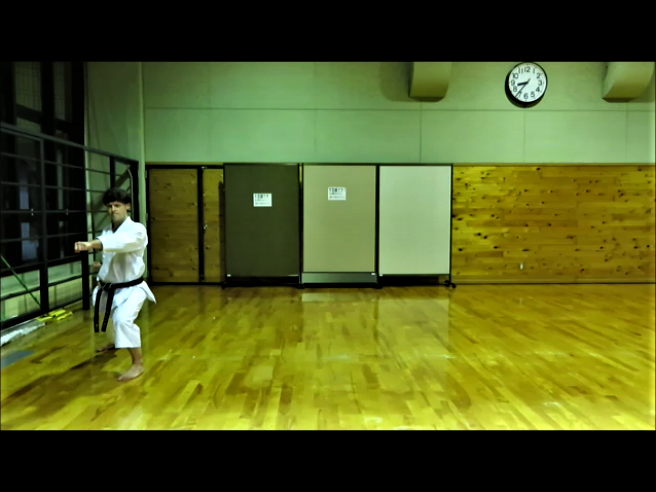
WANKAN KATA VIDEO

One of my personal students after learning 王冠 (Wankan) requested that I perform it slowly online. Wankan is a kata that I merely know - not one that I presently practice; therefore, I am regretful that I cannot give it the justice it deserves. Irrespective, I hope that this helps people seeking to learn Wankan correctly - in the technical sense -  as I have seen many strange versions posted online, which is, of course, very regretful. Best wishes from Japan, Andre Bertel.
  
SUMMARY OF WANKAN KATA
·         Rei (Musubi dachi)

·         Yoi (Ryoken daitai mae, Hachiji dachi)


1.      Ryoken chudan kakiwake uke (Migi kokutsu dachi)

2.      Ryoken chudan kakiwake uke (Hidarii kokutsu dachi)

3.      Ryozenwan jodan hasami uke (Hidari ashi dachi)

4.      Migi ashi ippo mae

5.      Hidari ashi ippo mae

6.      Hidari tate shuto chudan uke (Migi zenkutsu dachi)

7.      Uken chudan zuki (Migi zenkutsu dachi)

8.      Saken chudan zuki (Migi zenkutsu dachi)

9.      Sasho gedan sukui uke/Usho koko gedan osae (Hidari ashi mae neko ashi dachi)

10.  Hidari tate shuto chudan uke (Migi zenkutsu dachi)

11.  Uken chudan zuki (Migi zenkutsu dachi)

12.  Saken chudan zuki (Migi zenkutsu dachi)

13.  Sasho gedan sukui uke/Usho koko gedan osae (Hidari ashi mae neko ashi dachi)

14.  Hidari tate shuto chudan uke (Migi zenkutsu dachi)

15.  Uken chudan zuki (Migi zenkutsu dachi)

16.  Saken chudan zuki (Migi zenkutsu dachi)

17.  Migi kentsui chudan uchi mawashi uchi (Kiba dachi)

18.  Hidari chudan mae geri keage (Migi ashi dachi)

19.  Hidari chudan jun zuki (Hidari zenkutsu dachi)

20.  Migi chudan mae geri keage (Hidari ashi dachi)

21.  Migi chudan jun zuki (Migi zenkutsu dachi)

22.  Hidari chudan mae geri keage (Migi ashi dachi)

23.  Hidari chudan jun zuki (Hidari zenkutsu dachi)

24.  Saken chudan uken gedan yama zuki (Migi ashi mae fudo dachi) “EI!”


·         Naore (Ryoken daitai mae, Hachiji dachi)

·         Rei (Musubi dachi)
© André Bertel. Oita-City, Japan (2017).

Monday, 13 March 2017

RENSHUSEI FROM GERMANY: Oliver Schoemburg


Over the weekend Oliver Schoemburg, from Ahrensburg (Northern Germany) trained at my private dojo here in Oita City. I will not detail the time outside of the dojo with him and his lovely family, but I will briefly give an overview of the training.

Kihon was a large part of the practice, however, the overarching theme was 'technical moderation' and, at the heart of this, simplification. The three core techniques of Karate-Do: jun-zuki (oi-zuki), gyaku-zuki, and chudan mae-geri keage were given the greatest attention. Furthermore, zenkutsu-dachi and its various aspects (transitions from shomen, hanmi, gyaku-hanmi and unsoku/ashi-hakobi) in sonoba-kihon, ido-kihon and kumite were thoroughly addressed.

Supporting this training was a couple of imperative points in Kihon Ippon Kumite and the base understanding of the freestyle kamae in Jiyu Kumite; also, advanced practice of kata: Heian Shodan, Tekki Shodan and Hangetsu. Another theme trained, via kata, was "...waza no kankyu to achieve kime in every technique; in particular, during the execution of renzokuwaza". Indeed, all of these aspects were combined to work towards the physical aim of Budo Karate: Ichigeki-hissatsu.
In sum, Oliver did extremely well and has plenty of homework to take back to Germany for himself (and his students). おめでとうございます, 押忍! André.
© André Bertel. Oita City, Japan (2017).

Tuesday, 7 March 2017

2017 SEMINAR in KREFELD, GERMANY

Due to an extremely busy schedule here in Japan, I will only be giving one Technical Seminar abroad in 2017. This event will be held in KREFELD, central GERMANY on October 7th and 8th.


For those wishing to ensure that they get a place on the course, you should contact the organizers—Dojo Nakayama Krefeld e.V.—by email: alex@karate-Krefeld.de. As in all of my other open seminars, I advise people to book early to avoid disappointment.
Here is a link to the homepage of the host dojo: www.karate-Krefeld.de For those who will be attending, see you in Germany. 押忍, André

© André Bertel. Oita City, Japan (2017).

Thursday, 23 February 2017

SUSTAINED MOTIVATION


One of the biggest factors of success in any field is MOTIVATION. As everyone knows, “motivation is not something that is hard to attain; rather, it is very hard to sustain”. It is this point, SUSTAINED MOTIVATION, which is the base of high-level achievement in any field. However, this foundation is merely the springboard of potentiality; alternatively, the barrier to success if not attained or nurtured.

Without sustained motivation, irrespective of natural ability, one can never reach an elite level in any endeavour; likewise, for those lacking significant natural ability—with sustained motivation—it literally becomes possible to reach the highest of levels. In sum, talent is extremely overrated.

Interestingly and very importantly, sustained motivation is underpinned by one imperative psychological skill… RESILIENCE. If you are—or train yourself to be—a truly resilient human being, you will be in a superior state to achieve your goals. To read more on this topic, click here: http://andrebertel.blogspot.jp/2013/10/karate-do-powerful-mechanism-for.html; furthermore and better, read this interview with Hanshi Renzie Hanham: http://andrebertel.blogspot.jp/2012/01/interview-hanshi-renzie-hanham-8th-dan.html  

This was the result of after my final semester at university. Less than top marks was not good enough. I am not bragging nor claiming I`m smart. What I am saying is that with sustained motivation you can literally do anything.

People often ask me, how is that you have practised karate since your early childhood? My karate journey began in my pre-teens, then continued through my teens, 20s, 30s and now, I still practise daily in my 40s. I guess this is also an example of sustained motivation.


These are key points that I constantly emphasise to my students as they never lose their power; moreover, they empower individuals to achieve their goals. All the very best in your endeavours:whatever they may be. Osu, André Bertel.

© André Bertel. Oita City, Japan (2017).

Monday, 20 February 2017

Heel, toes or middle of the foot?

Migi sokuto tobi yoko-geri kekomi.
One of the ‘technical must do’s’ of standard Shotokan style is to keep the entire foot flat on the floor in kihon and kata training (and, indeed yakusoku-kumite). In particular, keeping sokuto/the sword edge of the foot grounded—as opposed to `rolling them upwards`; and kakato-chushin (heel centre-line) are emphatically stressed.

The issue of sokuto is widespread; however, kakato-chushin is a characteristic of budo/traditional Shotokan. Actually, kakato-chushin is one of the bedrock ‘fundamental technicalities’ of Shotokan as a karate style; that being said, the majority of people “…who practise the Shotokan-ryu kata 'primarily for sports-type competition', for the most part, omit kakato chushin from their kihon”. This is because their focus is merely upon superficial aesthetics: as opposed to executing effective kata with potent effectiveness in the real world. This practise has long been deeply ingrained internationally. However, “...here in Japan this didn't begin coming commonplace until late 1999”.

Kihon gyaku-zuki: Kakato-chushin with the vertical axis running down from the lead shoulder through the lead leg.

Anyway, as a result (due to what happened at that time), many stopped focusing on kakato-chushin; and consequently, increasing numbers of Japanese Shotokan-style karateka (like their Western counterparts) “…now no longer understand what part of the foot is the focal point for techniques in relation to transitions and movements”. Interestingly, they keep the foot beautifully flat, yet merely do so for appearance sake.

Overall, this skill vitally relates to the use of the hips, COG (center of gravity), and where the axis is located: centre, right or left-side. It is at this point where one folds the body in harmony with the driving leg. Needless to say, all of this comes back to the soles of the feet; hence, kakato-chushin and its variations (when the point of focus moves to tsumasaki and the centre of the foot) must be 'physically understood' and trained daily.

In sum, without precise and ongoing practise of this ‘most based skill’ (please excuse the pun) the effectiveness of ones techniques will be innately compromised.
Hidari jodan mawashi-geri.

© André Bertel. Oita City, Japan (2017).

Sunday, 12 February 2017

抜塞大 & 慈恩

Movement one of Bassai Dai: Sasho soede migi chudan uchi-uke (migi ashi mae kosa-dachi).
Today, BASSAI DAI and JION. The point of the training was to strip back another layer of these kata; in particular, via kihon, to improve application of techniques in Jiyu-kumite/Self-Defence. In sum, each of the sentei-gata are technically challenging (to the maximum). This is because they inherently demand "simplification and effectiveness of kihon". To answer my last post, physically speaking: this is BUDO KARATE.
The completion of movement 25 in Bassai Dai: Migi sokumen jodan uchi-uke doji ni hidari sokumen gedan-uke (Heisoku-dachi)
The opening kamae of Jion kata: Sasho uken shita ago mae (Heisoku-dachi)... A historically important posture.

Movement one of Jion: Migi chudan uchi-uke doji ni hidari gedan-uke (Migi zenkutsu-dachi).


© André Bertel. Oita City, Japan (2017).

Saturday, 11 February 2017

武道空手とは?


WHAT IS BUDO KARATE?

武道空手とは?


Movment six of Bassai-Dai: Migi gedan sukui-uke kara migi chudan soto-uke (Migi zenkutsu-dachi).
Movement  19 of Bassai Dai: Ryoshi-tsukamiyose doji ni migi sokuto gedan-kekomi (Hidari ashi dachi).
Movement 35 of Bassai Dai: Uken jodan saken gedan yama-zuki (Hidari ashi zenkutsu).

© André Bertel. Oita City, Japan (2017).

Wednesday, 1 February 2017

抜塞大: Bassai Dai


Bassai Dai (抜塞大) Kata is characterized by its advancing strength which essentially practices to suppress the opponents attack. This characteristic appears in the very first movement right through to the 42nd and final action. The name Bassai (‘Penetrate the fortress’ or ‘Storm the castle’) derives from this overarching theme. In this article I'd like to focus on some critical points of this kata and conclude with an overview.
Andre Bertel - Hidari seiken jodan kizami-zuki - February 6th, 2017.
Change from tateshuto to seiryuto: Recently, the current JKA (Japan Karate Association) Chief Instructor—Ueki Masaaki Sensei—stressed that movement nine of Bassai-Dai (previously Hidari tate shuto chudan uke in Hachiji dachi), unlike Kanku Dai, should now be applied as seiryuto instead of tateshuto; thereby, being consistent with the overarching theme of the kata.


Greater martial arts thematic consistency: Such a small variation may seem insignificant, nevertheless, I appreciate this change. Indeed, as kata are inherently martial arts templates—primarily existing to enhance ones unarmed self protection skills—any greater thematic consistency within them, in my opinion, is a very good thing.


Koshi no kaiten and chakugan: Probably the first thing that comes to mind when people think of Bassai Dai is koshi no kaiten (the rotation of the hips). Shomen, hanmi and gyaku-hanmi in Bassai Dai must be extreme. In doing this, one must keep the eyes, head and neck fixed to achieve proper chakugan. This is an essential skill but, for some including myself, very challenging.


Winding up: Another very important lesson from Bassai Dai, which I personally stress in my dojo, is the high emphasis on loading/chambering (or winding up) of techniques. This point is probably most obvious when executing the changing blocks. It is via theses switching actions, one learns to maximize tai no shinshuku (compression and expansion) from the core/centre; hence, avoiding “…rushing to the completion of techniques”, which merely results in ‘aesthetic strength’. I should add here that most people only focus on the chudan-uke switching actions, however, this lesson is found throughout the kata. For example, movements 38 and 39 (switching from migi to hidari gedan sukui whilst transferring from hidari to migi hiza kutsu) and movements 40-42 (the conclusive and unique shuto-uke sequence).


Moderation of tachikata: Moderation of tachikata (stances) is another aspect of Bassai Dai that one must face head on. In particular, stance width and length are primarily determined by: (a) hip and ankle flexibility (and joint health, and muscle strength); (b) the ability to maintain level hips and what I refer to as good 'three tier posture'; and (c) the optimization of the techniques being employed in regards to generating power from the entire body and, indeed, movements/transitions of COG (centre of gravity). Furthermore, just like techniques, not only incorrect positioning must be avoided but also superfluous positioning/actions must be eradicated.


Kakato chushin: Indeed on the subject of tachikata—for many karateka in Japan—Bassai Dai is seen as the kata where kakato chushin is taken to the next level. Turning with various ukewaza vividly elucidates this point. The heel-toe relationship in the various transitions found through Bassai Dai are extremely important and need to constantly be honed to develop, and maintain, optimum impact power. Needless to say, this brings to mind the importance of te-ashi onaji, which due to my time constraints, I will not specifically address today. However, if your interest is stimulated, please use the search function at the top left corner; moreover, you can reference my YOUTUBE CHANNEL: https://www.youtube.com/user/andrebertel


Conclusive remarks: The late Chief Instructor of the JKA, Nakayama Masatoshi Sensei, stated that “Bassai Dai is a bright jewel among the Shotokan kata”. I believe this is case largely due to the aforementioned points I’ve mentioned today: especially in regards to its applicative theme. Lastly, I will wrap with a complete outline of Bassai Dai Kata. All the best from chilly Oita City, Japan. — André


BASSAI DAI KATA
Overview

·         Rei (Musubi dachi)

·         Yoi (Sasho uken kafukabu mae, Heisoku dachi)


1.      Sasho soede migi chudan uchi uke (Migi ashi mae kosa dachi)

2.      Hidari chudan uchi uke (Hidari zenkutsu dachi)

3.      Migi chudan uchi uke (Hidari zenkutsu dachi)

4.      Hidari chudan soto uke (Migi zenkutsu dachi)

5.      Migi chudan uchi uke (Migi zenkutsu dachi)

6.      Migi gedan sukui uke kara migi chudan soto uke (Migi zenkutsu dachi)

7.      Hidari chudan uchi uke (Migi zenkutsu dachi)

8.      Ryoken migi koshi kamae (Hachiji dachi)

9.      Hidari tate seiryuto chudan uke (Hachiji dachi)

10.  Uken chudan choku zuki (Hachiji dachi)

11.  Migi chudan uchi uke (Hidari hiza kutsu)

12.  Saken chudan choku zuki (Hachiji dachi)

13.  Hidari chudan uchi uke (Migi hiza kutsu)

14.  Migi shuto uke (Hidari kokutsu dachi)

15.  Hidari shuto uke (Migi kokutsu dachi)

16.  Migi shuto uke (Hidari kokutsu dachi)

17.  Hidari shuto uke (Migi kokutsu dachi)

18.  Ryo sho chudan tsukami uke (Hidari ashi zenkutsu)

19.  Ryo sho tsukami yose/Migi sokuto gedan kekomi (Hidari ashi dachi): KIAI

20.  Hidari shuto uke (Migi kokutsu dachi)

21.  Migi shuto uke (Hidari kokutsu dachi)

22.  Morote jodan age uke (Heisoku dachi)

23.  Ryo kentsui chudan hasami uchi (Migi ashi mae fudo dachi)

24.    Uken chudan zuki (Yori ashi—Migi zenkutsu dachi)

25.  Sasho jodan nagashi uke/Migi shuto gedan uchikomi kara Migi sokumen jodan uchi uke/Hidari sokumen gedan barai (Heisoku dachi)

26.    Migi sokumen gedan barai (Kiba dachi)

27.  Hidari tekubi hidari sokumen kake uke (Kiba dachi)

28.  Sasho ni migi chudan mikazuki geri kara sasho ni migi mae enpi (Hidari ashi dachi kara Kiba dachi)

29.  Migi gedan uke/Hidari zenwan mune mae kamae (Kiba dachi)

30.  Hidari gedan uke/Migi zenwan mune mae kamae (Kiba dachi)

31.  Migi gedan uke/Hidari zenwan mune mae kamae (Kiba dachi)

32.  Ryo ken hidari koshi kamae (Migi ashi zenkutsu)

33.  Saken jodan uken gedan yama zuki (Migi ashi zenkutsu)

34.  Ryo ken migi koshi kamae (Heisoku dachi)

35.  Uken jodan  saken gedan yama zuki  (Hidari ashi zenkutsu)

36.  Ryo ken hidari koshi kamae (Migi ashi zenkutsu)

37.  Saken jodan uken gedan yama zuki (Migi ashi zenkutsu)

38.  Migi gedan sukui uke (Hidari hiza kutsu)

39.  Hidari gedan sukui uke (Migi hiza kutsu)

40.  Migi chudan shuto uke (Hidari kokutsu dachi)

41.  Migi te migi ashi uho e

42.  Hidari chudan shuto uke (Migi kokutsu dachi): KIAI


·         Naore (Sasho uken kafukabu mae, Heisoku dachi)

·         Rei (Musubi dachi)


© André Bertel. Oita City, Japan (2017).

Friday, 20 January 2017

Hatsugeiko 2017


This years Hatsugeiko was essentially the establishment of a new self-training regime for the start of 2017. Here is a schedule outlined. In sum, it can be best defined by its sheer simplicity and focus on kihon and kata as training systems for freestyle. This is a critical theme of Budo Karate. In sum, Karate-Do, when practiced properly, is first and fore mostly a Martial Art of extreme effectiveness. Best wishes from chilly Nippon. - André Bertel

Sonoba kihon
Chudan choku-zuki (Hachiji-dachi).
Chudan mae-geri keage (Heisoku-dachi).
Chudan gyaku-zuki (Hidari/Migi zenkutsu-dachi).
Chudan mae-geri keage (Hidari/Migi zenkutsu-dachi).

  • Repetitions: 10 slow reps followed by 30-50 reps with snap.

Ido-kihon
1. Sanbon ren-zuki.
2. Jodan age-uke kara chudan gyaku-zuki.
3. Chudan soto-uke kara chudan gyaku-zuki.
4. Chudan uchi-uke kara chudan gyaku-zuki.
5. Gedan-barai kara chudan gyaku-zuki.
6. Shuto chudan-uke (Kokutsu-dachi) kara nukite.
7. Chudan mae-geri keage.
8. Ren-geri: chudan mae-geri keage kara jodan mae-geri keage.
9. Chudan mawashi-geri.
10. Chudan yoko-geri keage ashi o kaete chudan yoko-geri kekomi (Kiba-dachi).
  • Please note: Zenkutsu-dachi is used unless otherwise stated.
  • Repetitions: 10 reps slow forward and back, followed by a minimum of 10 with snap (dependent on daily precision and physical state).


KUMITE

a. Kihon ippon kumite
(Jodan, chudan, mae-geri and yoko-kekomi)

b. Jiyu ippon kumite
(Jodan, chudan, mae-geri, yoko-kekomi and chudan mawashi-geri)

c. Uchikomi
1. Jodan gyaku-zuki; 2. Chudan gyaku-zuki; 3. Jodan oi-zuki; 4. Kizami-zuki kara jodan gyaku-zuki; 5. Kizami-zuki kara chudan gyaku-zuki; 6. Jodan gyaku-zuki kara jodan gyaku-zuki; 7. Jodan gyaku-zuki kara chudan gyaku-zuki; 8. Chudan mae-geri; 9. Chudan mae-geri kara jodan oi-zuki; 10. Chudan mawashi-geri; 11. Chudan mawashi-geri kara jodan gyaku-zuki; and 12. De ashi-barai kara jodan oi-zuki.
  • Repetitions: I practice a minimum of three sets of Kihon Ippon and Jiyu Ippon Kumite (Alternate days for each form of 'Ippon Kumite'). In the case of Uchikomi, repetitions are daily and typically go around 30-50 reps per individual technique and 10-20 per renzokuwaza. 
KATA

Each day of the week one Shiteigata (any Heian or Tekki Shodan); one Senteigata (Bassaidai, Kankudai, Enpi or Jion) and one Jiyugata (this is either a second Senteigata or one from the free kata list).
  • Repetitions: A minimum of four reps per kata with bunkai (analysis) of difficult sections: essentially and probably needless to say, this 'bunkai' is kata-specific-kihon.
  © André Bertel. Oita, Japan (2017).

Monday, 16 January 2017

Trainee from Belgium: Kathleen Lambein

I just had the pleasure of having Kathleen Lambein (3rd Dan, JKA—Japan Karate Association—Belgium) here in at my dojo for private training. In addition to being my first renshusei from Belgium she is also the first non-Japanese renshusei for 2017.

Kathleen successfully completed six hours of one-on-one training over two days. Without going into specifics (these are for her) I focused on specific points to boost her karate—via core aspects of Kihon, Kata and Kumite—from a pure Budo Karate perspective. Simplicity and depth, and efficiency, were major themes.
Overall, Kathleen was great to coach as she not only processed the information quickly, but immediately began moving better. I was really impressed by this point. Furthermore, we enjoyed some nice times outside of the dojo. Kathleen, my family and I wish you all the very best!! It was great to have you in Oita!!! See you again!!! 押忍, André

© André Bertel. Oita, Japan (2017).