Saturday, 11 December 2021

空

 The kanji 空 has eight brush strokes and eight is very important in budo.


In fighting there are eight generic directions/angles… Are you following me here? Master Funakoshi didn’t just change the name of karate from 'Chinese hand' to 'Empty hand', he was also trying to make a reputation above his peers, as there was clearly a race. 


The ‘kara’ in karate—was an extremely advantageous and intellectual way—to assist his efforts in this regard. His multi dimensional approach "...as a studious lover of classic Asian literature" was behind his labeling of our art. History shows, that Funakoshi Sensei became the dominant master introducing and promoting karate in mainland Japan (via the pen as opposed to the sword); hence, via transcending his peers. Consequently, he is now recognized as ‘the founder of modern day karate’.


Irrespective of whether this is taken as a compliment or otherwise, again, Funakoshi Sensei came out victorious amongst his contemporaries; and, as a result from this catapult, Shotokan became—by far—the most popular karate style in the world.


So now, allow me to return to the eight brush strokes in 空. He transcended the meaning of 'empty hand', and his study of Taoism and other Chinese classics underpinned this. This is because he included the technicality within the name ‘Karate’ and ‘Karatedo’. This technicality is 'Happo'. This concept and physical reality is at the heart of TENSHIN. Circle and point. Certainly, this immediately brings to mind the 八門型 (Hachimon Kata)—‘eight gates’, which is has an enbusen that “…covers all eight defensive and counter offensive directions”.


Asai Tetsuhiko Sensei ran with this idea and, in doing so, tied the karate of Funakoshi Sensei with Hakutsuru-ken (White Crane Fist) and contemporary JKA-style Shotokan-Ryu.


I will not address the reading issues of onyomi and kunyomi in this article, as that would be distracting from purpose of writing it. Instead, I recommend readers to focus on the eight brush strokes as this has relevance (to both tangible training and a facet of the intellectual basis) in the naming of KARAte. I’ll leave it there for today. 押忍 — アンドレ.

 © André Bertel. Oita City, Japan (2021).

Thursday, 9 December 2021

打ち込み (Uchikomi)

This article will hopefully clarify 打ち込み (uchikomi) and, more specifically, “…uchikomi practice and its purpose in budo/bujutsu karate”.

Osaka Yoshiharu Sensei and Kawasoe Masao Sensei

Before I do that I want to give some generic background details. Firstly, allow me to detail the meaning of the term: 打ちmeans ‘strike’/‘hit’; whilst 込み translates as ‘in’. Allow me to expand on the second part 込み, as in Japanese it literally has a deeper connotation; for example, ‘driving a weapon into a target so that it becomes lodged’. Only with this understanding can we practice uchikomi meaningfully; that being said, even here in Japan this is often overlooked in favor of ‘uchikomi training being a predominantly sports karate Kumite practice’. Basically a ‘point scoring’ exercise. Of course scoring points in a match is good. But this statement depends on the quality of technique, which is very different in sports kumite from what we do: ‘we’ meaning all of us who follow budo and understand technique as effective bujutsu. I will return to this point later in this article.


Secondly, I want to point out that uchikomi can be found in all of the arts of traditional budo/bujutsu (sumo, judo, kendo, etcetera…). It is important, and mainstream practice, for primarily making one’s kogekiwaza (attacking techniques) highly functional/effective: reliable—irrespective of environment and stimuli.


Thirdly, and unequivocally related to the previous point, uchikomi grooves techniques/precise and ‘adaptable motions’ deeply into the subconscious, thus, resulting in greater physical skill: especially under pressure. Obviously, this is stating the obvious, but it is important to do so for actual training as opposed to mere rhetoric. Returning to what I just inferred earlier about sports verses bujutsu, these strengthened synaptic connections are utterly critical. Why? Well, quite simply how you train is what you’ll do. Uchikomi for sports karate focuses on landing and retracting as quick as possible. This means that a destructive blow is counter to the aim, as this is slower, and means the escape is also slower; thus, risking being scored on. Sports karate kumite, in its current form, is literally a highly advanced tag match. I am by no means saying this with ill intent, but that’s what it is, and the athleticism is very high, which in itself somewhat deserves recognition. I’d like to add here: that this is not the athletes fault, they are world class. It is the rules and the judges, as they shape their behavior in order to ‘win’. I really hope this can be changed via consultation. I believe this would also contribute to a more globally popular version of mainstream Kumite competition that would not only reflect budo karate, but would also be more impressive for the masses outside the karate world. However, due to all of the political red tape, I don’t think that would ever happen.

Yahara Mikio Sensei.

So, back to uchikomi. How should it be done? Well, firstly control must still be applied; however, to avert the aforementioned sports karate slump, the aim of each respective waza must be ‘to optimize the potential to finish the opponent’. Notice that I’m not implying this to be a black and white scenario, but rather ‘the constant physical aim’. Therefore, exact kihon must be used each time. In saying this, I don’t mean adhering to basic movement, but ‘applying each waza with the underpinning of the base kihon’ (again, striving towards achieving Ichigekki Hisatsu every time). The idea here is to never short-change oneself in training, which can never contribute towards each individual achieving their very best. This, of course transcends all karate ‘styles’ and thus is totally inclusive.


Put another way, the training of uchikomi—like jiyu kumite—must be as follows: “…without control, serious damage will be inflicted”. This especially means that the distancing must be correct for maximum damage; hence, the distancing is naturally closer than the present-day mainstream/sports kumite .


Uchikomi, trained in this way, forms neural connections which are useful in the real world. To reiterate, this is because every attack is exactly how you will use it outside the dojo or shiai-jo. It’s like going to the firing range.


The present sports karate version of this would be firing out of distance. The bullet leaves the pistol and makes a weak trajectory, then, after all, the bullet drops to the ground before effectively penetrating the target. Of course, this is generally speaking, in relation to ‘point scoring’. I need to add, everyone who has competed in sports karate knows that heavy contact also occurs intermittently. But, again, that being said, “the majority of techniques thrown have anything but the potential to cause real damage”.

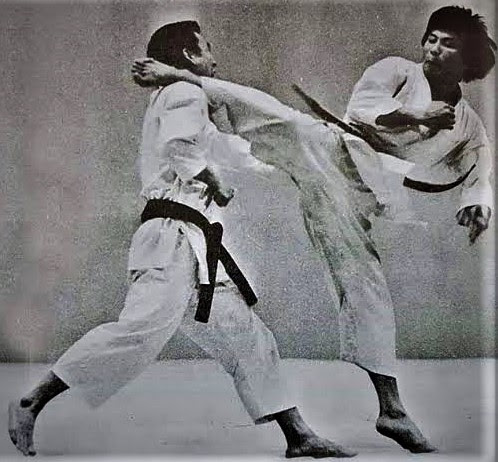
Tanaka Masahiko Sensei precisely planting a kick to his opponents temple.

 In karate as bujutsu, the bullet leaves the pistol and makes the optimal trajectory, then impacts with optimal effect. Irrespective of strength and size, with accuracy and the right weapons of the body—this is more than sufficient for civilian self defense. Bujutsu, irrespective of art, is focused on effective skills to save one’s life.


So what is uchikomi training? Well, we have so many variations, so today I will focus on the most basic form. This form is done with one or more training partners. But today let’s focus on three or more participants. In English this is often referred to as ‘line training’.


One person is the defender whilst the others attack one at a time. Each attacker charges ‘in’ with their waza then loops around returning to the rear of the line. At a basic level the attacks might be set; for example, jodan gyaku-zuki. However, this often builds up to any hand technique, any leg technique, grappling, throwing or a combination of all of these


As I mentioned earlier, there are higher levels such as using ‘tenshin’ and so forth; nevertheless, these are secondary—better put, supplementary—to the aforementioned base form of uchikomi.


Uchikomi training, if one desires to achieve a high level in true karate, requires that effective bujutsu waza is launched over and over again. This is what I term as an instructor as ‘habitual effectiveness’. Many karate people call their karate budo or traditional, but are not seriously training their techniques to REALLY work. My karate is always focused on this point, kihon—kata—and kumite. While I’ve competed, karate is not a sport for me.


I want to end by saying that I'm not to trying to undermine competition, as competition is essential. The experience is extremely valuable and bolsters one's level in the both the short and long terms. Rather, my advocacy is to keep competition under the direction of bujutsu karate waza; that is, not compromising kimewaza and “…the constant striving in daily keiko towards achieving Ichigeki-Hissatsu”. Of course I could expand a lot more on this today, but I will leave it there. OSU!

Asai Tetsuhiko Sensei.

 © André Bertel. Oita City, Japan (2021).

Thursday, 2 December 2021

'The moving leg'


One important point that often get slightly less attention than it needs is the ‘moving leg’ which, more often than not, is a little overshadowed by the pillar leg or sasae-ashi.


This is for several reasons, the first being the highly engagement and use of muscles into the sasae-ashi needed for compression, propulsion and so forth.


Irrespective of this, it is essential to correctly use the moving leg as it is still 50 percent of the leg actions; albeit, significantly lighter and swifter. In sum, this balance of hard and soft, powerful and swift, is essential if one wishes to optimize their leg movements.


While, for the most part—when doing kihon waza—we keep the hips at the same height. This means that we load the support leg by conscientiously bending/compressing at the knee and stretching the ankle. This allows us to utilize the momentum/contraction-expansion of the action and utilize the power line fully. In addition to these aspects the removal of superfluous and overt telegraphing is also ideally addressed following this methodology. Obviously, I could add to these points, but I think this is all very clear.

Movement three of Heian Yondan provides a very blatant example of this. When turning and advancing from hidari kokutsu-dachi into migi zenkutsu-dachi we begin with majority of the weight on the left leg. From there it is essential to strictly invert the lead right foot counterclockwise to precisely face shomen then transfer the majority of your weight to it. From here we drive forward transferring the weight to the left leg (with a swift action of ‘the moving leg’) forming hidari zenkutsu-dachi. In sum, open-close-open. Tai no shinshuku... Of course, the upper body actions also follow this process, which results in the dynamic and powerful waza: which characterizes Shotokan-Ryu.


Simply advancing with the moving leg—the pillar leg ‘playing catch up’—can work at a very low level; however, it is an unreliable and unsophisticated methodology, which cannot lead to technical excellence.


Asai Tetsuhiko Sensei was highly particular when it came to unsoku. I think that he greatly contributed to the JKA style that exists today, irrespective of organization. Sensei greatly emphasized maximum impact via unsoku, taisabaki and tenshin. Tenshin was the topic of his JKA Hachidan exams ‘Kenkyu Happyo’ (Research Presentation). In saying that, he did not compromise 'effectiveness for looks'; rather, his 'karate path' was was based on optimal effectiveness: KARATE AS BUJUTSU.


Irrespective of the type of unsoku, from the most simple to the most advanced, the mastery of both the pillar leg and moving leg—and their inseparable harmony—is of utmost importance to achieve optimal kime in one’s waza.

© André Bertel. Oita City, Japan (2021).

Wednesday, 1 December 2021

Welcome to Winter: Updated daily self-training regime

Today we officially entered winter here in Japan. So I decided to post my current self-training regime. I cannot believe that winter is back! Where did 2021 go? Before you read on, perhaps you remember my Kangeiko video last year? Irrespective, take care and all the best for your training! OSU, AB. 


KIHON

1. (Jiyu-dachi) Kizami-zuki (Zenkutsu-dachi) kara jodan oi-zuki, uraken jodan yokomawashi-uchi (Kiba-dachi), shuto jodan sotomawashi-uchi (Zenkutsu-dachi) soshite shuto jodan uchimawashi-uchi.


2. (Zenkutsu-dachi) Ippo sagatte jodan age-uke kara chudan mawashi-geri, uraken jodan yokomawashi-uchi soshite chudan oi-zuki.


3. (Zenkutsu-dachi) Chudan soto-uke kara chudanyoko-enpi (Kiba-dachi) soshite uraken jodan yokomawashi-uchi (Kiba-dachi).


4. (Zenkutsu-dachi) Kaiten-shinagara gedan-barai kara chudan uchi-uke (Nekoashi-dachi), jodan ura-zuki soshite chudan gyaku-zuki (Yoriashi—Zenkutsu-dachi).


5. (Kokutsu-dachi) Shuto chudan-uke kara chudan kizami mawashi-geri soshite yokonukite jodan gyaku-zuki (Zenkutsu-dachi).


6. Ren-geri: (Zenkutsu-dachi) Mae-geri keage kara yoko-geri kekomi, mawashi-geri soshite ushiro-geri kekomi.


KATA


A. Kanku Dai (intermittently accompanied by corresponding Heian). In sum, big scale, dynamic and large fundamental Shotokan Ryu waza. Don't get me wrong here.... I hate Kanku Dai as it epitomizes everything bad about my karate; hence, this practice. What I am trying to say here is that I'm challenging myself. I recommend that to you also! Always seek to leave 'the comfort zone'. That doesn't mean things will become your 'TOKUI', but it is uplifting in all regards.

B. Seiryu and Hushu (comparing and contrasting the extreme similarities and differences between these two Koten-gata from Asai Tetsuhiko Sensei). Asai Sensei when teaching often mixed up these two kata due to their similarities. To abstractly quote Funakoshi Sensei “…wind flows through the pine”. 


C. Random kata from the official IKS canon. For example, yesterday was Joko Gosei, today was Chinte, tomorrow??????????


KUMITE


I. Kihon Ippon Kumite

Special points: (a) to make all attacks optimally effective if the partners defense fails; and (b) to ensure that all counterattacks, if not controlled are optimally effective. Basic karate—Seiken to the jinchu, suigetsu; Josokutei to the ago, nodo, suigetsu etc...


II. Uchikomi

Repetitive practice of tokuiwaza. Blitzing with standup techniques: tsuki, uchi, keri, nage, gatame and shimewaza.


III. Newaza

Ground fighting practice focusing on my three tokuiwaza and various  shikake (set up strategies).


I will not provide my endurance and strength/power work this month as I want to share these at a later date, via a more comprehensive article. Best wishes, André


© André Bertel. Oita City, Japan (2021).

Sunday, 21 November 2021

岩鶴 (Gankaku)

I was asked to write a brief overview on Gankaku. So here you are. 押忍!!

Tanaka Masahiko Sensei's Gankaku: Movement one:
 Ryoko jodan sokumen awase-uke (Migi kokutsu-dachi).

This kata was originally known as ‘Chinto’ after its Chinese innovator (who allegedly ended up on Okinawa due to a shipwreck).


The funny part of the tale is that he was apparently stealing people’s crops to survive. Eventually Matsumura Sokon was sent to give the naughty Chinaman a lesson but found him to be an excellent martial artist.


After which, for a time, Chinto was ‘invited’ to teach his style of Chinese boxing in the Tomari area (probably as a pay back for all the fruit and vegetables he pinched).


The more descriptive and eloquent name 岩鶴 (Gankaku)—later adopted Funakoshi Gichin Sensei—literally translates as ‘rock crane’. This typically poetic label ‘from Shoto himself’ brings to mind ‘a crane boldly standing on a rock’ as opposed to ‘a fruit and vegetable thief from across the ditch’.


With 42 movements, this Tomari-te kata follows the 一字形演武線 (Ichi ji gata enbusen). This is where the performance line is linear, just like the kanji for ichi; moreover, relates to training space and indeed the potentiality for a narrow environment for application. The kiai are applied on movements 28 and 42 respectively both waza of which are migi chudan oi-zuki


Nakayama Masatoshi Sensei wrote that “…the nucleus of this kata is the mastery of balance, rotation, and the simultaneous use of yoko keage and uraken”. Notice there’s no mention of using the Manji Kamae to grab a farmers apple, then rip it out of distance for a high fructose snack…


On a serious note... It is standard to utilize yoko-geri keage in this kata, but the older sideward mae-geri keage is also acceptable; however, other variants are not (in Budo/Bujutsu Karate). 


Please forgive me for quoting my June 24, 2010 article: 'Hangetsu, Jitte and Gankaku'

"Asai Tetsuhiko Sensei was infuriated by the changing of yoko keage to yoko kekomi (amongst many sports karate competitors). His belief was that the yoko keage in Gankaku was a refined/improved side kick from the original (which was a mae geri to the side, still found in many styles today). He explained that "the yoko keage means you kick the opponents testicles, who is next you without having to turn your body at all. The upward trajectory of yoko keage, and the distancing with this kick, means that uraken uchi can easily be used offensively or defensively."


Gankaku overview 

(Official stance and action per command count and 'a few AB practice tips')


1. Ryoko jodan sokumen awase-uke (Migi kokutsu-dachi). Note - this is JODAN if you like your front teeth! Many sports karateka do this waza lower to make it faster and easier. This has no meaning, only for speed and looks. Please reference Tanaka Sensei's above and compare it to sports karateka.


2. Ryosho juji chudan osae-uke (Migi kokutsu-dachi).


3. Saken chudan-zuki (Migi kokutsu-dachi).


4. Migi chudan gyaku-zuki (Migi kokutsu-dachi).


5. Kaiten shinagara migi sokumen migi gedan-barai (Kiba-dachi).


6. Kaisho jodan juji-uke (Hidari zenkutsu-dachi).


7. Ryoken mune-mae (Hidari zenkutsu-dachi).


8. Nidan-geri kara gedan juji-uke (Hidari zenkutsu-dachi).


9. Gedan juji-uke (Hidari zenkutsu-dachi).


10. Uken gedan-uke, saken migi koshi mae kamae (Hidari kokutsu-dachi).


11. Hidari shuto gedan-uke, migi shuto hidari koshi mae kamae (Hidari kokutsu-dachi).


12. Ryosho chudan kakiwake-uke (Migi zenkutsu-dachi).


13. Ryosho chudan kakiwake-uke (Kiba-dachi).


14. Ryoken ryogawa gedan-kakiwake (Hachiji-dachi).


15. Migi sokumen jodan uchi-uke doji ni hidari sokumen gedan-uke (Migi kokutsu-dachi). This is Manji-uke/Manji-gamae. Load with te-nagashi-uke doji ni gedan shuto uchikomi and when making the waza use a power ratio of 7:3.


16. Hidari sokumen jodan uchi-uke doji ni migi sokumen gedan-uke (Hidari kokutsu-dachi).


17. Migi sokumen jodan uchi-uke doji ni hidari sokumen gedan-uke (Migi kokutsu-dachi).


18. Gedan juju-uke (Hidari ashi mae tatehiza-dachi: Migi ashi orishiki hidari hiza-tate).


19. Ryoken chudan kakiwake-uke (Kiba-dachi).


20. Ryoken ryogawa gedan-kakiwake (Hachiji-dachi).


21. Ryoken ryokoshi-kamae (Hachiji-dachi). Do not stop on this movement; instead, move immediately into movement 22 and 23.


22. Migi furi-enpi (Hidari zenkutsu).


23. Hidari furi-enpi (Migi zenkutsu).


24. Ryoken chudan kakiwake-uke (Migi ashi mae kosa-dachi).


25. Migi sokumen jodan uchi-uke kamae doji ni hidari sokumen gedan kamae (Migi tsuruashi-dachi). If you are well trained, straighten the sasae-ashi. 


26. Migi ryoken migi koshi kamae (Migi tsuruashi-dachi). Complete the kamae by compressing by slightly bending the sasae-ashi.


27. Hidari sokuto yoko-geri keage doji ni hidari uraken jodan yokomawashi-uchi. If you understand, 'hybrid action'.


28. Migi chudan oi-zuki (Migi zenkutsu-dachi) —KIAI!


29. Hidari sokumen jodan uchi-uke kamae doji ni migi sokumen gedan kamae (Hidari tsuruashi-dachi).


30. Hidari ryoken hidari koshi kamae (Hidari tsuruashi-dachi).


31. Migi sokuto yoko-geri keage doji ni migi uraken jodan yokomawashi-uchi.


32. Saken migi sokumen chudan-zuki (Kiba-dachi).


33. Migi sokumen jodan uchi-uke kamae doji ni hidari sokumen gedan kamae (Migi tsuruashi-dachi).


34. Migi ryoken migi koshi kamae (Migi tsuruashi-dachi).


35. Hidari sokuto yoko-geri keage doji ni hidari uraken jodan yokomawashi-uchi.


36. Uke next hidari sokumen chudan-zuki (Kiba-dachi).


37. Migi shuto zukami-uke (Migi ashi zenkutsu). I personally do this the old way, however, the newer version used by the JKA is just effective. I recommend testing both methods in self defense practice and establishing what works best for you (outside of exams and competitions where organizational norms must be followed).


38. Hidari jodan tate-enpi usho-ate (Migi ashi zenkutsu).


39. Sasho-uken hidari koshi (Migi ashi zenkutsu).


40. Kaiten shinagara ryoken koshi kamae (Migi tsuruashi-dachi). As everyone knows, this is an arm break. Roll kaisho jodan juji-uke similar to Heian Godan, above the head, descending into ryoken koshi kamae. Spin and compress the stance for maximum control of COG in perfect harmony with the upper body rotation and arm/hand actions. This is te-ashi onaji at the highest level within the 26 standard Shotokan kata, as this is most demanding action for precise balance. As such, train with these utmost points in mind (in regards to this waza; thereby, making it an easy task. 


41. Hidari sokuto yoko-geri keage doji ni hidari uraken jodan yokomawashi-uchi.


42. Migi chudan oi-zuki (Migi zenkutsu-dachi)—KIAI! Always remember, CHUDAN attacks often become JODAN because of the previous action or actions. This point is very important in the application of the Shotokan kata and cannot be elucidated enough.


© André Bertel. Oita City, Japan (2021).

Monday, 15 November 2021

五本組手 (Gohon Kumite): An extension article 19 years later


 五本組手 (Gohon Kumite) is unique to Shotokan Karate and some of the derivatives of it. It is generally the first form of Kumite (‘the meeting of hands’ or, more explicitly  described in English, ‘sparring’. That being said, my methodology focuses on the original purpose of ‘the basic Gohon drill’, which is ‘kihon practice with a partner’.


Before I move on, I’d like to offer this rationale as it is based on the real achievement outcomes of this form of ‘kumite’. Firstly, I want to stress that the basic Gohon Kumite will not make you into a great fighter. That’s hopefully obvious and, accordingly, it shouldn’t become a pseudo form of ‘sparring against one’s partner at the expense of technique’. Though, it certainly provides a baby step towards Kumite, for beginners, by putting an ‘opponent’/‘training partner’ in front of them as opposed to doing ‘air karate’.


In this regard, keep in mind that “…when ‘fighting better is the aim’ train specifically for that”. Some specific examples of such fighting training include uchikomi (i.e. – line work); impact work; explosive strength training; and, of course, various forms of jiyu-kumite including the training of newaza etc).


So why bother with Gohon Kumite? Why not just get straight into freestyle? Well, if fighting is one’s only goal, that’s a fair point. Let's face it, in that case, you can then drop kata as well. However, if one wishes to have the prime characteristic of karate in freestyle (for something to BE karate), which is kime, the basic for Gohon Kumite is an excellent basis.


One of the reasons for this is that 'it’s actually a difficult drill'. This difficulty comes from its simplicity “…which provides an extremely revealing template for oneself (and an insight into others as well)”. Excellent, correct or incorrect use of the feet, legs/stance, hips, upper torso/backbone neck and head position can be immediately (and uncompromisingly) assessed. This also applies, indeed, to the shoulders, forearms, wrists and fists.


How is movement conducted? How is the hikite utilized, in addition to its form? How the center is moved/used and the posture is made? Chikara no kyojaku? The psychological state in both defense and attack? Kihaku without compromising form? Correct Kiai (not the bellowing sports karate sound, but a short and sharp kiai that aids explosive power to achieve kime)? Zanshin?


One thing I want re-emphasize today is the main point of stance work between Gohon Kumite and the next stage of training 基本一本組手 (Kihon Ippon Kumite). I will do this in reverse…. In ‘Kihon Ippon’ you drop your weight (where you are, direct, angular or rotational) in order to be immediately effective with your counterattack. This is more difficult, because even though there are more options, you have only one chance. If your waza has no 'potential penetration' of the target (where, if not literally controlled, will cause optimal damage) your karate is incorrect. In fact, practice done incorrectly in this regard will help to make your karate less effective. Unfortunately, many people practice for years—or even decades—and never know, or strictly follow this imperative point of Kihon Ippon Kumite practice. Such aspects have contributed to many karateka having ineffective real fighting skills. It's so sad, but true.


Going back to Gohon Kumite. It has a very different approach. Instead of dropping the weight on the spot (nor using conveniently evasive angles, in Gohon, defense must follow the line) the point of unsoku is “…to not be there!” Yes, use zenkutsu-dachi to escape the opponents attacks with each respective ukewaza as a secondary cover. Yes, the ukewaza must be utilized, but ‘making distance’ is the main point; that, is, until final attack. Beginners will be usually out of distance after the fifth step. In this cases, it’s no problem. They must keep their stance and posture, and counter into the air with good form. Remember, this is obviously not a real fight, it’s a basic training drill. That being said—after attaining competence in Kihon Ippon Kumite, later in their training—they should then adjust their final defensive step to make the perfect distance for their hangeki-waza. That is, the last step basically becomes kihon ippon. I hope that makes sense and laces these two drills together over the respective timespan.


You can now see how, partner kihon, and different forms of ‘the control of maai’ in relation to: (a) tachikata, shisei and unsoku; (b) kihon waza—namely trajectory and form; and indeed, (c) the inherent psychological aspects—correlate and contribute towards the advancement of skills without compromising the foundational waza. 


In sum, “…the basic form of Gohon Kumite is not a drill that advanced practitioners NEED to do everyday”, but it’s periodic practice for self-evaluation and refinement is extremely valuable: especially pertaining to the core fundamental techniques. If you’d like to read more on this topic, please check out my 2002 article here (published here on this site in July of 2007: https://andrebertel.blogspot.com/2007/07/gohon-kumite.html). These two articles together give a good overarching understanding of the basic form of Gohon Kumite. If there is enough interest, I will write about more advanced forms in the future. Best wishes and best training. — 押忍! André


 © André Bertel. Oita City, Japan (2021).

Thursday, 11 November 2021

The HOUSE of SHOTO

Funakoshi Gichin Sensei was, of course, the founder of modern-day Karate-Do; furthermore, the founder of what became known as Shotokan-Ryu. More than these points, he was the first master to officially introduce Tode/Karate to mainland Japan from Okinawa. This name came from the masters pen name 松濤—‘Shoto’—meaning ‘Pine waves’, which was also used to label his first full time purpose built dojo facility: the Shotokan—‘the House of Shoto’.


These commonly known facts aside, Funakoshi Sensei did something else, which was a major evolution in the development of karate. He established training methods, systems and evaluations—based science and the other forms of budo already established in Honshu—in-conjunction with the karate he brought with him from Okinawa. This included improving the power of various movements by more efficiently using the body; in particular, utilizing the legs and hips for much stronger impact.

 
Talking with seniors here in Japan, there may be a little bit more to this than meets the eye. Funakoshi Sensei’s body was very small, even by Japanese standards at the time. Accordingly, it is said that he sought methods to increase the power and range of techniques to overcome his physical shortcomings.
 

Ironically, one saying here in Japan is: “Everyone’s kata is different (meaning the different ryuha/kaiha). One can tell what style a person is from their kihon and kata. However, everyone looks like Shotokan when engaging in kumite”.


I’d like to conclude by saying that while Shotokan, and all the traditional styles are great, it is not enough to merely train without conscientious self-evaluation alongside the daily physical practice/training. To practice karate as budo/bujutsu we must seriously and constantly train and test our waza with ichigeki-hissatsu fore-mostly in mind.


To do this, we can look back to the approaches of Funakoshi Sensei and trace that to the present time. What has been lost? What have been gained? And how we make the most of ourselves through practice? ‘Using the knowledge of the past’, ‘making the most of the present’, and ‘always aiming for future improvement’. Yes, simple words, but truthful and well worth being mindful of!  


In recent times I’ve heard some criticism of Shotokan. This criticism is unfounded. In saying that, we must also be critical thinkers, in regards to our training; moreover, this must be used to improve our physical capacity via physical training. 


Obviously in my mid 40s I had no relationship with Funakoshi Sensei, nor, sadly, Nakayama Sensei; however my main instructor Asai Tetsuhiko Sensei did. Furthermore, my other instructors and seniors here in Japan did also. I really believe that we must appreciate what’s been handed down from the past and use this knowledge for future gains, not only for ourselves but also for the next generation.

Accordingly, Funakoshi Gichin Sensei will always be an important figure in the karate world, especially to us who practice ‘The House of Shoto’ style.


 Osu,  André

 © André Bertel. Oita City, Japan (2021).

Thursday, 4 November 2021

抜塞小 (Bassai Sho) Overview

 Bassai Sho (抜塞小) Kata, in contrast with the overtly powerful Bassai Dai, is more subtle in its use of strength; furthermore, Bassai Sho utilizes smaller scale waza to undermine one’s opponent. Mindful of these points, the name Bassai (‘Penetrate the fortress’ or ‘Storm the castle’) should be understood—via the contrasting uses of power and scales of waza—within the two Shotokan versions of Bassai.

In the process of completing RYOSHO CHUDAN TSUKAMI-UKE.

Certainly, bo-jutsu cannot be overlooked when analyzing Bassai Sho, Kanku Sho, Meikyo, Jitte and, indeed, other kata featuring various ‘bo uke’. In saying that, more often than not, the waza in these kata are primarily empty handed applications against an unarmed assailant. That being said, many of the waza work more efficiently with executed with the feeling of holding a staff; in particular, when applying the various joint locks. This is a major commonality between the teachings of Kase Taiji Sensei and Asai Tetsuhiko Sensei. But I will not go into that topic here today.


In all of these regards what’s most interesting is the difference between bunkai and oyo. When learning the ‘kata movements’ the understanding of correct actions (trajectories and positions), in Bassai Sho, are most readily learned using a bo. This is BUNKAI in Shotokan. It’s not realistic, and realism is not the purpose. The aim is ‘correct movements and positions when learning the kata’. Please think of Nakayama Sensei’s books and videos here. Do you really think he believed that the bunkai demonstrated in these publications would be effective in the real world? Those who think so, are really stupid. Just image two guys attacking you at the same time, one from the front with a chudan mae-geri and the other from the rear with jodan oi-zuki—“oh, yes, (you think), a perfect opportunity to use my manji-uke”…


Of course, after learning the kata, bunkai (as termed in Shotokan) has no purpose. The focus then turns to OYO (actual 'APPLICATION'): this is the actual fighting techniques and principles to be derived from the kata—for real world self-defense.


I hope that this post on Bassai Sho clarifies these points.


Osaka Yoshiharu Sensei fine tuning my sokuto gedan-kekomi. 

In sum, we have a very ‘directly applicable style’ that is second to none: via the power from our kihon, which literally remains unsurpassed.

These points aside, I would now like to move on to each of the 27 movements of Bassai Sho.

抜塞小 (BASSAI SHO): OVERVIEW


Rei: Musubi dachi


Yoi: Heisoku dachi — Hidari shuto migi haito kafukubu mae


1. Ryosho juji jodan awase uke (Migi ashi mae kosa dachi).


2. Ryosho jodan bo uke (Migi kokutsu dachi).


3. Migi haito gedan sukui uke kara migi gedan barai (Heisoku dachi).


4. Ryosho jodan bo uke (Migi kokutsu dachi).


5. Saken migi haishu hidari koshi kamae (Ryo hiza kutsu—Heisoku dachi).


6. Migi sokuto chudan yoko geri keage doji ni haito jodan uchimawashi uchi (Hidari sagi ashi dachi).


7. Hidari tateshuto chudan uke (Kiba dachi).


8. Migi choku zuki (Kiba dachi).


9. Hidari choku zuki (Kiba dachi).


10. Hidari manji kamae (Migi kokutsu dachi).


11. Migi manji kamae  (Hidari kokutsu dachi).


12. Migi shuto chudan uke (Hidari kokutsu dachi).


13. Hidari shuto chudan uke (Migi kokutsu dachi).


14. Migi shuto chudan uke (Hidari kokutsu dachi).


15. Ippo sagatte hidari shuto chudan uke (Migi kokutsu dachi).


16. Ryo sho tsukami uke (Hidari ashi zenkutsu).


17.  Migi sokuto gedan yoko kekomi doji ni ryosho tsukami yose (Hidari sagi ashi dachi) —KIAI.


18. Ryoken chudan kakiwake uke (Migi kokutsu dachi).


19. Yori ashi ryoken jodan ura zuki (Migi kokutsu dachi).


20. Migi jodan soto uke kara ryoken hidari koshi soshite migi sokumen chudan morote zuki (Hidari sagi ashi dachi kara migi deashi barai soshite kiba dachi).


21. Hidari kentsui chudan uchimawashi uchi (Kiba dachi).


22. Migi chudan oi zuki (Migi zenkutsu dachi)—KIAI.


23. Migi jodan soto uke kara ryoken hidari koshi soshite migi sokumen chudan morote zuki (Hidari sagi ashi dachi kara migi deashi barai soshite kiba dachi).


24. Hidari jodan soto uke kara ryoken migi koshi soshite hidari sokumen chudan morote zuki (Migi sagi ashi dachi kara hidari deashi barai soshite kiba dachi).


25. Migi jodan soto uke kara ryoken hidari koshi soshite migi sokumen chudan morote zuki (Hidari sagi ashi dachi kara migi deashi barai soshite kiba dachi).


26. Ryosho chudan tsukami uke (Hidari ashi mae nekoashi dachi).


27. Ryosho chudan tsukami uke (Migi ashi mae nekoashi dachi). 


Naore: Heisoku dachi — Hidari shuto migi haito kafukubu mae


Rei: Musubi dachi


Catching up with Mr.Bassai Sho: Abe Keigo Sensei.

I was asked to comment on the conclusive movements of Bassai Sho, as taught by the late Kanazawa Hirokazu Sensei, which are more dramatic, via greater extension of the sweeping leg. For me personally, both ways are equal. More than just movement I advise all karateka to test each waza in jiyu kumite. If one method is obviously superior for that individual, use that. Likewise, if both fine, but one is more natural, use that one. A special point for me was relearning Bassai Sho from the late Abe Keigo Sensei, who insisted teaching all of the Shotokan kata exactly as Nakayama Sensei did. Of course, you will know that Abe Sensei demonstrated Bassai Sho in ‘Best Karate 9’. What's interesting about that is that Asai Tetsuhiko Sensei taught me quite differently, and Abe Sensei could tell what I was doing was from Master Asai, which actually impressed me a lot.

In my dojo, as long as the movements are effective, I do not correct technical differences; rather, I respect them! Likewise and accordingly, when testing karateka, I don’t mind the variation of form. The main point is form for functionality, which I always check and strongly encourage others to focus on as well. The key point, in this regard, as I said earlier, is that each karateka tests their waza for optimal effect as opposed to ‘inactively learning’.

Asai Sensei's Bassai Sho. as always unique and not to be copied; yet, to be emulated.
 

"What is the purpose of kihon and kata? The purpose is JISSEN KUMITE". - T. Asai.

To wrap up specifically, on Bassai Sho, and in relation to pragmatic functionality, ‘chikara no kyojaku’ (the use of power) cannot be overlooked. In fact, Bassai Sho provides an excellent template for perfecting lightness and relaxation for speed, smoothness, and accuracy. For me personally, besides fighting application, this is the most valuable technical gain from this kata.

 © André Bertel. Oita City, Japan (2021).

Wednesday, 3 November 2021

An insight

 Usually I do not detail my additional/supplementary daily practices, however, I decided to do that today, here in the office. My reasoning was to show how simple my non-documented self-training often is. BASICS INSIDE BASICS.


基本 (KIHON)

From migi zenkutsu-dachi with hidari seiken chudan gyaku-zuki practice the following four renzoku-waza. 

1.  (a) Load migi gedan-barai in shomen; (b) Migi gedan-barai into hanmi; and (c) Hidari chudan gyaku-zuki.

2. Repeat ‘1’ on the opposite side.

3. (a) Load migi jodan age-uke in shomen; (b) Migi jodan age-uke into hanmi; and (c) Hidari chudan gyaku-zuki.

4. Repeat ‘3’ on the opposite side.

5. (a) Load migi chudan soto-uke in shomen; (b) Migi chudan soto-uke into hanmi; and (c) Hidari chudan gyaku-zuki.

6. Repeat ‘5’ on the opposite side.

7. (a) Load migi chudan uchi-uke in shomen; (b) Migi chudan uchi-uke into hanmi; and (c) Hidari chudan gyaku-zuki.

8. Repeat ‘7’ on the opposite side.

 For these eight ren waza the focus is hand/waist timing; namely, connectivity and harmony of the johanshin and kahanshin to achieve kime (in each uke and tsuki). Very basic and not  directly practical, yet imperative for maximum power via koshi no kaiten. This practice came directly from Osaka Yoshiharu Sensei.


Assume heisoku-dachi loading migi shuto chudan-uke:

9. Step back into hidari kokutsu-dachi with migi shuto uke then return to heisoku-dachi loading hidari shuto-uke then step back into migi kokutsu-dachi with hidari shuto-uke. Repeat this alternately focusing on remaining shomen until the last moment each time to perfectly at koshi no kaiten with the completion of the tachikata and each ukewaza. Again, very simple yet critical practice to achieve maximum power in the fundamentals.

 This training perfectly relates to the previous practice with the exception of the ukewaza and tachikata.


型 (KATA)

10. 平安初段 (Heian Shodan):

Apply the previous fundamentals in Heian Shodan Kata; namely, timing of koshi no kaiten: (1) In and out with the hips in first movement using the guide hand to help; (2) In the third movement slide the right guide hand close to the body and decisively to get a full turn of the hips with turning 180 degrees; (3) Use the hips, by reserving rotation into hanmi, for kentsui tatemawashi uchi also;  (4) Keep the heel of the pillar leg planted and, for moving leg—use tsumasaki; therefore, when rotating into hanmi transfer the weight, rotate, and make jodan age-uke at the last moment; (5) Likewise, use the same transfer into shomen with the three oizuki advancing urashomen, however, make sure to conclusively vibrate the rear hip inward towards the pelvic girdle; lastly (6) When moving into kokutsu dachi with shuto uke squeeze the legs to compress and set the foot positions; moreover, make sure hands precede the stance, which is paramount for effective application.


11. 抜塞小: (Bassai Sho):

I will detail this I my next post, with some supplementary points.


組手 (KUMITE) 

12. 基本一本組手 (Kihon Ippon Kumite)

  • Attacks: Jodan, Chudan, Maegeri, Yokokekomi, Mawashigeri.
  • Defense and counterattacks: Jiyuwaza (Free/Random) -- Asai Tetsuhiko Sensei 'reflexive style'.

13. In relation to kumite I also blasted through all five of the Junro Kata, with special focus on Junro 
      Shodan in relation to the points practiced earlier in Heian Shodan and in correspondence with my 
      Kihon Ippon training. In particular, my focus 'attack timing'. In sum, Junro kata are 'kumite 
      exercises and kihon more than kata. If one has this understanding and puts this into practice, they 
      have great value: otherwise, no value, just movement. For most people, this is the case.

© André Bertel. Oita City, Japan (2021).